Reviewed · WALKING TOURS
Plymouth: Best of Plymouth Walking Tour
Plymouth’s story comes into focus on foot, from the Mayflower Steps and old Barbican lanes to the open views from Plymouth Hoe. This 102-minute route links seafaring history, local characters, food stops, post-war architecture, and one of Devon’s best waterfront outlooks.
I like the way guide Hannah, a proud Plymothian, combines heritage stories with useful local advice about eating and spending time in town. I also like the family-friendly format, plus the option to arrange a stair-free route or audio description. The main consideration is the surface: cobbles and moderate inclines may make parts of the walk tiring, so contact the operator before booking if you have access needs.
Key points at a glance
- Starts and finishes at the Mayflower Steps: You return to the same central Barbican meeting point, making the tour easy to fit into a day in Plymouth.
- Covers both old and modern Plymouth: The route moves from Elizabethan streets and maritime sites to the 1950s city center and its post-war architecture.
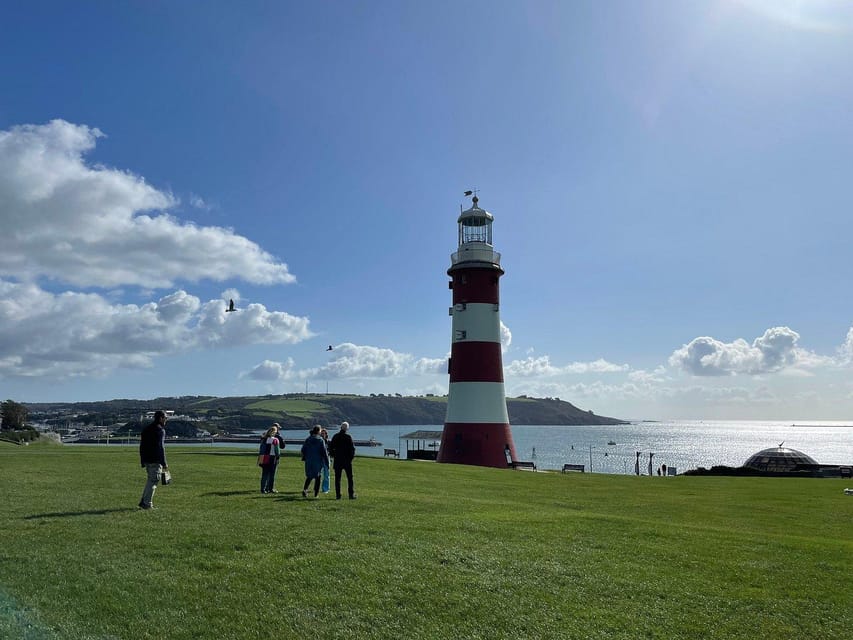
- Includes Plymouth Hoe and Smeaton’s Tower: You get broad views across Plymouth Sound toward Cornwall, with Victorian landmarks along the way.
- Led by local guide Hannah: Her Plymothian background and work in visitor engagement shape a tour that mixes stories with practical town advice.
- Friendly to families, dogs, and mobility scooter users: Step-free routes can be arranged, though cobbles and slopes still require planning.
- Good value at $21.22: For less than the cost of many paid attractions, you receive a guided orientation lasting about 102 minutes.
Why this walk is a smart first look at Plymouth
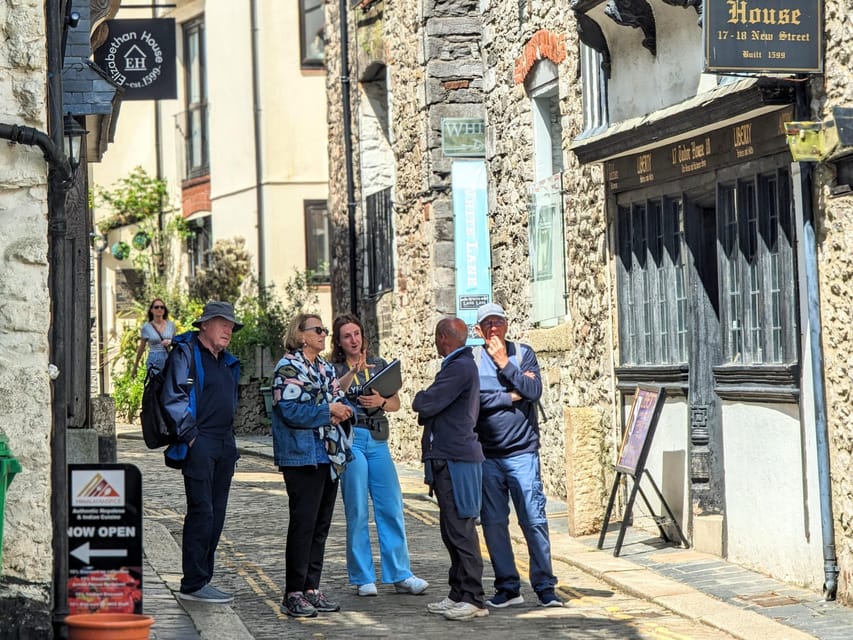
Plymouth can feel like several cities placed side by side. The Barbican has old lanes, timber-framed buildings, pubs, small shops, and strong links to the sea. The city center was heavily rebuilt after wartime damage, creating a very different mood with broad post-war streets and architecture. Then Plymouth Hoe opens out over the Sound, with sea views and grand Victorian features.
A walking tour helps you connect those pieces. Instead of seeing isolated sights, you learn how the port changed over time and how voyages, religion, trade, war, and rebuilding shaped the city you see today.
The route is also useful as an orientation walk. Hannah can point you toward places to eat, independent shops, coffee stops, and ideas for the rest of your visit. That matters in Plymouth, where the most rewarding places are spread between the waterfront, the center, and the Hoe.
At $21.22 per person, the price is reasonable for a live guided walk lasting 102 minutes. Admission fees are not included, but the tour itself focuses mainly on streets, viewpoints, churches, public spaces, and exterior landmarks. You are paying for the local explanation and route planning, not a bundle of expensive tickets.
More walking tours in Britain:
- Magical London: Harry Potter Guided Walking Tour
★ 4.7 · 22,044 reviews - London: The Original Jack the Ripper Walking Tour
★ 4.7 · 7,833 reviews - Oxford: University and City Walking Tour with Alumni Guide
★ 4.7 · 4,429 reviews
Meeting Hannah at the Mayflower Steps
The walk begins opposite the Mayflower Steps Memorial. Look for the large blue flag. This is a practical meeting point in the Barbican and a fitting place to begin, since the memorial recalls the Mayflower passengers and crew who left Plymouth in 1620.
The opening section sets up the port’s role in travel and trade. You will hear about journeys that left from Plymouth and the people who lived in, visited, or passed through the town.
The Mayflower connection is well known, but the value here is the local setting. You are not meeting the story in a distant museum display. You are standing beside the waterfront, where Plymouth’s links with the sea remain part of the city’s identity.
Because the tour returns here at the end, you do not need to arrange transport back from another neighborhood. That makes it especially convenient if you are staying near the Barbican or using the walk as your first activity after arriving.
Elizabethan streets and the old Barbican
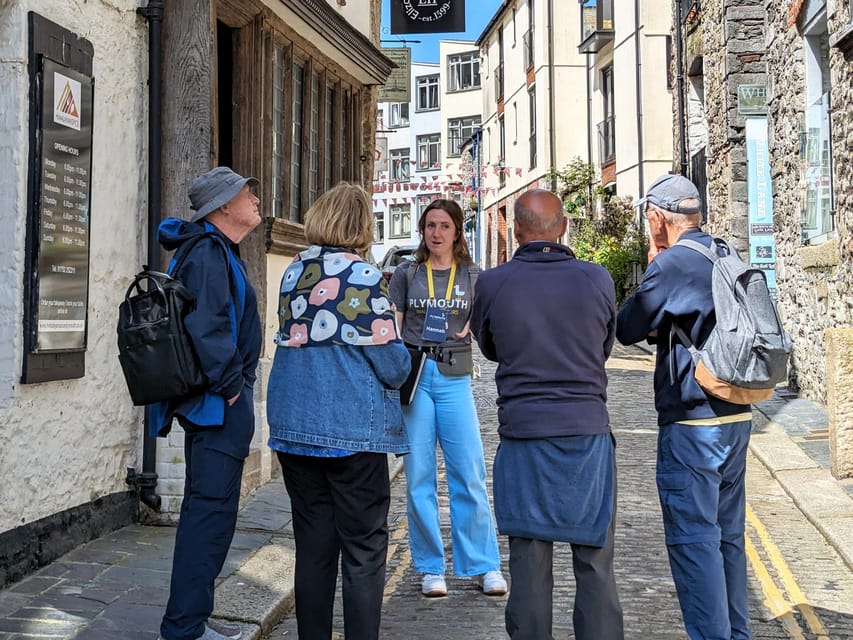
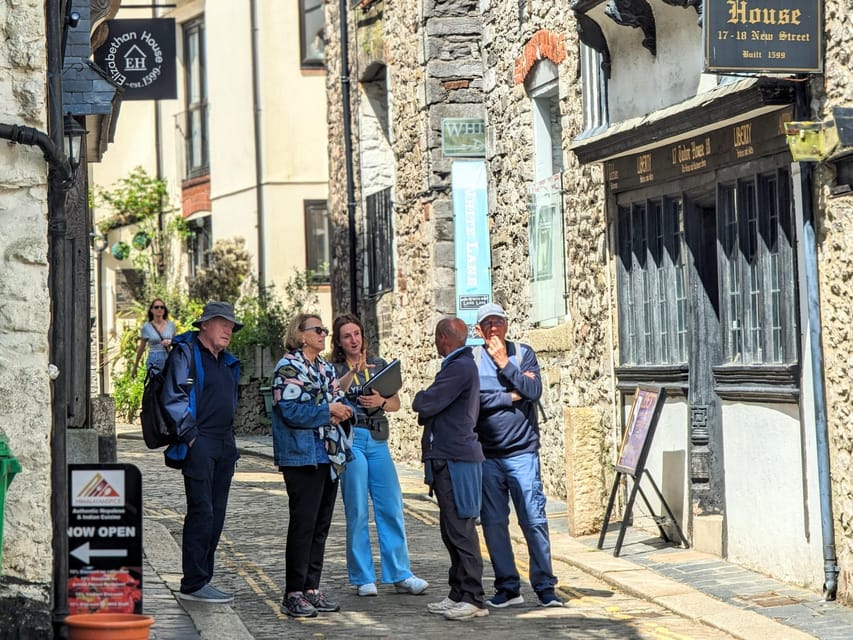
From the Mayflower Steps, the route moves through New Street and Elizabethan Street. These lanes offer a sense of earlier Plymouth, before the city’s later rebuilding changed much of its central appearance.
The Elizabethan House is one of the key sights in this area. The tour gives you context for the buildings and streets rather than simply pointing them out. That extra explanation can help you notice how the older waterfront quarter differs from the 1950s city center later in the walk.
Southside Street adds some of Plymouth’s most recognizable food and drink landmarks. The route includes iconic pubs, England’s oldest bakery, and the famous Plymouth Gin Distillery.
These stops are useful even if you do not enter them. Hannah can help you understand which places are part of the town’s character and suggest options for eating later. If you want to visit an attraction such as the distillery or Elizabethan House, remember that admission is not part of the walking tour.
The old streets are atmospheric, but they are also where the route’s cobbles matter most. Wear shoes with a firm grip and allow a little extra time if you use a mobility scooter. A step-free alternative may be available if arranged in advance.
Plymouth’s waterfront quarter and Merchant’s House
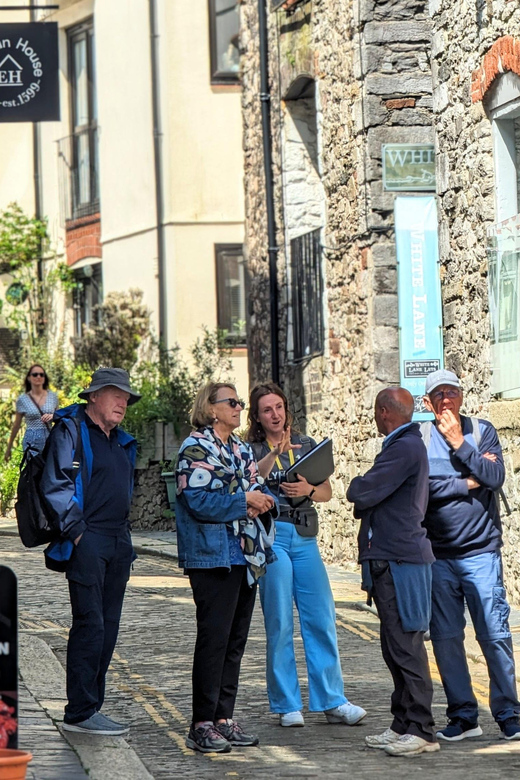
The Barbican section brings together several strands of Plymouth life. Its maritime past is clear, but the area also has independent shops, coffee shops, nightlife, and links to local art history.
I like this part of the walk because it gives you more than a list of old buildings. You get a sense of how the Barbican functions today. It is not only a historic district. It is also a place to return for a meal, a drink, or a slower wander after the tour.
The Merchant’s House adds another layer. Its connections with some of Plymouth’s most notorious historical characters make it a useful stop for understanding the people behind the city’s public story.
Specific interior access is not included, so think of the tour as a guided look at the area and its stories rather than a series of house visits. If a particular attraction matters to you, check its separate opening hours and admission details.
The Barbican is likely to be one of the most enjoyable sections for first-time visitors. It gives you old streets, waterfront atmosphere, food suggestions, and easy links to other sights. The tradeoff is that its narrow routes can feel less comfortable for larger groups or anyone who needs a smooth surface.
Same city, a completely different sort of afternoon:
- London: The London Eye Entry Ticket
★ 4.6 · 35,875 reviews - From London: Harry Potter Warner Bros Studio Tour
★ 4.7 · 26,588 reviews - London: Westminster to Greenwich River Thames Cruise
★ 4.5 · 22,836 reviews - London: Madame Tussauds London
★ 4.6 · 20,915 reviews
St Andrew’s Church and Plymouth’s religious quarter
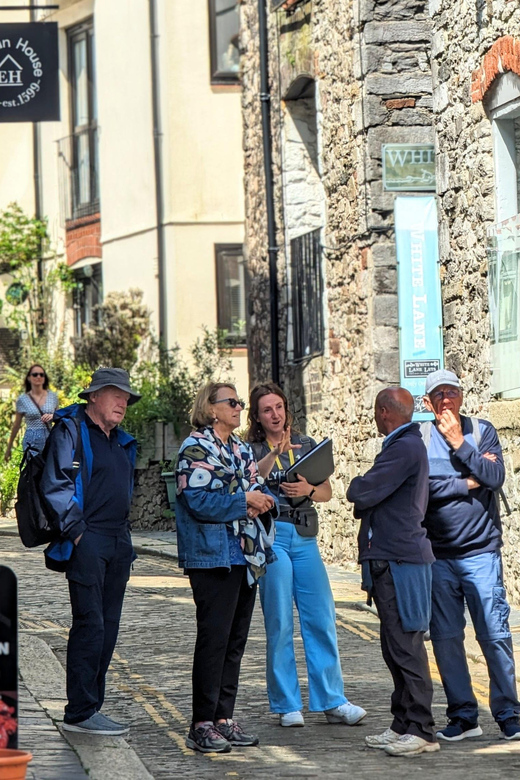
The route then reaches St Andrew’s Church and the religious quarter. This part changes the focus from ships and merchants to faith, civic life, and the institutions that helped shape Plymouth.
A church stop can be easy to rush past, especially on a busy city walk. With a guide, you get a reason to pause and see how the religious quarter fits into the wider town.
The information provided does not promise an interior visit, so you should not book this tour expecting extended time inside the church. Its value is the historical setting and the way it helps connect the older quarters with the modern city nearby.
This is also a good point in the walk for visitors who want more than famous names. Plymouth’s identity is not limited to the Mayflower or the sea. Its streets reflect ordinary residents, religious communities, trade, rebuilding, and changing city life.
The 1950s city center and post-war architecture
One of the more unusual parts of the route is the edge of Plymouth’s 1950s city center. Many walking tours focus only on older buildings. This one includes post-war architecture, described as some of the best examples in England.
That choice gives the tour a wider time frame. Plymouth was changed by wartime destruction and later reconstruction, so the modern center is part of the city’s story, not a gap between historic sights.
You may find this section less immediately picturesque than the Barbican. That is part of its appeal. It asks you to look at the city as it was rebuilt, not only at the parts that survived from earlier centuries.
For architecture fans, this may be one of the strongest reasons to choose the walk. For visitors mainly seeking old pubs and waterfront views, it may feel like a change of pace. I would still keep it in the route, since it explains why Plymouth looks so different from many historic English towns.
Reaching Plymouth Hoe and the Sound
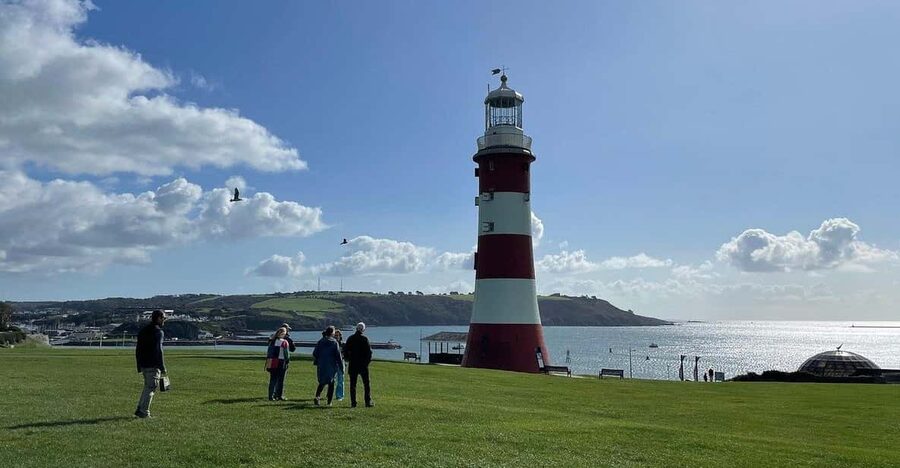
The final major section takes you onto Plymouth Hoe. Here the streets open toward Plymouth Sound and views across to Cornwall.
The Hoe supplies the visual payoff. After the tighter lanes of the Barbican and the denser central streets, the open waterfront gives you room to see Plymouth’s coastal setting. The route includes Victorian memorials, terraces, and Tinside Pool.
Tinside Pool is one of the city’s most distinctive waterfront features. Even without admission, it helps explain the Hoe’s long role as a public place for leisure and civic display.
The views are weather dependent, of course. On a clear day, the outlook toward Cornwall can be a memorable part of the walk. In poor weather, you still get the architecture and seafront setting, but the distant view may be less impressive.
The route’s moderate inclines become relevant here. The Hoe is not described as a flat promenade from start to finish, so tell the operator about mobility needs before the walk. A step-free route can be used where possible, but the surface and slopes should still be part of your planning.
Smeaton’s Tower and the return to the Barbican
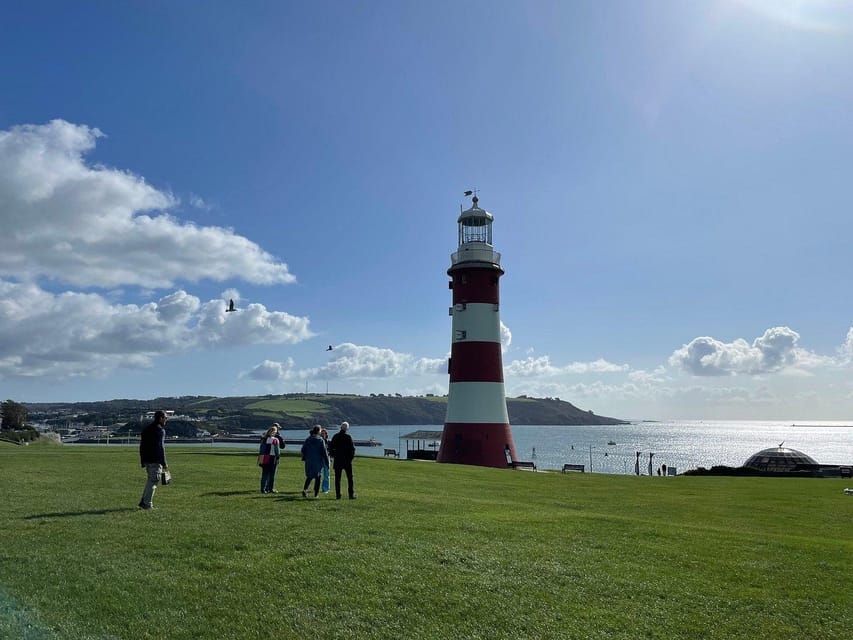
Smeaton’s Tower is Plymouth’s best-known lighthouse landmark and a natural high point for the tour. Its position on the Hoe makes it easy to connect the city with the exposed waters and navigation challenges beyond the harbor.
The walk does not include admission fees to attractions, so the tour should not be treated as a ticket to climb the tower. Instead, you get the setting, the outside view, and the story that places the lighthouse within Plymouth’s waterfront identity.
From the Hoe, the route returns to the Mayflower Steps. Finishing where you began is helpful. You can continue exploring the Barbican, use Hannah’s food suggestions, or head toward another part of town without first figuring out how to get back.
The full duration is about 102 minutes. That is long enough to cover a substantial part of Plymouth without taking over your day. Still, you should expect a steady walking experience rather than a casual stroll with long breaks at every stop.
Accessibility, pace, and who will enjoy it most

The tour is wheelchair accessible, and step-free routes are available. Mobility scooter users can be accommodated, but you should contact Plymouth Walking Tours ahead of time with your requirements. The operator can also include audio description for people with visual impairment.
Those options are useful, but they do not erase the physical character of the city. You may encounter cobbles and moderate inclines. Ask about the adjusted route before booking rather than assuming every street on the standard route will suit your equipment.
Families should find the format manageable, since the route is designed for all ages. Dogs are welcome too, which makes this a practical choice for visitors who do not want to leave a pet behind.
The tour is best for:
- First-time visitors who want a clear sense of Plymouth’s layout
- People interested in maritime stories and local characters
- Architecture fans who want to see both historic streets and post-war rebuilding
- Families looking for an outdoor activity
- Visitors who want food and sightseeing suggestions from a local guide
- Cruise or short-stay visitors with roughly two hours to spare
It may be less suitable if you want long interior visits, extensive museum time, or a completely flat route. It is also not the right pick if you prefer to explore alone at a slow pace with no fixed schedule.
What the guide adds to the price
The strongest part of this experience is the human explanation. Hannah’s background in visitor engagement, heritage interpretation, and digital walking trails gives the tour a clear purpose: help you understand Plymouth while giving you useful ideas for the rest of your stay.
That combination is more valuable than a simple landmark checklist. You learn why the Mayflower Steps matter, how the Barbican developed, why the rebuilt center looks the way it does, and how the Hoe fits into the city’s public life.
The price also compares well with a self-guided walk. You could see many of these places without paying, but you would need to plan the route and research the connections yourself. At $21.22, the tour offers a modest-cost way to save that preparation time and ask questions as you go.
The value drops if you already know Plymouth well or want to spend the whole time inside paid attractions. For a first visit, though, the route covers enough ground and gives enough local context to justify the fee.
Should you book the Best of Plymouth Walking Tour?
Book it if you want a friendly introduction to Plymouth that combines the Barbican, maritime stories, the rebuilt city center, and the views from Plymouth Hoe. Hannah’s local connection is a major advantage, especially if you want practical advice about food and the rest of your visit.
I would choose it early in a Plymouth stay. The walk finishes where it starts, so you can return to the Barbican afterward and follow up on the places that interest you most.
Think carefully about the cobbles and inclines if you have mobility concerns, and contact the operator before booking to arrange a suitable route. If you want a balanced introduction rather than a narrow tour of one attraction, this is a well-priced and useful choice.
FAQ
Where does the Plymouth walking tour start?
The tour starts opposite the Mayflower Steps Memorial in the Barbican. Look for the large blue flag.
Where does the tour finish?
The walk ends back at the meeting point by the Mayflower Steps.
How long does the tour last?
The tour lasts 102 minutes. Starting times vary, so check availability when booking.
What language is the tour in?
The live tour guide speaks English, and English is the listed tour language.
Is the tour wheelchair accessible?
Yes. The tour is wheelchair accessible, and step-free routes can be arranged. Contact Plymouth Walking Tours in advance with your access requirements.
Are mobility scooters suitable for the route?
Mobility scooter users can be accommodated, but the route includes stretches of cobbles and moderate inclines. Contact the operator ahead of time so the route can be adjusted where possible.
Are dogs allowed?
Yes. The walking tour is dog friendly.
Are attraction admission fees included?
No. The walking tour and guide are included, but admission fees to attractions are not included.
Just added around Britain
- London: Wimbledon Tennis Club and Westminster Walking Tour★ 4.5 · 86 reviews
- London: Westminster to Richmond River Thames Cruise★ 4.8 · 23 reviews
- Winchester: Historic Castles and Cathedrals Walking Tour★ 4.9 · 154 reviews
- Westminster Abbey Skip-the-Line Entry and Private Tour★ 4.6 · 4 reviews
- Best of London by LE GRAND – London’s Luxury Bus Tour★ 4.2 · 23 reviews
- Whitby: Guided Distillery Tour with Gin Tasting★ 5.0 · 28 reviews
- Warwick: Entry Ticket for Warwick Castle★ 4.7 · 215 reviews
- West Berkshire,UK: The Living Rainforest Centre Entry Ticket★ 4.7 · 8 reviews
Walking Tours, compared.

Magical London: Harry Potter Guided Walking Tour
Read our review →

University and City Walking Tour with Alumni Guide
Read our review →
Harry Potter Movies Walking Tour (Kids Go Free)
Read our review →
The Great British Rock and Roll Music Walking Tour
Read our review →
Jack the Ripper Walking Tour – Ripper Vision Tours
Read our review →