
Reviewed · HISTORICAL TOURS
Portsmouth: Historic Dockyard Ultimate Explorer Ticket
The first surprise is the scale. This is not a quick ship visit but a working waterfront packed with 500 years of naval stories. I love the Mary Rose Museum, where a Tudor warship and thousands of recovered objects turn a wreck into a very human story. I also like the freedom of the 365-day ticket, since a single day is barely enough for the main ships.
The catch is simple: there is a lot here, and some ships are not fully accessible. HMS Victory is also under major conservation work, so much of its exterior is covered, although you can still go aboard and see the repair project in progress. Plan carefully, or accept that you will need a return visit.
Key points to know before you go
- The Mary Rose is the emotional centerpiece: Allow at least 90 minutes, and longer if you enjoy shipbuilding, archaeology, and personal stories.
- HMS Victory works best at your own pace: The included audio guide explains Nelson’s flagship and the Battle of Trafalgar as you move through the decks.
- HMS Warrior offers a different kind of spectacle: Its iron hull, steam machinery, and Victorian design contrast sharply with the wooden Mary Rose and Victory.
- The ticket is built for repeat visits: At $62 per person, it becomes especially good value if you return during the 12-month validity period.
- The submarine museums require extra planning: The water bus runs on weekends and during school holidays, and the trip adds a second waterside area to your day.
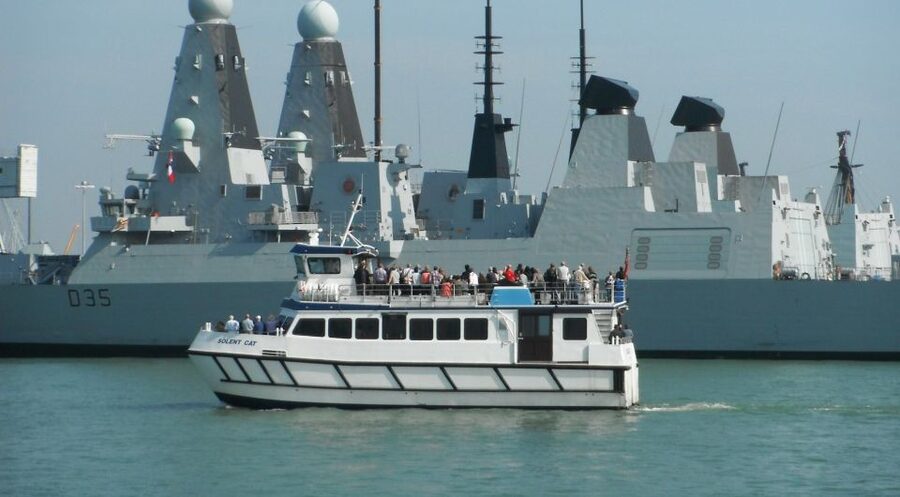
- The harbour cruise changes the view: You see modern Royal Navy vessels, historic dockyard buildings, and the port from the water rather than from the quayside.
Arriving at Portsmouth Historic Dockyard

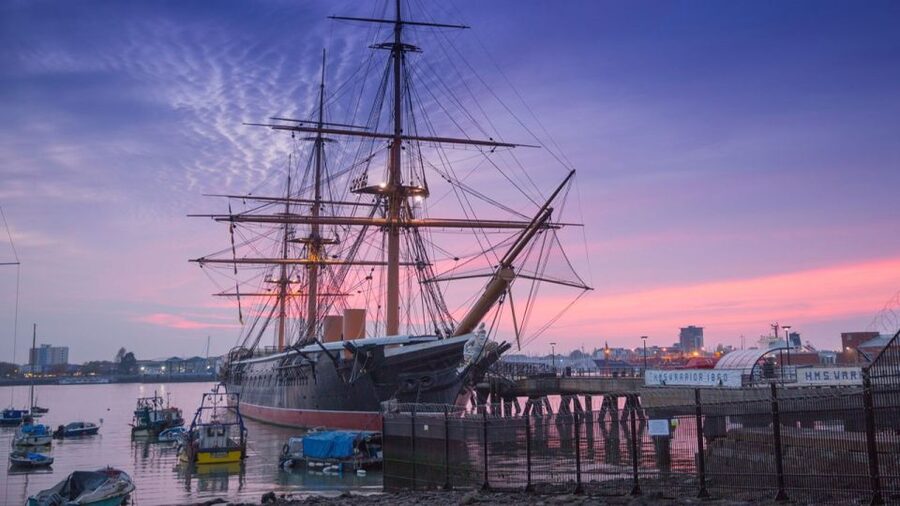
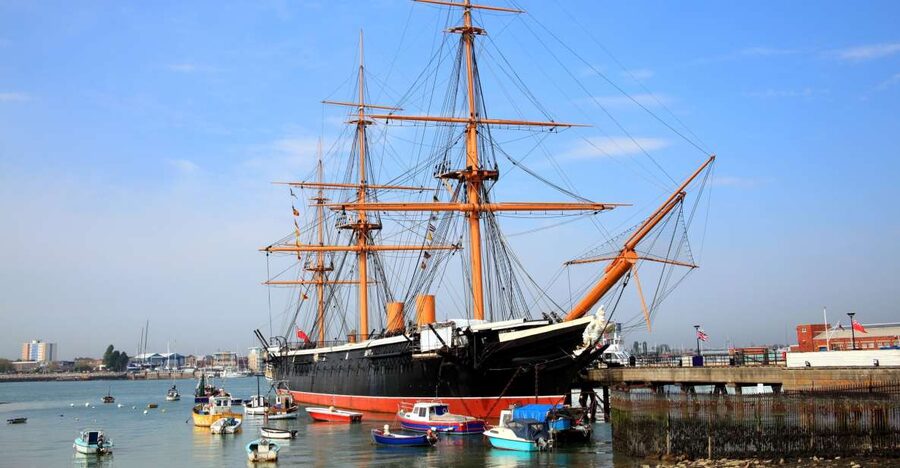
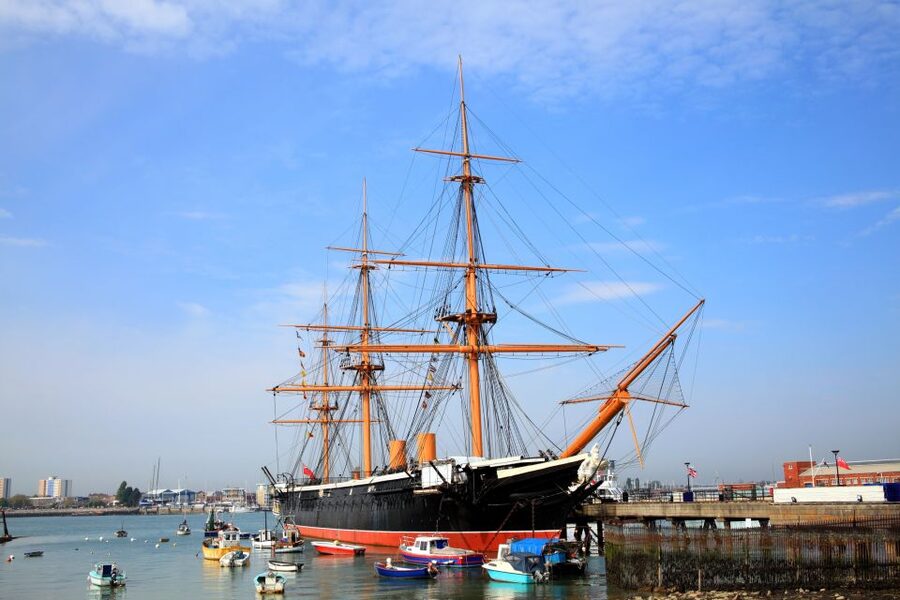
Portsmouth Historic Dockyard is about a five-minute walk from Portsmouth Harbour train station. As you approach, HMS Warrior is usually the first great sight, floating beside the dockyard with its tall masts and dark iron hull. It gives you a useful preview of the variety ahead.
Enter through the visitor entrance and exchange your voucher at the Visitor Centre. Ask the staff to help you map out the day. Opening begins at 10:00, and you can visit at any point during the day once your ticket is active. A bag search takes place at entry, so arrive without large luggage, sharp objects, drones, tripods, food or drinks that are not permitted on transport.
I would start with a quick walk through the dockyard rather than rushing straight to a ship. The waterfront setting matters here. You are walking through a naval base that has been shaped by shipbuilding, war, repair, and Royal Navy life for centuries. That atmosphere helps connect the separate museums into one larger story.
A few more Britain days worth weighing up
- Portsmouth: Spinnaker Tower Ticket
★ 4.6 · 437 reviews - Portsmouth: Hovercraft Flight to the Isle of Wight
★ 4.7 · 170 reviews - Portsmouth: Spinnaker Tower High Tea in the Clouds
★ 4.5 · 126 reviews
The Mary Rose, a Tudor time capsule
The Mary Rose is the best place to begin if you want history to feel personal rather than abstract. Built during the reign of Henry VIII, the warship sank in 1545 and remained on the seabed until its dramatic recovery centuries later. The museum presents the surviving hull alongside thousands of objects from the ship and its crew.
Allow around 90 minutes at a minimum. Many people need two hours or more because the displays reward slow reading. You will see equipment, tools, clothing, personal possessions, and objects that reveal how sailors worked and lived. The power of the museum comes from those ordinary items. A weapon tells you about battle, but a cooking tool or personal belonging tells you about the people inside the ship.
The ship is shown in a carefully arranged gallery, with displays explaining the work needed to recover and preserve it. The presentation is clear enough for visitors with little background in British naval history, while still offering plenty for anyone already interested in archaeology or Tudor England.
Do not rush past the Dive the Mary Rose 4D presentation. It adds a sensory account of the wreck and its recovery, and it works as a useful final chapter after the museum displays. The Mary Rose also has a cafe with views toward HMS Victory and, when they are anchored nearby, modern aircraft carriers. It is a good place to pause, though you may want to compare food prices before ordering, as cafe costs can be high.
Walking aboard HMS Victory
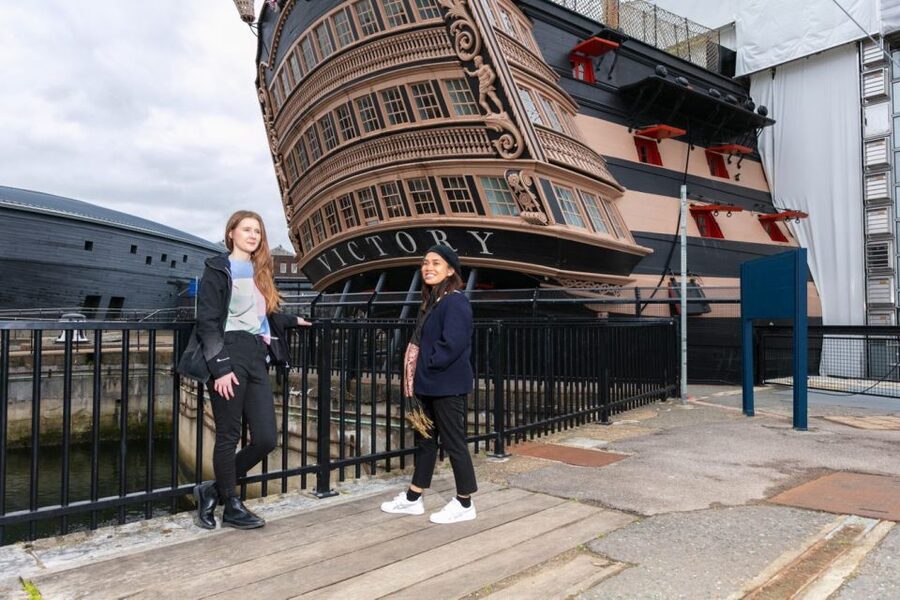
HMS Victory is the dockyard’s most famous ship. This was Vice Admiral Lord Nelson’s flagship at the Battle of Trafalgar, and stepping aboard lets you follow the route from the gun decks to the officers’ areas and the stern.
The included audio guide is particularly useful here. You can move at your own pace, stop when something catches your eye, and listen to explanations of the ship, its crew, and Nelson’s final battle. I prefer this format to being tied to one large group, especially when the decks are busy or when you want extra time with the cannon, rigging, and cramped living spaces.
The ship’s 104 guns help you understand its force, but the tighter spaces tell the more revealing story. You see where sailors worked, how the crew lived, and how little privacy or comfort was available. The contrast between the officers’ quarters and the working decks is worth noticing.
Victory is currently part of Victory Live: The Big Repair, an extensive conservation project. Much of the outside is under cover, apart from the well-known stern and prow. That changes the classic view of the ship, but it gives you something unusual in return: access to parts of the vessel that are normally hidden and a chance to watch shipwrights and conservators at work.
The quality of interpretation can vary by area. Most staff and guides are helpful and well informed, but one personal account described a Victory guide as less engaging and unwilling to take questions during the talk. The audio guide gives you a reliable alternative, and staff elsewhere on the site are generally ready to explain what you are seeing.
HMS Warrior and Victorian sea power
HMS Warrior makes a sharp contrast with the Mary Rose and Victory. Launched in 1860, it was a Victorian ironclad powered by both steam and sail. Instead of Tudor timber or Nelson-era wooden warship design, you get metal, engines, armor, and industrial power.
Start below deck in the engine room, where the machinery gives the ship its physical presence. The vessel feels less like a museum case and more like a huge machine. You can also meet members of the former crew and staff who enjoy explaining life at sea.
Warrior is a good stop for visitors who think naval history means only battles and famous admirals. Its design reflects a major change in technology and warfare. The ship helps you see how quickly naval power moved from sail and timber toward steam and iron.
One practical weakness is the signage. Some areas do not clearly explain what each piece of equipment did, and the ship does not offer the same kind of structured audio experience as Victory. If you want every technical detail, ask staff questions as you go. The people on board are often the best source of explanation.
More history walks around Britain:
- London: Historic Pubs of Central London Walking Tour
★ 4.9 · 1,065 reviews - York: Witches and History Old Town Walking Tour
★ 4.7 · 928 reviews - London: Soho Music and Historic Pubs Walking Tour
★ 4.9 · 836 reviews - London: Rock ‘n’ Roll History Tour
★ 4.6 · 645 reviews
HMS M.33 and the National Museum of the Royal Navy
HMS M.33 is a First World War vessel that survived the Gallipoli campaign. It is smaller than the main attractions, but it adds a different scale and period to the visit. After seeing the grand ships, this vessel helps you consider what naval service looked like for crews working in a more confined environment.
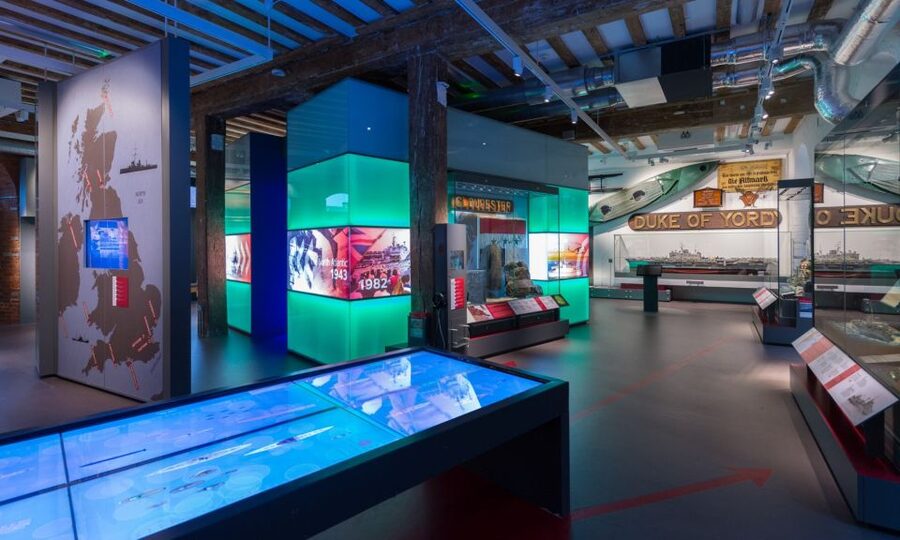
The National Museum of the Royal Navy carries the story from the 1700s to the present day. It provides the broader setting that the ships alone cannot. You can connect the Mary Rose to the later development of naval power, then link Victory and Warrior to changes in weapons, engineering, and Royal Navy operations.
This is one reason the ticket works better over two visits. The major ships demand attention, and the museum displays can feel like an afterthought if you are trying to fit everything into one afternoon. If you have a full day, use the museum to break up the ship visits. If you have another day available, give it a dedicated block of time.
The water bus to HMS Alliance
The Royal Navy Submarine Museum and Explosion Museum of Naval Firepower are across the harbour at a separate waterside location. On weekends and during school holidays, the water bus is included in the ticket. Check operating times before setting off, since this part of the visit depends on that service.
The boat ride is more than a simple transfer. It gives you another view of the dockyard and its vessels, and the change of setting makes the submarine museum feel like a separate chapter rather than another room in the same complex.
HMS Alliance, a 1945 submarine, is the main draw. You can take a tour with an ex-submariner and hear about life at sea from someone with direct experience. Expect narrow passages and tight spaces. The submarine is not the easiest part of the dockyard for anyone with limited mobility, so ask about access before you commit to boarding.
Do not skip Holland 1, identified as the first submarine. It gives you a useful comparison with Alliance and shows how submarine design developed over time. At Explosion, the focus shifts to naval firepower and the equipment used to store and deploy it. Cafe Camber Lights offers harbour views and snacks, making this a sensible place to take a break before returning.
The included harbour cruise
The harbour tour is a worthwhile part of the package, not just a filler attraction. From the water, you get views of modern frigates, destroyers, and other vessels that may be easy to miss from inside the historic dockyard. You also see the older buildings and the changing skyline from a better angle.
The cruise adds context to the ships you have already visited. After walking through wooden decks, iron engine rooms, and submarine corridors, you can look back at the port as an active maritime setting. Bring a camera, but keep the timing in mind. The full dockyard has enough to occupy you without trying to squeeze the cruise into the final minutes before closing.
How long should you allow?
The basic suggested route gives about 90 minutes each to the Mary Rose and HMS Victory, but that is only a starting point. If you add HMS Warrior, the National Museum, HMS M.33, the harbour cruise, and the submarine area, a single day becomes a long one.
I would use this plan:
- One day: Mary Rose, HMS Victory, HMS Warrior, and either the museum or harbour cruise.
- Two days: Add HMS M.33, the National Museum, the water bus, HMS Alliance, Holland 1, and Explosion.
- Several visits: Return for the parts you had to skim, especially the Mary Rose galleries and the submarine museum.
The ticket remains valid for 365 days, so you do not need to force everything into one visit. Many people spend six hours and still leave sections unseen. That is not a flaw in the attraction, but it is a reason to avoid treating the ticket as a standard half-day entry.
Is the $62 ticket good value?
At $62 per person, the Ultimate Explorer ticket is expensive if you only see one ship. It becomes much better value when you visit the Mary Rose, Victory, Warrior, museums, harbour cruise, and submarine area.
The strongest value comes from the year-long access. You can return later to finish the dockyard, bring visiting family, or split the experience into shorter days. If you live within reach of Portsmouth, this feature changes the calculation completely. Even for an overseas visitor, a second day can make the ticket worthwhile if you are already spending time in the city.
Food and drinks are not included. There are cafes at the Mary Rose and at Explosion, but prices may not suit every budget. Plan a meal break, and check the current rules before bringing anything onto the water bus, since food and drinks are not allowed in the vehicle.
Access, families, and practical limits
The dockyard is wheelchair accessible in general, and one visitor using a wheelchair found staff especially helpful. However, some ships are not fully accessible. Tight ladders, narrow passages, uneven surfaces, and historic construction can limit what you can reach on Victory, Warrior, Alliance, or other vessels.
Families can get a lot from this ticket. The Mary Rose displays, the large ships, the submarine, and the 4D presentation give children several ways into the subject. The amount of reading may be tiring for younger children, so alternate galleries with open-air ship visits and breaks.
You cannot bring pets, large bags, oversize luggage, weapons, sharp objects, drones, tripods, skates, or fireworks. Smoking and vaping are not allowed indoors, and unaccompanied minors are not permitted. These rules are strict because this is a working historic site as well as a public attraction.
Should you book Portsmouth’s Ultimate Explorer ticket?
Book it if you want more than a quick look at HMS Victory. The Mary Rose is worth serious time, Victory gives you the Nelson connection, Warrior shows the leap into steam and iron, and the submarine museums widen the story beyond the famous names.
I would especially recommend it for families, naval-history fans, visitors who enjoy museums, and anyone able to return within a year. If you have only two or three hours in Portsmouth, the ticket may offer more than you can use. In that case, focus on the Mary Rose and Victory, then consider the full pass only if a return visit is realistic.
For most people with a full day, the $62 cost is fair. For anyone with two days or a chance to come back, it is one of the more practical ways to experience the dockyard without rushing through its best parts.
FAQ
How long is the Ultimate Explorer ticket valid?
The ticket is valid for 365 days, allowing you to return during that period and visit attractions you could not fit into your first day.
What attractions are included?
It includes the Portsmouth Historic Dockyard, Mary Rose Museum and its 4D presentation, HMS Victory, HMS Warrior, the National Museum of the Royal Navy, HMS M.33, Explosion Museum of Naval Firepower, and Royal Navy Submarine Museum.
Is the water bus included?
Yes. Water bus transport to the Royal Navy Submarine Museum and Explosion Museum of Naval Firepower is included, but it operates on weekends and during school holidays.
Is the harbour cruise included?
Yes. The harbour tour is included and provides views of modern Royal Navy vessels, historic buildings, and the harbour skyline.
Can I visit HMS Victory during the conservation work?
Yes. HMS Victory is open to visitors as part of Victory Live: The Big Repair. Much of the outside is under cover, but you can still board the ship and see conservation work in progress.
Is Portsmouth Historic Dockyard wheelchair accessible?
The site is wheelchair accessible, but some ships are not fully accessible. Check access arrangements for individual vessels before your visit, especially if you plan to board the submarine.
Just added around Britain
- London: Wimbledon Tennis Club and Westminster Walking Tour★ 4.5 · 86 reviews
- London: Westminster to Richmond River Thames Cruise★ 4.8 · 23 reviews
- Winchester: Historic Castles and Cathedrals Walking Tour★ 4.9 · 154 reviews
- Westminster Abbey Skip-the-Line Entry and Private Tour★ 4.6 · 4 reviews
- Best of London by LE GRAND – London’s Luxury Bus Tour★ 4.2 · 23 reviews
- Whitby: Guided Distillery Tour with Gin Tasting★ 5.0 · 28 reviews
- London: Westminster Walking Tour & St Paul’s Cathedral Entry★ 4.7 · 7 reviews
- Warwick: Entry Ticket for Warwick Castle★ 4.7 · 215 reviews
Historical Tours, compared.





J&M’s City Sightseeing and History Walking Tour
Read our review →
Shadows of York: Ghost Walk and Horrible History.
Read our review →Browse the lists this tour appears in