
Reviewed · WALKING TOURS
London: Street Art and Graffiti Guided Walking Tour
East London’s street art is not arranged behind glass. It appears on shop shutters, brick walls, signs, rooftops, stickers, and even the pavement. This two-hour walk from Spitalfields to Brick Lane and Shoreditch helps you spot work you would likely miss alone, including pieces by Banksy, ROA, Invader, Stik, and many other artists.
I like the way the guides connect each artwork to the history of the East End, rather than treating the walls as a string of photo stops. I also like the broad mix of work, from huge murals to tiny paste-ups and stickers. The one thing to keep in mind is that street art changes constantly, so no tour can promise that every named piece will still be visible.
Key points to know before booking

- See around 40 artists: The route includes local and international names, with styles ranging from large murals to small hidden pieces.
- Start at Old Spitalfields Market: Meet under the White Goat Statue on Brushfield Street, close to Liverpool Street Station.
- Learn how the art is made: Guides discuss spray paint, stickers, materials, techniques, tagging, and the meaning behind different works.
- Hear the East End story: The walk explains how the area’s culture and past shaped its art scene.
- Expect a changing route: New work appears, old pieces are painted over, and the tour is adjusted often.
- English and wheelchair accessible: The experience includes a live English-speaking guide and lasts about two hours.
Starting under the White Goat in Spitalfields

The meeting point is easy to find once you know what to look for: the White Goat Statue on Brushfield Street, outside Old Spitalfields Market. From Liverpool Street Station, exit onto Bishopsgate, turn left, then right onto Brushfield Street between Pizza Express and the RBS building. Walk about 100 metres and look up for the white goat on top of the statue.
Arrive 10 minutes early. Brushfield Street can be busy, and Liverpool Street Station has several exits, so leaving yourself a little time is sensible. The route begins just outside the City of London, London’s old financial district, then moves into the East End. That change in setting gives the walk a useful opening contrast: polished office blocks are only a short distance from streets known for art, music, food, and alternative culture.
Your guide will shape the tone of the walk. Gabi, Eva, Josh, Laura, Ava, and Natalie have all led this experience, and several guides bring direct links to the art scene. Natalie and Ava, for example, are artists themselves, while the tour’s wider guide team has worked with artists or featured them through related street art projects and podcasts.
That matters because the walk is not just a list of names. You get explanations of how artists work, how pieces are placed, and why some art is made to last while other work is intended to disappear. The best guides also adjust their explanations to the group, making room for people who know hip-hop and graffiti culture as well as those seeing it for the first time.
More Walking Tours in London
- Magical London: Harry Potter Guided Walking Tour
★ 4.7 · 22,044 reviews - London: The Original Jack the Ripper Walking Tour
★ 4.7 · 7,833 reviews - London: Harry Potter Movies Walking Tour (Kids Go Free)
★ 4.7 · 3,071 reviews
From Spitalfields to Brick Lane
The first part of the walk introduces the East End and its changing walls. You may see art in places that look unremarkable at first: a small sticker beside a doorway, a paste-up partly covered by another piece, or lettering tucked above eye level. This is one of the tour’s real strengths. You are trained to look around you, not just straight ahead.
Brick Lane is the natural center of the experience. It is famous for its food, vintage shops, markets, nightlife, and street art, but the best pieces are not always on the most obvious stretch. A guide can lead you into side streets and less familiar corners, where small works sit beside large painted walls.
The route includes work by about 40 local and international artists. The range is more interesting than a simple parade of famous names. Banksy may draw the biggest recognition, but the walk also introduces artists such as ROA, Invader, Shepard Fairey, and Stik. You may also encounter artists whose work is less familiar but whose methods help explain how broad the scene has become.
I especially like the way this mix changes your idea of street art. A giant mural is easy to notice, but a small sticker can carry just as much personality. Some pieces are playful. Others are political, personal, abstract, or designed mainly to mark a place and claim attention.
Banksy is only one part of the story
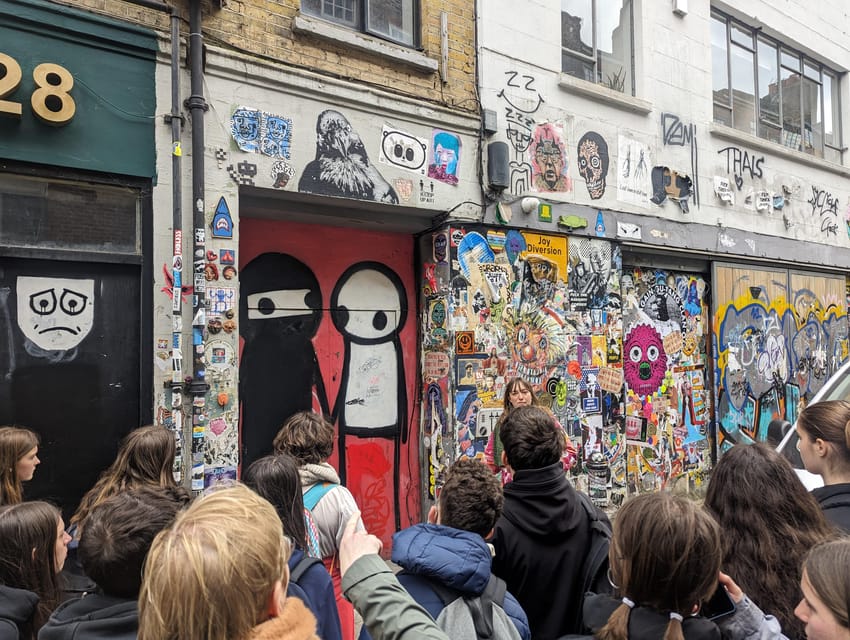
The chance to see a Banksy is a useful draw, but I would not book this walk only for a guaranteed Banksy photograph. Street art is exposed to weather, construction, repainting, theft, and new work. Even a famous piece may be altered or gone by the time you arrive.
The greater value is learning how to read the wider scene. The guide explains the difference between graffiti and street art, the culture of tagging, and the rules and expectations that shape work in public spaces. That context helps you understand why artists choose certain walls, materials, sizes, and locations.
You might see a stencil, a freehand mural, a wheatpaste image, a sticker, or a piece built from unusual materials. These are not all made in the same way, and the guide explains the technical side in plain language. Spray paint is only one tool. Stickers and paste-ups can be placed quickly, while large murals demand more time and planning.
This is also where the personal background of a guide can add real value. Natalie’s experience as a street artist, for example, gives her a direct sense of the work and its setting. Ava’s art background helps her explain why particular methods or details matter. Other guides, including Josh and Laura, are praised for making technical points clear without turning the walk into a lecture.
Reading the walls, floors, and rooftops
Do not assume every stop will be a grand mural. The tour’s most memorable discoveries may be small. Manuel, one of the recent participants, described finding work on walls, signs, roofs, and even the floor. That is exactly the point of taking a guided walk here: you learn where to look.
Your guide may point out layers of old work beneath newer paint. A wall can become a record of changing artists and styles, even when only fragments remain. A sticker may be part of a larger international network. A stencil can show how an image is repeated, adapted, or placed in a way that changes its meaning.
The guide also discusses possible meanings behind the art. With public work, there is often no single official explanation, and a good guide will separate known facts from interpretation. You may hear about an artist’s usual themes, the setting of a piece, or the way a local issue shapes its reading.
This makes the walk useful for photographers and artists, but you do not need an art background. The explanation stays approachable, and the frequent questions make it feel more like a conversation than a formal class. If you already know graffiti culture, the guides can still offer new material, especially on East London’s local history and on techniques that are easy to overlook.
A few more London days worth weighing up
- From London: Harry Potter Warner Bros Studio Tour
★ 4.7 · 26,588 reviews - London: Westminster to Greenwich River Thames Cruise
★ 4.5 · 22,836 reviews - London: Madame Tussauds London
★ 4.6 · 20,915 reviews - London: Warner Bros. Studio Tour with Transfers
★ 4.7 · 17,586 reviews
Shoreditch and the changing end of the route
The walk continues toward Shoreditch, an area where street art sits alongside cafés, shops, galleries, offices, and nightlife. The contrast can be sharp. One wall may carry a carefully planned mural, while the next has a quick tag or a fresh sticker. That mixture is part of the appeal and part of the challenge.
The route changes regularly because the art changes. A guide may show you new work, point out a piece that has been painted over, or take a slightly different path to include current highlights. This keeps repeat visits worthwhile, but it also means you should treat the itinerary as a living route rather than a fixed checklist.
The route is described as wheelchair accessible, though street surfaces and the density of the East End can still affect comfort. If you use a wheelchair or have limited mobility, it is sensible to confirm current route conditions before booking, especially after wet weather or street works. The activity is outdoors, so bring rain gear. London weather can change quickly, and the walk continues in light rain unless conditions lead to a change.
The pace is generally gentle. One recent participant found the walk lasted about an hour and a half, while the advertised duration is two hours. Allow the full two hours in your plans, but understand that the actual finish can vary with the group, the route, and the amount of discussion at each stop.
What the East End history adds
The art makes the walk enjoyable, but the local history gives it depth. Your guide explains how the culture of the East End shaped the work and how the area’s identity connects with its public art. You are not simply moving from one decorated wall to another. You are learning why this part of London became such a strong setting for creative expression.
The history also helps explain contrasts within the neighborhood. Spitalfields begins close to the City, while Brick Lane and Shoreditch offer a different mix of streets, businesses, and creative activity. As you walk between them, the guide can show how location affects what appears on the walls and how people respond to it.
Several guides make this history a major part of the experience. Gabi places graffiti, paint, and stickers within different periods of the area. Josh connects the art scene to East End culture. Eva and Laura combine artist background with local context, so you gain more than a collection of names and dates.
I would pay attention here even if you booked mainly for photographs. A good image of a mural is easy to take. Understanding why it is there, how it was made, and what surrounds it is harder to gain on your own.
Is $33 good value for two hours?
At $33 per person, this is not the cheapest way to spend two hours in London, since you can walk around Brick Lane without paying anything. The question is what you would learn without a guide.
If you already know East London well and mainly want to wander with a camera, you may prefer exploring independently. But if you want to find less obvious work and understand the people, methods, and culture behind it, the price is reasonable. The guide turns a free public area into a focused experience.
I see the value in three things: access to hidden or easy-to-miss pieces, expert explanations, and a route that changes with the art. You also avoid spending your first hour wondering which side streets are worth following. For a visitor with limited time, that can make the difference between seeing a few obvious murals and understanding the area’s wider scene.
The tour is also a good choice for families with older children and teenagers. One family used it during a school break, and another found that teenagers left with ideas for their own art projects. The related workshop can be booked separately or combined with the walking tour, making this a useful option if some members of your group want to create art while others prefer to keep walking.
Who will enjoy this walk most?
I would recommend it to:
- People curious about graffiti, murals, stickers, and public art
- Visitors who want a different view of London beyond major museums and monuments
- Teenagers and adults interested in drawing, painting, photography, or design
- Anyone who enjoys local history told through streets rather than formal exhibits
- Repeat visitors who have already seen the main sights
- Art fans who want to understand artists such as Banksy, ROA, Invader, Shepard Fairey, and Stik
You do not need prior knowledge. The guides explain basic ideas without talking down to beginners, while people familiar with hip-hop or graffiti culture can ask more detailed questions.
I would hesitate only if you dislike walking outdoors in uncertain weather or want a guaranteed list of specific artworks. Because the scene changes, the exact pieces are never fully predictable. That uncertainty is part of the nature of street art, but it is worth accepting before you book.
Practical details for a smooth morning or afternoon
Meet under the White Goat Statue at Old Spitalfields Market, 10 minutes before the start. Liverpool Street Station is the closest station, and the address is Brushfield Street, London E1 6AA.
The tour is conducted in English. The guide is included, and the activity is wheelchair accessible. Bring rain gear, wear comfortable shoes, and keep your phone or camera ready. You will want to photograph details as well as whole walls.
Free cancellation is available up to 24 hours before the tour for a full refund. You can also reserve now and pay later, which is useful if your London plans are still shifting.
If you want to add the creative side, a 45-minute to one-hour street art workshop is available daily for people over 10. A longer two-hour version with a break is available for people over 12. Under-16s must be accompanied by an adult throughout, and separate bookings can be made if some of your group wants only the walking tour.
Should you book the East London street art tour?
Book it if you want more than a quick photo beside a famous mural. The strongest part of this experience is the guide’s ability to make you notice small pieces, understand different techniques, and connect the walls with East End culture.
I would choose this tour for a first visit to Brick Lane, for a family with artistic teenagers, or for anyone who has walked through Shoreditch before without knowing what to look for. The guides, especially figures such as Josh, Eva, Laura, Gabi, Ava, and Natalie, bring different strengths, but the common thread is clear explanation and real enthusiasm for the subject.
Skip it if you prefer an entirely unplanned stroll or need a fixed list of guaranteed artworks. For everyone else, $33 buys a well-paced introduction to one of London’s most changeable and creative neighborhoods, with enough context to keep you noticing street art long after the walk ends.
FAQ
Where does the London street art tour meet?
Meet under the White Goat Statue on Brushfield Street, outside Old Spitalfields Market. The closest station is Liverpool Street Station.
How long does the walking tour last?
The advertised duration is two hours. The exact finish can vary, and one recent tour was reported as lasting about an hour and a half.
Which areas does the tour visit?
The route begins near Old Spitalfields Market and continues toward Brick Lane and Shoreditch in East London.
Which artists might I see?
The tour features work from around 40 local and international artists, including Banksy, ROA, Invader, Shepard Fairey, and Stik.
Is the tour offered in English?
Yes. The activity includes a live English-speaking guide.
Is the tour wheelchair accessible?
Yes, the activity is listed as wheelchair accessible.
What should I bring?
Bring rain gear. The tour takes place outdoors, so comfortable walking shoes are also sensible.
More Street Art Walks in London
- London: Landmarks & Secrets Bike Tour with Pub & Street Art
★ 4.9 · 314 reviews - London: East End Street Art Tour and Spray Painting Workshop
★ 4.8 · 297 reviews - London: Half-Day Street Art Tour and Workshop
★ 4.9 · 172 reviews - The Original London Street Art Tour (French)
★ 4.9 · 64 reviews
Just added around London
- London: Wimbledon Tennis Club and Westminster Walking Tour★ 4.5 · 86 reviews
- London: Westminster to Richmond River Thames Cruise★ 4.8 · 23 reviews
- Westminster Abbey Skip-the-Line Entry and Private Tour★ 4.6 · 4 reviews
- Best of London by LE GRAND – London’s Luxury Bus Tour★ 4.2 · 23 reviews
- London: Westminster Walking Tour & St Paul’s Cathedral Entry★ 4.7 · 7 reviews
- From London: Oxford, Stratford-upon-Avon & Cotswolds Trip★ 4.5 · 64 reviews
- From London: Warwick, Oxford, Stratford & Cotswolds Day Tour★ 4.0 · 270 reviews
- Warner Bros. Studios and 1-Day London Hop-on Hop-off tour★ 4.7 · 9 reviews
Walking Tours, compared.

Magical London: Harry Potter Guided Walking Tour
Read our review →

University and City Walking Tour with Alumni Guide
Read our review →
Harry Potter Movies Walking Tour (Kids Go Free)
Read our review →
The Great British Rock and Roll Music Walking Tour
Read our review →
Jack the Ripper Walking Tour – Ripper Vision Tours
Read our review →

Browse the lists this tour appears in