
Reviewed · WALKING TOURS
Oxford: Private Walking Tour with University Alumni Guide
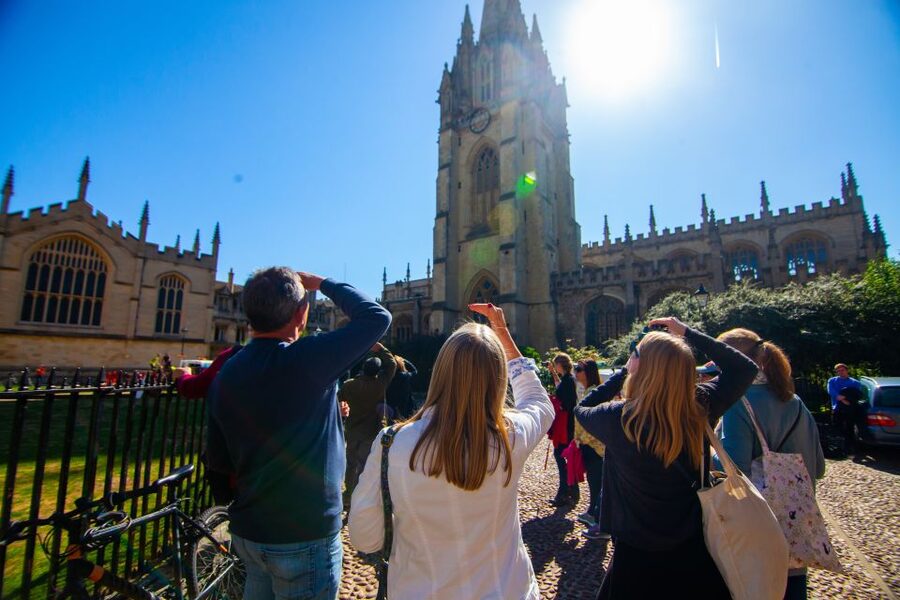
Oxford’s best stories are often tucked behind college walls, and this private walking tour gives you a guide who knows the university from the inside. You’ll hear about student life, college traditions, famous graduates, old rivalries, and the darker episodes that shaped the city.
I like the private format, since you can ask questions, set the pace, and focus on subjects that interest you. I also like the chance to walk through the Bodleian Library area, see the Bridge of Sighs, and connect Oxford’s grand buildings with its scholars, writers, politicians, and religious history.
The main thing to consider is that the standard tour lasts only two hours, and entry to paid sites is not included. You may see some interiors, but access depends on the day and must be arranged with the guide or supplier in advance.
Key points to know before you book
- University insight: Most guides have studied at Oxford, so you can ask how the university really works, not just hear dates and architectural labels.
- Private and adjustable: Choose a preferred meeting point, start time, theme, and pace by contacting Footprints Tours before the visit.
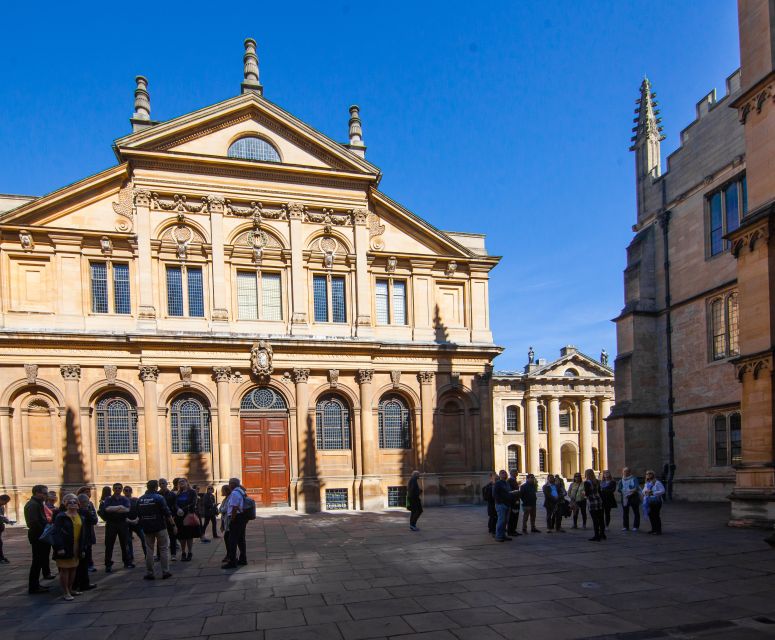
- Bodleian highlights: The route can include the Old Schools Quadrangle, Divinity School, Sheldonian Theatre, and Radcliffe Camera area.
- Unusual Oxford details: Christ Church Meadow is said to keep its own time zone, while All Souls College is linked to one of the world’s toughest exams.
- Strong guide feedback: Freddie, Mikolaj, Trevor, John, and other guides have been praised for humor, storytelling, and making room for questions.
- Extra costs: The walking tour is included, but paid attractions and college entry fees are separate.
Why a private Oxford tour works well
Oxford can feel confusing at first. The university is not one enclosed campus with a single entrance, but a collection of colleges, libraries, lecture halls, churches, gardens, and streets woven into the city center.
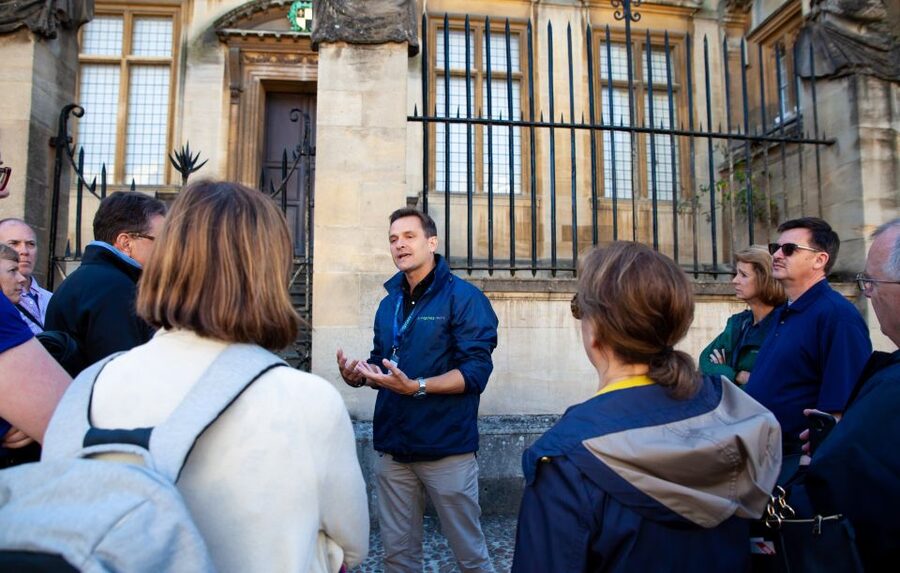
That makes a private guide useful. You are not simply ticking off famous buildings. You are learning how the colleges fit together, why certain gates matter, and how university life shapes Oxford’s daily rhythm.
I especially like this format for a first visit. You can get your bearings quickly, then return later to the places that catch your attention. A large group tour may cover the same streets, but a private group gives you more freedom to stop, ask questions, or shift the emphasis toward literature, architecture, religion, student life, or film locations.
The guide is a major part of the experience. Freddie has been praised for witty, informative storytelling. Mikolaj made the tour useful for a young person curious about university subjects and future study. Trevor was described as generous with his knowledge, while John, a current PhD student at the time of one visit, was able to explain both Oxford’s buildings and present-day academic life.
That mix matters. Oxford’s buildings can look impressive without making much sense. A guide who has studied there can explain the difference between the colleges, how students use the university, and why the institution feels less like a conventional campus than most visitors expect.
More Walking Tours in Oxford
- Oxford: University and City Walking Tour with Alumni Guide
★ 4.7 · 4,429 reviews - Oxford: Harry Potter Walking Tour Including New College
★ 4.6 · 1,446 reviews - Oxford: University Walking Tour with Christ Church Visit
★ 4.6 · 820 reviews
Starting on Broad Street
The meeting point is Oxford Tourism Information at 16 Broad Street, postcode OX1 3AS. This puts you close to several important university buildings, so the tour can begin in the historic center without a long walk from the railway station or an outlying neighborhood.
Broad Street is a fitting place to start because Oxford’s academic identity is all around you. From here, the route can reach Balliol College, Trinity College, the Sheldonian Theatre, and the Bodleian Library area.
Your guide can also arrange a different starting point if you request it in advance. That is helpful if you are staying near another part of central Oxford, arriving at a specific time, or want the tour to begin closer to a paid attraction.
The meeting point is practical, but confirm any special request before the day. Customization is offered, yet it is not something you should leave to chance at the last minute.
Balliol and Trinity: Oxford’s college system
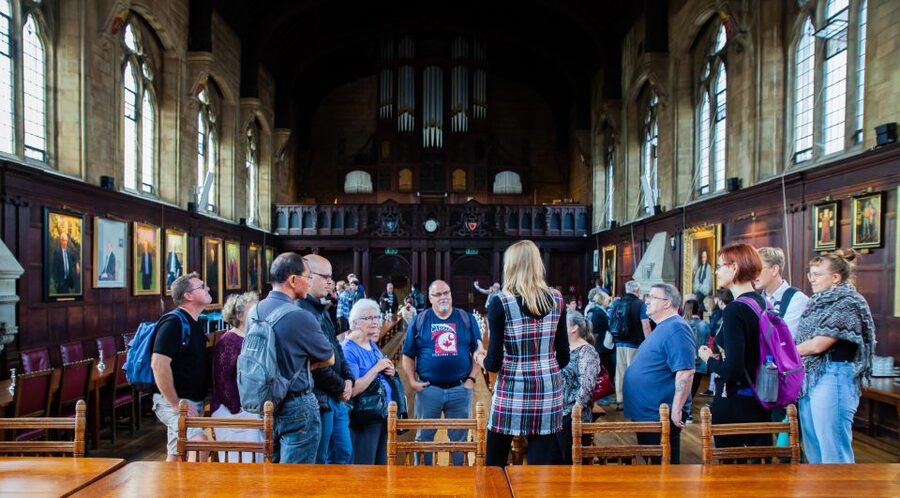
Balliol College and Trinity College help introduce the structure of Oxford University. The colleges are not just historic buildings for decoration. They are the places where students live, eat, study, and take part in much of university life.
A guide with personal Oxford experience can make this section more useful than a simple list of founders and dates. Ask how college membership affects students, how traditions work, and how the colleges differ in character.
You will also see how closely university life is tied to the public streets. Oxford’s colleges do not sit behind one giant campus boundary. Their walls and entrances appear throughout the center, often beside shops, pubs, libraries, and busy roads.
Access can vary. Some colleges charge an entrance fee, restrict hours, or close during university events. The guide can discuss available options, but additional admission costs are not included in the tour price.
The Sheldonian Theatre and the Bodleian Library

The Sheldonian Theatre is one of the route’s major architectural highlights. It is part of the university’s ceremonial world, and its presence helps explain how Oxford combines teaching, ritual, and public academic display.
Nearby, the Bodleian Library gives you one of Oxford’s most recognizable settings. The Old Schools Quadrangle forms the forecourt of one of the world’s famous libraries, with stone arcades and ornate details that reward a slower look.
The nearby Divinity School is another key stop. It is especially important for visitors interested in medieval architecture, university ceremony, or film locations. One private group was able to enter the Divinity School and the Sheldonian Theatre, but that access came through the circumstances of the visit and the guide’s connection with the university. You should not assume that every interior is included.
This is where the two-hour limit becomes noticeable. The Bodleian complex contains more than you can properly explore during a quick walk. If you want to go inside paid sites, tell the supplier ahead of time and ask what can be arranged. You may need extra time and an additional entrance fee.
A few more Oxford days worth weighing up
- Oxford: City and University Tour, including college entry
★ 4.5 · 2,243 reviews - Oxford: Harry Potter Insights Divinity School Group Tour
★ 4.6 · 783 reviews - Morse, Lewis and Endeavour Walking Tour of Oxford
★ 4.8 · 710 reviews - Oxford: City Sightseeing Hop-On Hop-Off Bus Tour
★ 4.5 · 706 reviews
The Bridge of Sighs and Radcliffe Camera
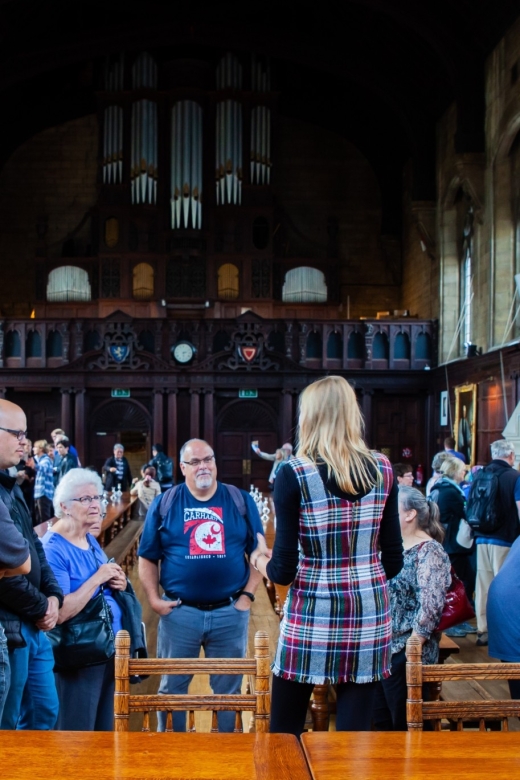
The Bridge of Sighs is one of Oxford’s most photographed sights. Its covered stone passage links parts of Hertford College and is often compared with Venice’s better-known bridge.
The comparison is fun, but the Oxford bridge has its own purpose and character. Your guide can place it in the setting of college movement and student routines, which makes the structure more than a photo stop.
The Radcliffe Camera is another visual high point. Its round form and warm stone make it one of the city’s defining buildings, even for people who know little about Oxford before arriving.
You will usually appreciate these places more after hearing how the university buildings connect. Without context, the route can become a procession of handsome façades. With a private guide, you can pause at the details that interest you, ask about the library system, or learn why Oxford’s architecture shifts from practical college buildings to grand ceremonial spaces.
The University Church of St Mary the Virgin
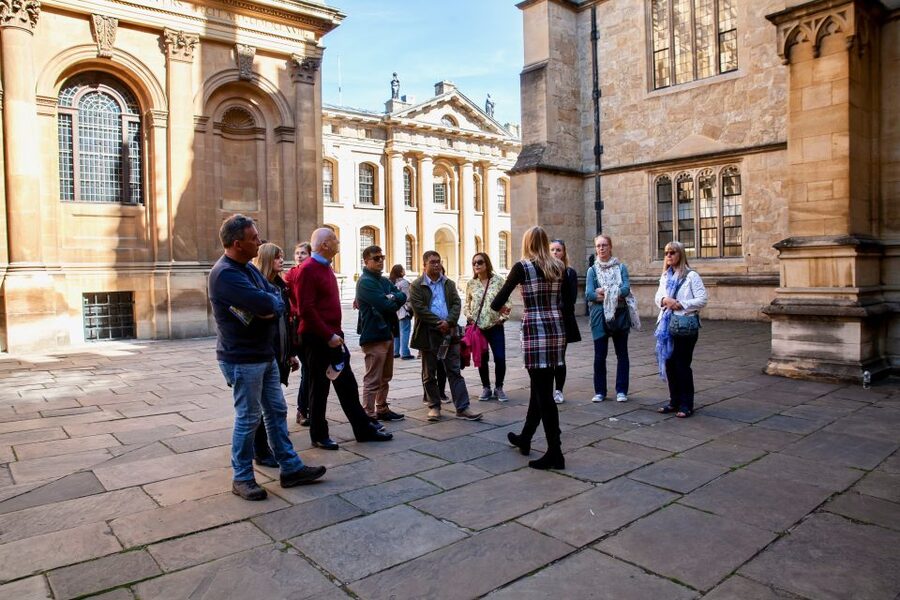
The University Church of St Mary the Virgin brings Oxford’s religious and academic past together. It was closely tied to the university long before modern lecture halls and laboratories became the main image of higher education.
The church also helps set up one of Oxford’s more serious stories: the Oxford Martyrs. Nearby streets and buildings are linked to the religious conflicts that shook England during the Reformation.
The tour can take you to the place where a powerful English archbishop was burnt alive. That detail changes the feel of the walk. Oxford is not only a city of libraries, famous authors, and picturesque courtyards. Its past includes political pressure, religious punishment, and public executions.
A good guide needs to handle this material with clarity rather than turning it into cheap drama. The tour’s strong feedback for storytelling and humor suggests that guides can move between lighter college anecdotes and darker historical subjects without making the whole walk feel like a lecture.
All Souls College and Oxford’s toughest exam
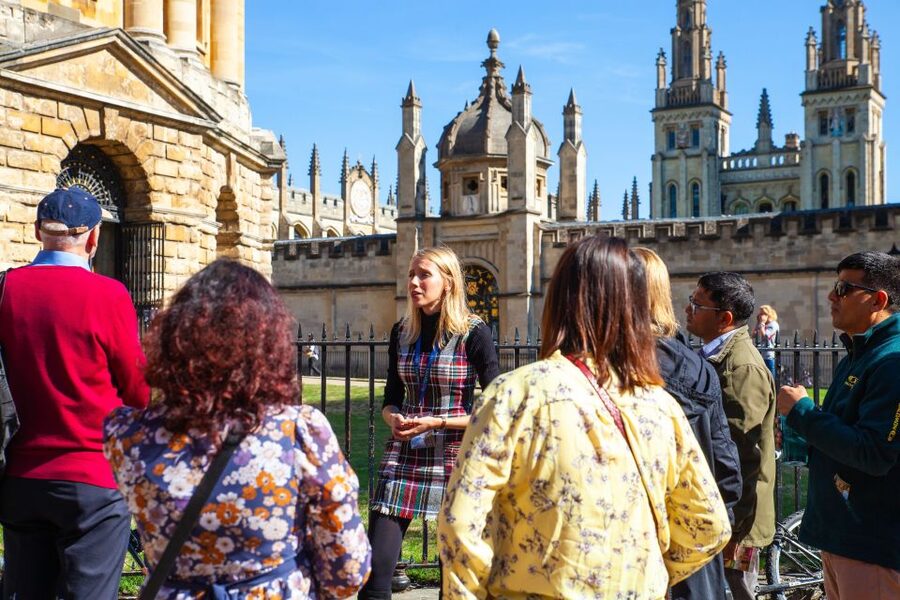
All Souls College is one of Oxford’s most exclusive institutions. It is associated with an exam often described as one of the hardest in the world.
That claim makes an excellent talking point, but the larger value is understanding how Oxford’s colleges developed different purposes and reputations. All Souls is not simply another stop on a pretty street. Its traditions reflect the university’s long focus on scholarship, selection, and academic status.
You may not be able to enter the college. College access is one of the tour’s variable parts, and paid entrances are separate. Even from the street, however, the guide can explain what makes All Souls different from the colleges where most undergraduates study.
This stop is also a good place to ask about the gap between Oxford’s historic image and modern student life. The alumni guides are well placed to answer questions about how the university operates today, particularly if you are considering Oxford for yourself or visiting with a student.
Oriel, Merton, and the city’s literary side
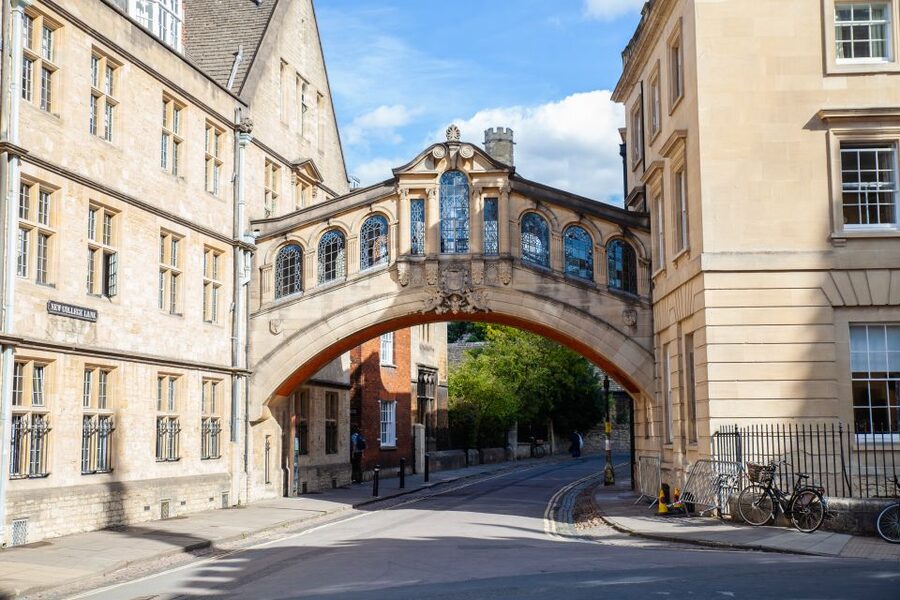
Oriel College and Merton College are part of the typical route, along with several other historic colleges. Each adds another layer to Oxford’s long academic story.
The city’s literary connections are just as important. Oxford was the alma mater of major writers, politicians, philosophers, and other public figures. The tour can also point you toward the pub where early copies of The Hobbit and The Lion, the Witch and the Wardrobe were handed out.
Those details give the walk a more human scale. You are not only looking at institutions. You are hearing how writers and scholars met, argued, worked, and built friendships in the same streets you are walking.
Harry Potter filming locations may also be included if that interests you. You should state this preference before the tour, since the route is customizable and the standard two-hour itinerary has plenty to cover.
The private format is particularly useful for mixed groups. One person may want architecture, another may care about fantasy films, and someone else may be choosing a university. A guide can adjust the balance instead of forcing everyone through the same script.
Christ Church College and its meadow

Christ Church College is one of Oxford’s most famous names and usually a major point on the route. Its scale and reputation make it an important part of understanding Oxford’s colleges.
The tour may also include Christ Church Meadow, a broad open area with a curious local distinction: it is described as the only part of the city with its own time zone. That is the sort of odd Oxford fact that helps break up the formal architecture.
The meadow offers a change of pace after the central college streets. You can discuss the relationship between the university and the wider city, rather than looking only at gates, towers, and quadrangles.
Christ Church is also a place where admission rules and opening times matter. If entering the college is important to you, ask about arrangements and extra fees in advance. The walking tour itself does not include paid-site admission.
What two hours can realistically cover
Two hours is enough for a strong introduction, not a complete study of Oxford University. You can see many headline buildings and hear the main stories, but you will not have time to linger inside every college or visit every library room.
The route listed for a typical tour includes Balliol, Trinity, the Sheldonian Theatre, Divinity School, Bridge of Sighs, Bodleian Library, Radcliffe Camera, University Church of St Mary the Virgin, Christ Church, All Souls, Oriel, and Merton.
That is an ambitious list. The exact balance may depend on walking speed, college access, questions, and the themes you choose. If you want a relaxed pace or several interior visits, ask the supplier to adjust the plan rather than expecting every stop to receive equal time.
I would book this as an orientation walk, then return independently to the places you want to explore in greater detail. It works well early in a day trip because it shows you where the major sights are and gives the rest of your visit more shape.
Price, group size, and practical value
The price is about $101 per person, and the tour is private. That is not the cheapest way to see Oxford, especially for one or two people, but the value improves as your group grows because the cost buys a dedicated guide rather than a seat on a large public walk.
The real benefit is control. You can ask questions without waiting for a group of strangers, slow down for photographs, or focus on university admissions, literature, religion, architecture, or film locations.
The tour is in English and is wheelchair accessible. Since it is a walking experience through historic streets and college areas, anyone with mobility concerns should still discuss preferred routes and access needs with the supplier before booking.
You can cancel up to 24 hours before the start for a full refund, and you can reserve now and pay later. Those policies are useful if your Oxford visit is part of a changing day-trip plan.
Who should book this Oxford walk
I would choose this tour for a first visit, a family group, or friends with different interests. It is also a good fit if you want to ask direct questions about studying at Oxford, since the guides often have firsthand university experience.
Students and parents may get extra value from the chance to discuss subjects and university life. The experience can be more than sightseeing if you use the guide as a source of practical context.
It is less suitable if you want a long interior visit to one particular college or library. In that case, you should ask about a customized plan and budget for admission fees. It is also not the best choice for someone who wants to explore alone at a very slow pace.
FAQ
Where does the Oxford private walking tour meet?
The meeting point is Oxford Tourism Information at 16 Broad Street, Oxford, OX1 3AS.
How long does the tour last?
The walking tour lasts two hours.
Is the tour private?
Yes. It is offered for a private group rather than as a shared large-group tour.
What language is the tour in?
The tour is conducted in English.
Are the guides Oxford University alumni or students?
Most guides have studied at the University of Oxford. Some may be current students, including postgraduate students.
Can the tour be customized?
Yes. You can request different themes, attractions, starting points, and times. Contact Footprints Tours in advance with your preferences.
Does the price include entrance fees?
No. The private walking tour is included, but any additional entrance fees for paid sites are separate.
Is the tour wheelchair accessible?
Yes. The activity is listed as wheelchair accessible.
Can I cancel the booking?
Yes. You can cancel up to 24 hours in advance for a full refund. You can also reserve now and pay later.
Should you book the Oxford alumni walking tour?
Book it if you want Oxford explained by someone with a real connection to the university, and if you value a flexible private route over the lowest possible price. The strongest reasons are the guides’ storytelling, the chance to ask personal questions, and the range of major sights covered in two hours.
Before booking, decide what matters most. If you want the Bodleian and Divinity School interiors, ask about access. If your group cares about Harry Potter, literature, university applications, or religious history, request that theme in advance.
For a compact first look at Oxford, this is a smart choice. Just treat the two hours as an informed introduction, not a full college tour, and budget separately for any paid entry.
Just added around Oxford
- Undiscovered Cotswolds Private Driving Tour★ 5.0 · 5 reviews
- Oxford: Christ Church Harry Potter Film Locations Tour★ 4.6 · 302 reviews
- Oxford: City and Universities Express Tour & Audio Guide★ 4.5 · 18 reviews
- London: Small Group Oxford, Stratford and Cotswolds Day Tour★ 4.9 · 104 reviews
- Oxford University: Guided Small Group Walking Tour★ 4.8 · 90 reviews
- Oxford: City, Universities and Pubs Walking Tours★ 4.2 · 6 reviews
- Oxford: Alumni-Led Walking Tour w/New College Entry Option★ 4.6 · 124 reviews
- Oxford: Town & Gown Walking Tour★ 4.3 · 12 reviews
Walking Tours, compared.

Magical London: Harry Potter Guided Walking Tour
Read our review →

University and City Walking Tour with Alumni Guide
Read our review →
Harry Potter Movies Walking Tour (Kids Go Free)
Read our review →
The Great British Rock and Roll Music Walking Tour
Read our review →
Jack the Ripper Walking Tour – Ripper Vision Tours
Read our review →

Browse the lists this tour appears in