
Reviewed · GHOST TOURS
Oxford: Twilight Ghost Tour
Oxford’s old streets have no trouble looking haunted after sunset. On this 75-minute walk, you’ll pass Martyrs Cross, Dead Man’s Walk, and Magpie Lane while hearing about burned bishops, restless spirits, murders, and the real history behind the tales. It is part ghost story, part city walk, and part literary tour.
I like the way the route links spooky stories to Oxford’s actual buildings and streets. I also like the strong guide-led style: Simon, Tom, Jonathan, Ajai, Alle, Sophie, and others have been praised for clear storytelling, humor, and theatrical timing. The main drawback is that colleges are normally closed in the evening, so you should not book this expecting an indoor college tour.
Key points to know before booking
- Martyrs Cross sets a grim tone: Learn about bishops burned alive during the reign of Mary I.
- Dead Man’s Walk adds atmosphere: A ghostly soldier is said to guard Oxford’s ancient walls.
- Magpie Lane brings the poltergeist stories: Listen for tales of an anguished spirit and strange street happenings.
- The tour covers more than ghosts: Oxford’s university buildings, literary links, murders, executions, and local legends all appear.
- The guides make the difference: Simon, Tom, Jonathan, Ajai, Tom, Alle, and others have been praised for humor, clarity, and dramatic delivery.
- The route works best after dark: Twilight, old stone, narrow lanes, and street lighting create the mood, though warm clothing is wise in colder months.
Why Oxford works so well after dark
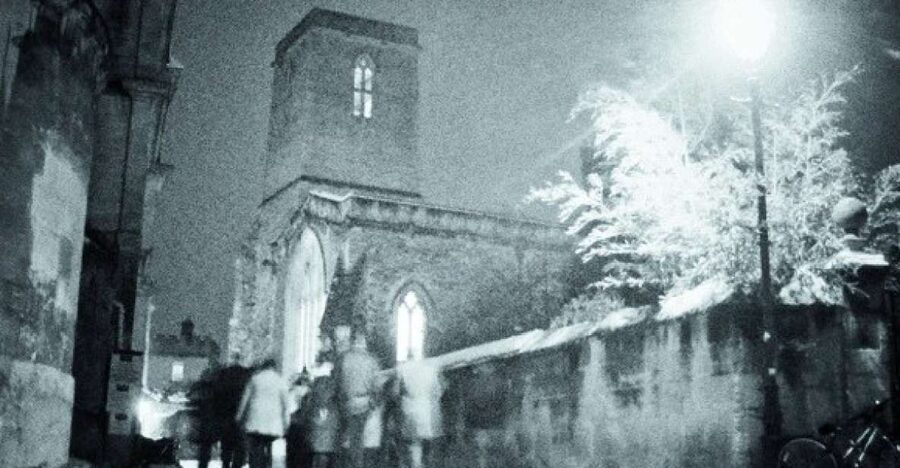
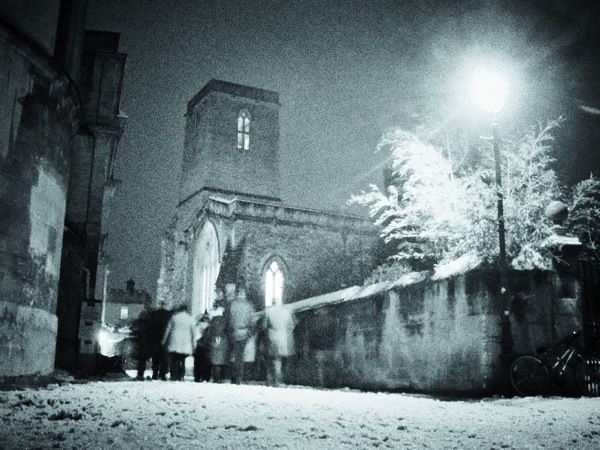
Oxford can feel formal in daylight. You see grand college walls, towers, libraries, and academic courtyards. After sunset, the same streets take on a different character. The tour uses that change well, turning familiar architecture into the setting for stories about faith, punishment, scholarship, crime, and the supernatural.
The focus is not on jump scares or special effects. You walk from place to place while your guide builds the tale around the street under your feet. That makes the experience a good fit if you want atmosphere and local history, not a staged horror show.
The ghost stories also give you a reason to notice parts of Oxford you might otherwise pass. Smaller lanes, old lamps, college walls, and views toward the spires become part of the story. You are not simply listening to legends in a room. You are hearing them where they are supposed to have happened.
The mood depends on the guide. Some, such as Tom and Jeremy, have used a theatrical style, with gestures, comic timing, and dramatic voices. Others, including Jonathan, Simon, Eleanor, and Alle, have been praised for clear explanations and a strong grasp of Oxford’s past. That variety can make each departure feel a little different.
More ghost walks around Oxford:
- Oxford Official Ghost Tour
★ 4.3 · 41 reviews - New: Oxford Costumed Ghost Tour In-Character
★ 4.1 · 10 reviews - Oxford: Haunted Oxford Tour – by Uncomfortable Oxford™
★ 4.5 · 5 reviews
Martyrs Cross and the story of Bloody Mary
The walk begins at Martyrs Cross, one of the most serious points on the route. Here, your guide sets the historical background with the story of bishops burned at the stake during the reign of Mary I, often remembered by the nickname Bloody Mary.
This opening gives the tour more weight than a simple collection of haunted-house tales. The supernatural stories grow out of real suffering, religious conflict, public punishment, and political fear. You get a reminder that Oxford’s dark past is not all folklore. Some of its most disturbing events are firmly rooted in documented history.
Expect your guide to explain the place and then connect it to the stories that have gathered around it. The best part of this stop is the contrast between the peaceful modern street and the brutal events associated with it. You are standing in a functioning university city, yet the ground carries memories of executions meant to frighten an entire population.
This is also where the guide’s delivery matters most. A flat lecture would make the material feel distant. A good guide gives it a human scale, while still leaving room for the grim facts to speak for themselves. Cevriye Arzu singled out Jeremy’s timing and dramatic presentation, while other guides have been praised for making difficult history easy to follow.
Through Oxford’s medieval lanes
From Martyrs Cross, the route moves into older streets and alleys. The walking pace has been described as comfortable, and the tour covers a good deal of ground in its 75 minutes. You should still wear sensible shoes because this is an evening walk on city streets, not a stationary storytelling session.
The route is designed around mood. Oxford’s pale stone, enclosed passages, old lamps, and darkening sky do much of the work. Your guide fills in the details with stories of phantoms, unsolved mysteries, murders, executions, and unusual incidents connected with the city.
You may also hear about the university as a place of rivalries, strict rules, ambition, and eccentric behavior. That matters because Oxford’s ghost stories make more sense when you understand the setting. A centuries-old academic institution, filled with private courtyards and restricted spaces, naturally produces secrets and speculation.
Several guides have added background about how the colleges function and how Oxford developed. Jonathan, an Oxford alumnus, was praised for explaining the city and university as well as telling ghost stories. This broader context is useful if you are visiting Oxford for the first time, since the tour can help you read the buildings rather than simply photograph them.
Dead Man’s Walk and the spectral sentinel
Dead Man’s Walk is one of the route’s key atmospheric stops. The name alone sounds like it belongs in a ghost story, and the tale here concerns a spectral soldier who guards the old city walls for eternity.
The story works because the setting provides a clear image. You are near ancient defensive walls, walking through a part of Oxford that feels quieter and more enclosed than the main streets. The idea of a soldier still keeping watch turns the city’s medieval defenses into a stage for a lingering spirit.
Your guide may treat the story with a straight face, a wink, or a full theatrical performance. That balance is important. The tour is intended to be spooky, but it is also entertaining. Families and younger visitors have found it accessible because the tone is generally more amusing and atmospheric than frightening.
This stop also shows why walking tours can offer more than a list of facts. You might remember a date or a name, but you are more likely to remember the sensation of moving beside old walls in the dark while hearing about a guard who never left his post.
A few more Oxford days worth weighing up
- Oxford: University and City Walking Tour with Alumni Guide
★ 4.7 · 4,429 reviews - Oxford: City and University Tour, including college entry
★ 4.5 · 2,243 reviews - Oxford: Harry Potter Walking Tour Including New College
★ 4.6 · 1,446 reviews - Oxford: University Walking Tour with Christ Church Visit
★ 4.6 · 820 reviews
Magpie Lane and the poltergeist tale
Magpie Lane brings a different type of story. Instead of a bishop or soldier tied to a major historical event, the focus turns to a troubled spirit and an alleged poltergeist.
The lane is one of the places where the tour’s playful side comes forward. The guide may tell you to tread carefully, since the resident spirit is said to dislike being disturbed. Stories connected with flickering or dimming street lights have added a touch of eerie drama to the walk, though you should treat such moments as part of the folklore rather than proof of anything supernatural.
This section is likely to appeal if you enjoy local legends that have been passed from person to person. It is less about grand history and more about the way a single street can collect stories over time. You may hear about the guide’s own unsettling experiences, depending on who leads your walk and how much the group wants to hear.
The route does not require you to believe in ghosts. I see that as a strength. You can enjoy the storytelling, examine the architecture, and decide for yourself how much of the tale is memory, invention, coincidence, or something stranger.
From ghost stories to Tolkien, Lewis, Wilde, and Rowling
The tour’s literary side adds welcome range. Oxford’s moonlit spires and old lanes have inspired writers including J.R.R. Tolkien, C.S. Lewis, Philip Pullman, and Oscar Wilde. The walk also connects the city with fictional worlds and characters, including Hamlet and Harry Potter.
These references are not presented as a replacement for the ghost stories. They show how Oxford’s buildings and atmosphere have fed the imagination for generations. You may hear where Tolkien and Lewis spent time, where literary figures met, and how particular views or streets became linked with familiar stories.
Harry Potter fans should keep expectations sensible. The walk can point out locations associated with the films and the wider Oxford setting, but this is not a dedicated film-location tour. Likewise, the Tolkien and Lewis material is part of a larger route that includes history, folklore, and university life.
I like this mixture because it keeps the 75 minutes from becoming one-note. You might begin with religious executions, move to a ghostly guard, hear about a poltergeist, and then find yourself considering how Oxford’s architecture helped shape fantasy literature. The links feel natural because the city itself is the common thread.
The guide is the main attraction
The route matters, but the guide controls the experience. The most praised qualities are clear speech, good timing, humor, and the ability to tell a story without losing the historical facts.
Simon has been repeatedly praised for his Oxford background, warmth, and engaging stories. Tom has been described as theatrical, enthusiastic, and well prepared. Jonathan has drawn praise for his understanding of the colleges and for making an effort to respond to the group’s interests.
Other guides have their own styles. Ajai has been described as funny and well informed, while Alle and Eleanor have been praised for articulate delivery and easy-to-follow explanations. Jeremy’s dramatic presentation and precise timing have also made a strong impression.
You cannot normally select a specific guide when booking, so it is best to think of these names as examples of the standard the tour aims for, not a promise of who will lead your departure. The upside is that the experience does not depend on special equipment. A lively guide can make an old street, a lamp post, or a view of the spires feel significant.
What the 75 minutes feel like
The 75-minute length is well judged for an evening walk. It gives the guide enough time to develop several stories while keeping the route manageable. Some walks have run a little longer, but you should plan around the advertised duration.
The tour covers a lot in a short period. You will hear about Oxford’s religious conflicts, medieval streets, university buildings, literary connections, ghosts, executions, and local mysteries. That means the experience is broad rather than exhaustive.
You should not expect every story to receive a long historical explanation. The guide has to keep the group moving and maintain the mood. If you want a detailed study of Oxford’s colleges or a full account of the Reformation, choose a specialist daytime tour as well.
For most visitors, the pace provides a useful first look at the old city. You get enough information to return later and explore specific places in daylight. The tour can also work near the start of an Oxford visit because it helps you recognize streets and landmarks during the rest of your stay.
Colleges, access, and practical comfort
The tour is wheelchair accessible, and private or small-group options are available. The meeting point can vary depending on the option booked, so check your confirmation carefully rather than assuming every departure begins at the same place.
The important limitation is college access. Colleges do not normally open for this tour in the evening, so most of the experience takes place outdoors. You will see college exteriors, streets, walls, and views, but you should not count on entering historic interiors.
One participant did report being able to enter a college on one occasion. That appears to be an exception, not something you should plan around. If entering a college is high on your Oxford list, book a separate daytime visit and treat any evening access as a bonus.
Dress for the conditions. Oxford evenings can be cold, and one December group still enjoyed the walk despite bitter weather. A warm layer and shoes suitable for uneven or hard-paved streets will make the experience more pleasant.
The live tour is in English. You need to be comfortable following spoken storytelling, jokes, and historical explanations as you walk. The guides have generally been praised for being easy to hear and understand, but the outdoor setting can still make it harder to catch every word if you drift too far from the group.
Is $29 a fair price?
At $29 per person, the tour offers reasonable value if you want an evening activity that combines several themes. You are paying for a 75-minute guided walk, not admission to a college or a museum. The value lies in the guide’s interpretation, the route, and the atmosphere.
I would compare it with the cost of a standard city walk and ask what you want from the evening. If you only want ghost stories, the historical and literary material may feel like extra padding. If you want a quick introduction to Oxford after dark, the mixture makes the price easier to justify.
The small-group or private options may suit you if you prefer to ask questions or want a more personal pace. A larger group can still work well, but stay close to the guide so you can hear the stories and see the places being discussed.
Flexible booking helps if your plans are uncertain. You can reserve and pay later, and cancellation is available up to 24 hours before the tour for a full refund. Starting times vary, so check availability for your date.
Who should book this Oxford ghost walk?
I would recommend it to first-time Oxford visitors who want more than a daytime photo walk. The stories give you a memorable way to learn about the city’s religious conflicts, university traditions, old streets, and literary connections.
It also suits families with older children and teenagers. The tone is spooky and dramatic but not designed as extreme horror. One family found the storytelling engaging enough to spark an interest in Oxford’s history books, which is a good sign for curious young minds.
History fans will appreciate the real events behind the legends. Literature fans will enjoy the Tolkien, C.S. Lewis, Philip Pullman, Oscar Wilde, Shakespeare, and Harry Potter connections. Couples and small groups may like the moody evening setting and the chance to see quieter corners of Oxford.
I would be more cautious if you dislike walking outdoors at night, need a fully indoor activity, or want extensive access to college interiors. This is also not the right choice if you want a purely factual historical lecture with no theatrical storytelling.
Should you book the Twilight Ghost Tour?
Book it if you want Oxford to feel mysterious, human, and a little absurd for one evening. The best parts are the combination of true historical events with local ghost tales, the route through old streets and walls, and the guides’ ability to keep the mood lively.
The tour is not a haunted attraction, and the ghosts are not the whole point. It is a compact introduction to Oxford’s darker stories, with literary landmarks and university history added along the way. At $29, it is a sensible pick for an evening when you want to walk, listen, and see the city from a different angle.
FAQ
How long is the Oxford Twilight Ghost Tour?
The walking tour lasts 75 minutes. Starting times vary, so check availability for your chosen date.
What language is the tour in?
The tour is conducted in English with a live English-speaking guide.
Does the tour go inside Oxford colleges?
Normally, no. Colleges are usually closed in the evening, so the route generally focuses on outdoor streets, buildings, walls, and views. Occasional access may be possible, but it is not guaranteed.
Is the tour wheelchair accessible?
Yes, the activity is listed as wheelchair accessible.
Can I book a private or small-group tour?
Yes. Private and small-group options are available, depending on the option you select.
Where does the tour meet?
The meeting point may vary according to the option booked. Check the meeting details for your specific reservation.
Can I cancel the tour for a refund?
Yes. You can cancel up to 24 hours in advance for a full refund. You can also reserve now and pay later, subject to the booking terms.
Just added around Oxford
- Undiscovered Cotswolds Private Driving Tour★ 5.0 · 5 reviews
- Oxford: Christ Church Harry Potter Film Locations Tour★ 4.6 · 302 reviews
- Oxford: City and Universities Express Tour & Audio Guide★ 4.5 · 18 reviews
- London: Small Group Oxford, Stratford and Cotswolds Day Tour★ 4.9 · 104 reviews
- Oxford University: Guided Small Group Walking Tour★ 4.8 · 90 reviews
- Oxford: Alumni-Led Walking Tour w/New College Entry Option★ 4.6 · 124 reviews
- Oxford: Town & Gown Walking Tour★ 4.3 · 12 reviews
- Oxford: City, Universities and Pubs Walking Tours★ 4.2 · 6 reviews
Ghost Tours, compared.







Shadows of York: Ghost Walk and Horrible History.
Read our review →Browse the lists this tour appears in