
Reviewed · WALKING TOURS
Secrets of Central London Walking Tour
Central London has transport stories hiding in plain sight. On this two-hour walk, you move from Covent Garden to Theatreland, Kingsway, and Embankment Gardens while tracing how streets, rivers, trams, trains, and tunnels shaped the city from the 1500s to today. I especially like the focus on transport history you can see from the pavement and the way the Thames is treated as London’s first public transport route.
I also like that the stories come from the London Transport Museum, rather than from a general city guidebook. You’ll hear about Convent Garden, early theatres, the first professional police force, the Kingsway Tram Tunnel, and Crossrail construction. The main drawback is that the tour is in English only, and one verified booking found the guide spoke too quickly at times. The pace and uneven ground may also be a concern if you have mobility limitations.
Key points to know before you book

- The Thames is part of the transport story: Learn how London’s river functioned as its first public transport thoroughfare.
- The route covers four central districts: Expect Theatreland, Covent Garden, Kingsway, and the Embankment.
- The tour stays above ground: You will not enter disused Tube stations or other closed underground spaces.
- The stories reach from the 1500s to Crossrail: The walk connects old streets with modern railway construction.
- It is a full two hours on foot: Busy roads, uneven surfaces, and frequent walking make sturdy shoes essential.
- The price is modest for a museum-led tour: At $26 per person, the value rests on the quality of the guide and your interest in transport history.
Starting beside the London Transport Museum

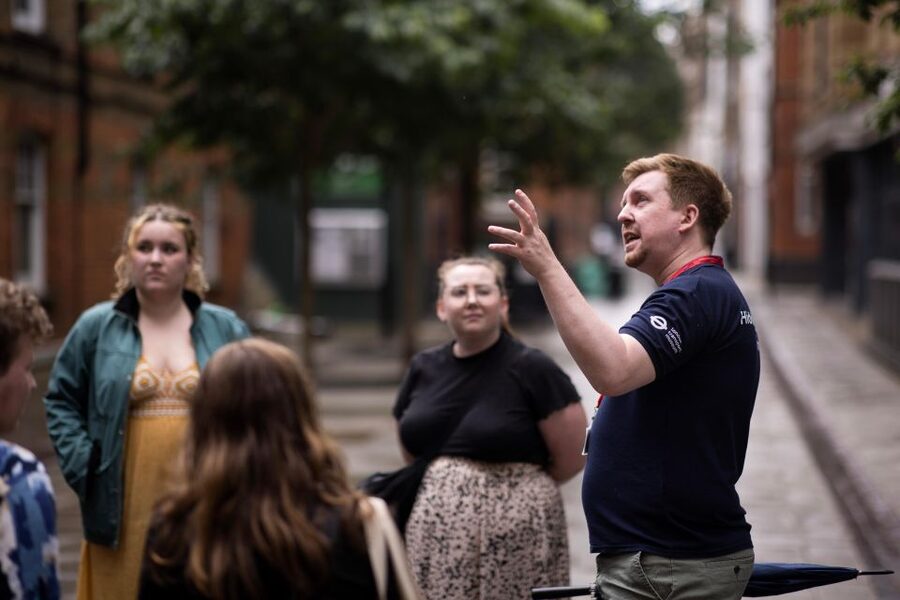
Meet outside the main entrance of the London Transport Museum in Covent Garden Piazza. A member of the Hidden London team meets the group 15 minutes before the scheduled start, so arrive with enough time to find the entrance and settle in.
The museum itself is not included. That matters if you are comparing this walk with a museum ticket or planning a full visit. You pay for the guided walk only, and the route begins outside rather than inside the galleries.
This is a useful starting point because the museum gives the tour a clear subject. You are not simply walking between famous central sights. You are looking at how London moved, and how transport projects changed the streets beneath your feet.
Bring a passport or ID card. Large bags and luggage are not allowed, and there is no cloakroom. That makes this a poor choice straight after checking out of a hotel with suitcases in tow. Travel light, wear sturdy shoes, and dress for two hours outdoors.
More Walking Tours in London
- Magical London: Harry Potter Guided Walking Tour
★ 4.7 · 22,044 reviews - London: The Original Jack the Ripper Walking Tour
★ 4.7 · 7,833 reviews - London: Harry Potter Movies Walking Tour (Kids Go Free)
★ 4.7 · 3,071 reviews
Covent Garden before the market became a landmark
The first part of the walk explores Covent Garden and the story of Convent Garden, its original name. This gives you a useful reminder that central London districts often began as working places long before they became popular stops on a sightseeing route.
The exact appeal here is not just the square itself. The guide uses the area to show how names, streets, and public spaces changed over time. You can expect stories drawn from the museum’s archive, with transport history placed alongside the social and urban changes that shaped the neighborhood.
The tour also brings you near the city’s oldest shop, according to the supplied tour details. That is the sort of quick landmark that helps connect a street you might otherwise pass without a glance to a much older London.
You should not expect a long stop at every point. This is a walking route, so the experience depends on listening while moving and pausing in public spaces. If you prefer slow photography or extended time inside historic buildings, this may feel brisk.
Theatreland and the birth of London’s stage district

From Covent Garden, the route moves through Theatreland and examines the first theatres that opened in the area. London’s theatre district is easy to treat as a row of bright signs and crowded pavements. This tour looks instead at how the district developed and how its streets helped shape movement through the West End.
I like this section because it links entertainment and transport. Theatres draw crowds, and crowds need streets, footways, rail connections, and ways to move in and out. The walk uses that relationship to explain why central London developed the way it did.
You’ll also hear how London’s first professional police force was born. That story adds another layer to the route. A city with theatres, markets, commercial streets, and growing public transport needed systems to manage public space, traffic, and large gatherings.
The practical point is that these are listening stops rather than attraction entries. The tour does not include theatre admission, and the information provided does not promise interior access to theatres or other buildings. You are seeing the streets and learning what happened there.
Kingsway and the engineering beneath the road

Kingsway is one of the most important parts of this walk for anyone interested in infrastructure. Here, the focus turns to the Kingsway Tram Tunnel and the construction of the Piccadilly line.
The tunnel story is especially useful because you can understand the scale of underground engineering without entering a closed station. You will be above ground, but the guide explains what was built below and how transport planners used the space under the road.
This is also where the tour shows how a familiar street can carry several layers of transport history. The present-day road is only one part of the story. Older tram systems, Tube construction, and later projects all left their mark on the central London network.
Do not book this walk expecting access to abandoned platforms, service passages, or disused stations. The tour specifically does not visit disused Tube stations or underground spaces. Its appeal is the explanation of what lies beneath ordinary streets, not physical entry into those places.
A few more London days worth weighing up
- From London: Harry Potter Warner Bros Studio Tour
★ 4.7 · 26,588 reviews - London: Westminster to Greenwich River Thames Cruise
★ 4.5 · 22,836 reviews - London: Madame Tussauds London
★ 4.6 · 20,915 reviews - London: Warner Bros. Studio Tour with Transfers
★ 4.7 · 17,586 reviews
Holborn’s tunnels and the city below your feet
The Holborn area brings more attention to London’s underground network. You’ll hear about the multitude of tunnels in and around the district, along with the engineering work needed to build and connect transport routes.
That word multitude is important here. London’s underground world is not just the Tube map you see on a station wall. It includes different kinds of passages and routes built for changing transport needs. The walk uses Holborn to show how much infrastructure can exist below a busy central district.
I find this kind of explanation more useful than simply being told that London has a famous Underground system. It helps you look at roads, buildings, and entrances with a sharper eye. The city becomes a record of past transport decisions.
Still, keep your expectations practical. The tour does not promise a descent into the tunnels. If you want to see transport artifacts, trains, station interiors, or technical displays, plan a separate visit to the London Transport Museum.
The Embankment and London’s first transport thoroughfare
The route continues toward the Embankment and the Thames. Here, the river is presented as London’s first public transport thoroughfare, a point that gives the walk a much wider frame.
Before the modern Tube and railway systems, the river was central to movement through London. The Thames carried people and goods and helped the city function across its two banks. On this tour, the river is not just a scenic backdrop. It is part of the transport network that came first.
This is one of the strongest parts of the walk because it lets you compare different forms of movement in a small area. You have the river at ground level, roads beside it, railway routes nearby, and tunnels below. The Embankment becomes a compact lesson in how London kept adding new ways to move.
The area can be busy, and the tour involves crossing roads and passing through active public spaces. Stay close to the guide and expect the group to keep moving. A calm stroll through a garden is not the whole experience, even though some portions pass through quieter surroundings.
Why trains run near Embankment Gardens
One of the tour’s more memorable questions is why you can hear trains while walking through tranquil Embankment Gardens. The contrast is the point. A peaceful garden can sit directly above or beside major transport works, allowing the city’s machinery to make itself heard even when it is out of sight.
The explanation gives you a practical way to read central London. Sound becomes a clue. A train you cannot see may reveal the route of infrastructure below or nearby, and the guide helps place that sound within the city’s transport story.
This is a small detail, but it captures the character of the tour. You are not only stopping at major landmarks. You are learning to notice ordinary clues, such as a street alignment, an old shop, a tunnel reference, or the noise of a train in a garden.
From the Piccadilly line to Crossrail
The final historical sweep reaches into the 2010s and the work to build Crossrail. This brings the tour into a period you may remember, showing that transport history is still being made beneath London’s streets.
The value here is the long time span. In two hours, the route moves from the 1500s, through early theatres and the first professional police, to trams, the Piccadilly line, and Crossrail. You get a sense of transport as an ongoing process rather than a finished system.
That timeline also makes the $26 price easier to judge. You are paying for a live guide to organize a large subject into a route you can follow on foot. At roughly $13 per hour, the cost is reasonable if you enjoy city history and want more than a list of famous sights.
The value is weaker if you mainly want entry tickets, photographs, or access to restricted spaces. The museum admission is separate, and the walk’s main product is interpretation. You are buying stories, context, and a carefully chosen route.
Pace, language, and accessibility
The tour is conducted in English. One verified booking from Germany found the route interesting but difficult to follow because the guide spoke quickly and sometimes continued speaking while walking. If English is not comfortable for you, this is a real consideration, not a minor detail.
You may be able to ask the guide to slow down or repeat a point, but no translated tour or other language option is provided in the supplied information. The tour is specifically listed as English-language only.
The route is listed as wheelchair accessible, yet the same information says it is not suitable for people with mobility impairments. It also warns of up to two hours of walking, uneven ground, road crossings, and busy areas. Those details do not fit every mobility need, so you should treat the accessibility note with care and contact the provider before booking if you need specific assistance.
Children under nine are not suitable for this activity. Older children who enjoy trains, tunnels, and city engineering may find the subject appealing, but the walking and listening demands still matter.
How to prepare for the two-hour route
A few simple choices will make the experience easier:
- Wear sturdy footwear for uneven ground and continuous walking.
- Bring suitable clothing for changing outdoor conditions.
- Carry only what you need because large bags and luggage are not allowed.
- Bring a passport or ID card.
- Arrive 15 minutes early at the London Transport Museum entrance.
- Do not assume the museum visit is included.
- Plan for an English-language presentation delivered while walking.
- Avoid booking this as a luggage transfer between hotels or stations.
The activity has free cancellation up to 24 hours before the start, and you can reserve now and pay later. Those terms help if your London schedule is still changing, but they do not solve the practical issue of fitting two hours of walking into a busy sightseeing day.
Who should book the Secrets of Central London Walking Tour?
I would choose this tour if you like London’s transport system, old streets, engineering projects, and the stories behind familiar places. It suits someone who has already seen the main sights and now wants to understand why the center looks and sounds the way it does.
It is also a good use of time for a visitor staying near Covent Garden or the West End. The meeting point is central, the price is moderate, and the route covers several districts without requiring a separate Tube journey between them.
I would think twice if you want a relaxed sightseeing walk, a museum visit, or access to abandoned stations. The route can be brisk, the surface is not always even, and English comprehension matters. The lack of luggage storage is another small but important limit.
Should you book it?
Book this walk if the idea of hearing trains beneath a quiet garden, tracing old tram routes, and seeing London’s streets as transport projects appeals to you. The strongest feature is its specific focus on infrastructure hidden in everyday surroundings, backed by the London Transport Museum’s archive.
Skip it if you want interior access, a multilingual guide, or a slow tour with little walking. At $26, it offers fair value for a focused two-hour introduction to Central London’s transport story, as long as you arrive prepared to walk, listen, and look beneath the surface.
FAQ
Where does the tour meet?
The meeting point is outside the main entrance of the London Transport Museum in Covent Garden Piazza, WC2E 7BB. A member of the Hidden London team meets you 15 minutes before the tour starts.
How long does the walking tour last?
The tour lasts approximately two hours.
What areas does the route cover?
The walk covers Theatreland, Covent Garden, Kingsway, and the Embankment, with discussion of the Holborn area.
Is entry to the London Transport Museum included?
No. Entry to the London Transport Museum is not included in the walking tour price.
Does the tour visit disused Tube stations or underground spaces?
No. The tour does not visit disused Tube stations or other disused underground spaces.
What language is the tour conducted in?
The live guided tour is conducted in English.
Is the tour suitable for children and people with mobility impairments?
Children under nine are not suitable for the tour. The activity involves up to two hours of walking, uneven ground, road crossings, and busy areas, and it is listed as not suitable for people with mobility impairments.
Just added around London
- London: Wimbledon Tennis Club and Westminster Walking Tour★ 4.5 · 86 reviews
- London: Westminster to Richmond River Thames Cruise★ 4.8 · 23 reviews
- Westminster Abbey Skip-the-Line Entry and Private Tour★ 4.6 · 4 reviews
- Best of London by LE GRAND – London’s Luxury Bus Tour★ 4.2 · 23 reviews
- London: Westminster Walking Tour & St Paul’s Cathedral Entry★ 4.7 · 7 reviews
- From London: Oxford, Stratford-upon-Avon & Cotswolds Trip★ 4.5 · 64 reviews
- From London: Warwick, Oxford, Stratford & Cotswolds Day Tour★ 4.0 · 270 reviews
- Warner Bros. Studios and 1-Day London Hop-on Hop-off tour★ 4.7 · 9 reviews
Walking Tours, compared.

Magical London: Harry Potter Guided Walking Tour
Read our review →

University and City Walking Tour with Alumni Guide
Read our review →
Harry Potter Movies Walking Tour (Kids Go Free)
Read our review →
The Great British Rock and Roll Music Walking Tour
Read our review →
Jack the Ripper Walking Tour – Ripper Vision Tours
Read our review →

Browse the lists this tour appears in