
Reviewed · CITY TOURS
Birmingham: City Center Highlights Private Guided Tour
Birmingham’s story is a remarkable one: a small market town that grew into Britain’s second-largest city through industry, canals, invention, and trade. This private tour connects that past with today’s city center, moving from St. Philip’s Cathedral and grand civic squares to Symphony Hall, Broad Street, and the canalside cultural quarter.
I like the private format, which gives your group control over the pace and lets you ask about the parts of Birmingham that catch your eye. I also like the broad sweep of the route: you get major landmarks, public art, architecture, and clues to modern city life in just 90 minutes.
The main limitation is time. You will see many places, but most are outside visits rather than long stops inside museums or galleries. The tour also goes ahead in all weather, so bring proper clothing and shoes.
Key points at a glance
- A compact route through central Birmingham: Start at Cathedral Square and finish by the Ikon Gallery after seeing the city’s main civic and cultural areas.
- Your own private guide: The price covers a group of up to six, making the cost more attractive when shared.
- A useful mix of old and new: Expect the cathedral, Victorian civic buildings, industrial-era stories, canals, concert halls, and modern art spaces.
- Flexible timing: You can choose the start time, with pickup available from a city-center hotel.
- A weather-ready experience: The tour operates rain or shine, and one guide adjusted the program during heavy rain.
- English only: The live tour is delivered in English and is wheelchair accessible.
Why this short Birmingham tour works
Birmingham can feel scattered at first. Its major sights are not gathered around one compact medieval square, and the city’s identity is spread across grand civic buildings, former industrial routes, shopping streets, canals, and newer cultural spaces.
This tour gives you a framework. In 90 minutes, you can see how the city center fits together and hear the basic story behind its growth. That is valuable early in a visit, especially if you want to return later to the museum, concert hall, canal area, or art gallery on your own.
The route is also more than a checklist of buildings. Birmingham’s rise from a market town to a major industrial city explains why it has such a strong mix of engineering, trade, public institutions, and transport routes. The canal story adds another layer, while the references to Cadbury connect the city to one of Britain’s best-known food brands.
You should think of this as an orientation tour rather than a museum visit. You will get introductions to important places and local context, but the 1.5-hour schedule does not allow for extended indoor exploration.
A few more Birmingham days worth weighing up
- Birmingham: Cadbury World Entry Ticket
★ 4.4 · 230 reviews - Birmingham: Slogging Gangs Guided Walking Tour
★ 4.2 · 216 reviews - From Birmingham: Cotswolds Full-Day Tour
★ 4.7 · 215 reviews
Starting under St. Philip’s dome
Meet your guide by the flag pole in Cathedral Square. This is a sensible starting point because St. Philip’s Cathedral gives the tour a clear visual anchor and places you close to several of the city center’s main squares.
The cathedral is an important reminder that Birmingham did not begin as an industrial giant. Its story reaches back to the earlier market town, before factories, canals, and commercial expansion changed the scale of the city.
From here, you are well placed to look at the contrast between older civic Birmingham and the larger city that grew around it. Your guide can set the scene before the route moves toward the central public spaces.
Because the tour meets outdoors, make sure you identify the flag pole rather than simply heading toward the cathedral doors. If you arrive early, Cathedral Square is an easy place to wait.
Victoria Square and the civic heart
Victoria Square brings you into the city’s grand public center. The route includes Birmingham Town Hall, Birmingham Museum & Art Gallery, and Chamberlain Square, so this portion gives you some of the strongest architectural and civic context of the tour.
Birmingham Town Hall reflects the confidence of a city that grew wealthy and influential during the industrial period. The museum and art gallery adds a different note, showing how the city invested in culture and public education as its importance increased.
Chamberlain Square helps link these buildings into one civic setting. You will not have time to tour the museum and art gallery properly during this experience, but an outside introduction can help you decide if it deserves a separate visit.
I would pay attention here to the changes in scale. The route is not only about individual buildings. It shows how Birmingham created formal public spaces to match its growing economic and political weight.
Centenary Square and the city’s public memory
The next part of the route moves toward Centenary Square, one of Birmingham’s major public gathering areas. It is a useful point for understanding the city’s newer cultural identity and for seeing how civic space has expanded beyond the Victorian center.
The Hall of Memory provides a more reflective stop. Its presence brings the human cost of war into a route otherwise focused on trade, industry, public buildings, and entertainment.
Baskerville House adds another architectural marker as you continue toward Broad Street. The route gives you a change of mood here, shifting from formal civic buildings to an area associated with nightlife, entertainment, hotels, and busy city activity.
That change is one reason I like the itinerary. Birmingham is not presented as a preserved old town. You see a working modern city that has kept important older buildings while adding new cultural and commercial uses.
Same city, a completely different sort of afternoon:
- Birmingham: Winterbourne House and Garden Admission Ticket
★ 4.7 · 199 reviews - From Birmingham: Stonehenge & Bath Day Tour
★ 4.6 · 158 reviews - Birmingham: Guided City Center Walking Tour (10:30am & 2pm)
★ 4.8 · 147 reviews - Alton Towers Resort: Entrance Ticket
★ 4.2 · 96 reviews
Broad Street, Symphony Hall, and Birmingham after dark
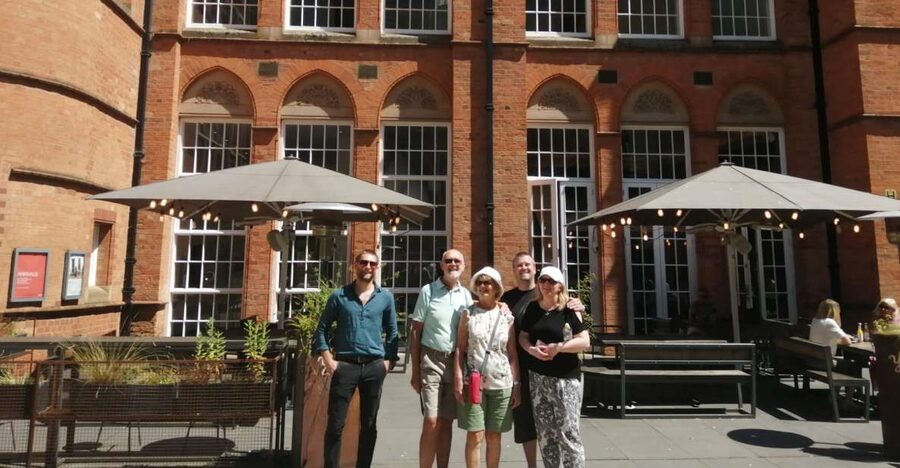
Broad Street is one of the city center’s best-known entertainment corridors. Seeing it in the context of the earlier civic squares helps explain how Birmingham’s public life has changed over time.
The route also includes Symphony Hall, a major concert venue and one of the city’s most recognizable cultural buildings. You may not go inside for a performance, but its place on the route shows that Birmingham’s cultural offer is not limited to museums and historic architecture.
This part of the tour is especially useful if you are planning an evening in the city. Your guide can help you understand where Broad Street fits into the center, while Symphony Hall gives you a strong cultural reference point.
The drawback is that Broad Street may feel less atmospheric if you prefer quiet historic lanes. It is an urban entertainment district, not a picturesque old quarter. Still, its inclusion makes the tour more honest about modern Birmingham.
Canals, modern art, and the route’s final turn
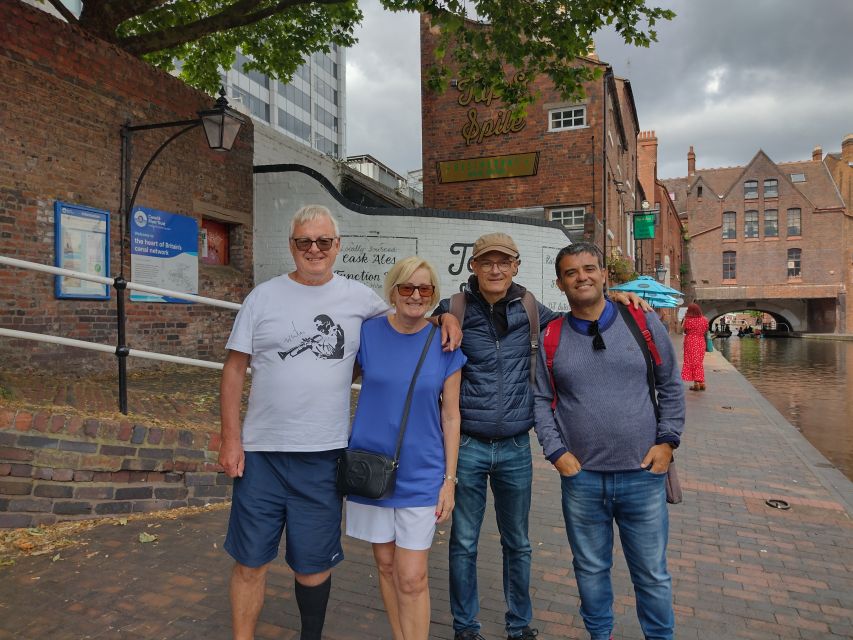
Birmingham’s canals are part of the city’s industrial story and are one of the tour’s most distinctive themes. They point to the practical infrastructure that helped goods and materials move during the industrial era.
The route finishes at the Ikon Gallery, placing you in the modern cultural quarter. That creates a neat arc from cathedral and civic buildings to canals, concert halls, and contemporary art.
You should not expect a full gallery visit during the tour. The Ikon Gallery is the endpoint, not a scheduled extended indoor stop. If contemporary art interests you, you can use the finish as a prompt to return later.
The ending is also practical. You finish in an area with several other city-center attractions nearby, rather than being returned to the original meeting point. Plan your next stop before you begin, especially if you need to meet a train or return to your hotel.
What the private format adds
A private group of up to six is the strongest reason to choose this experience over a large general tour. You are not sharing the guide with dozens of people, and you can ask questions without waiting for a whole group to move on.
The price is $168 per group. For six people, that works out to $28 each. For three people, it is $56 each, while a solo guest pays the full group price. The value is therefore much better for families or small groups than for one person traveling alone.
The format also allows a more personal pace. You can choose the start time, and hotel pickup is available from a city-center hotel. The provided details do not specify how far outside the center pickup extends, so confirm that point if your accommodation is beyond the central area.
A private guide can also adjust the emphasis. If your group cares more about industrial Birmingham, civic architecture, canals, music, or present-day city life, say so at the start. The tour promises local insight and lesser-known details, but you will get the most from it by asking direct questions.
Weather, walking, and access
The tour runs rain or shine. That is not a minor detail in Birmingham, where wet weather can change the comfort of an outdoor sightseeing route quickly.
One group had heavy rain, and the guide changed the program to suit the conditions while still covering interesting information about the city. That suggests some flexibility in practice, but you should not rely on perfect weather adjustments.
Wear comfortable shoes and bring clothing suited to the forecast. The route includes several squares, streets, and outdoor viewpoints, so footwear matters even though the experience lasts only 90 minutes.
The tour is wheelchair accessible. If you use a wheelchair, it is still sensible to discuss your needs when booking, particularly because the route connects multiple public spaces and the weather may affect comfort.
The guide makes the difference
This experience depends heavily on the person leading it. The tour is delivered in English by a local guide, and Arthur is one named guide associated with the experience. He received especially strong praise for his command of the subject and his ability to work well with a group.
That matters because Birmingham’s story can become a string of dates and buildings if it is not explained clearly. A good guide should connect the cathedral, industrial growth, canals, civic squares, and modern venues into one understandable story.
The available feedback is small, but it points to two useful qualities: strong local knowledge and the ability to adapt. During severe rain, the guide adjusted the program instead of simply pushing through the original plan.
I would still keep expectations realistic. A 90-minute tour cannot cover every corner of Birmingham or provide an in-depth study of each landmark. Its success depends on giving you a clear sense of place and helping you decide what deserves more of your time.
Who should book this experience?
I would recommend it most strongly to first-time visitors, families, couples, and small groups who want a private introduction before exploring on their own.
It suits you if you enjoy asking questions, want a flexible start time, or prefer not to follow a large group. It also works well for visitors with only a short window in Birmingham, since the route covers the main center in an hour and a half.
The tour is a good fit for architecture fans, people interested in the industrial revolution, and anyone curious about how a city changes from its commercial beginnings into a major cultural center. It is also useful for visitors who want to understand the relationship between Birmingham’s canals, civic buildings, music venues, and newer art spaces.
You may want a different experience if your priority is spending substantial time inside museums, attending a concert, or visiting the Cadbury site. The tour refers to Cadbury as part of Birmingham’s wider story, but this route does not include a visit to the chocolate attraction.
Booking value and practical planning
The reserve-now, pay-later option keeps your plans flexible, and cancellation is free up to 24 hours before the experience for a full refund. Those terms are useful if your Birmingham schedule is still changing.
Choose a morning start if you want to use the tour as an introduction to the center, then return to the museum, cathedral, gallery, or canals later. Choose a later start if you would rather see Broad Street and Symphony Hall as part of an afternoon city walk.
Since the tour ends at the Ikon Gallery rather than Cathedral Square, plan around the finish. You can continue sightseeing from there, but you should not assume the guide will return you to your hotel.
For the best value, fill the private group. At six people, the per-person price is reasonable for a dedicated guide and a tailored route. For one person, the cost is harder to justify unless personal attention and flexible scheduling are especially important to you.
Should you book the Birmingham city center tour?
Book it if you want a short, private introduction to Birmingham that connects the cathedral, civic squares, industrial past, canals, entertainment district, and modern art quarter.
The tour’s strengths are its compact route, private guide, flexible start time, and useful range of sights. Its limits are just as clear: 90 minutes goes quickly, most stops are sightseeing visits rather than full indoor tours, and the experience runs in all weather.
For a small group, I think the price is fair, especially if you use the tour to plan the rest of your stay. Come prepared with comfortable shoes, a rain layer, and a few questions. That is the best way to turn a brisk city overview into a genuinely useful first look at Birmingham.
FAQ
How long does the Birmingham city center tour last?
The tour lasts 1.5 hours.
Where does the tour begin?
Meet your guide by the flag pole in Cathedral Square.
Where does the tour finish?
The tour finishes at the Ikon Gallery.
Is the tour private?
Yes. It is a private group experience for up to six people.
How much does the tour cost?
The price is $168 per group of up to six people.
Can I choose the starting time?
Yes. You can choose the start time from the available options.
Is hotel pickup available?
Pickup is available from hotels in Birmingham city center.
What language is the tour conducted in?
The live tour guide speaks English.
What should I bring?
Bring comfortable shoes and clothing suitable for the weather. The tour operates rain or shine.
Just added around Birmingham
- MATRIX VR – Virtual Reality Gaming Experience Session – 1hr★ 4.9 · 7 reviews
- From Birmingham: Stonehenge & Bath Day Tour★ 4.6 · 158 reviews
- Digbeth, Public art and Peaky Film Guided Walking Tour★ 4.7 · 11 reviews
- Birmingham: Victorian Canals and Modern-Day Birmingham Tour★ 4.7 · 92 reviews
- Birmingham: Guided City Center Walking Tour (10:30am & 2pm)★ 4.8 · 147 reviews
- Birmingham: Legoland Discovery Centre Entry Ticket★ 4.1 · 74 reviews
- Birmingham : Must-see Attractions Private Walking Tour★ 5.0 · 3 reviews
- Birmingham: Cadbury World + SEA LIFE + LEGOLAND Discovery★ 5.0 · 5 reviews
City Tours, compared.
City Sights Hop-On Hop-Off Bus & Bookable Extras
Read our review →
City & Beatles Tour with Live Guide & Live Music
Read our review →
University and City Walking Tour with Alumni Guide
Read our review →
Etihad Stadium: The Manchester City Stadium Tour
Read our review →
City and University Tour, including college entry
Read our review →
City Walking Tour with Optional Roman Baths Entry
Read our review →
Go City Explorer Pass® – Tickets for 2-7 Attractions
Read our review →
Browse the lists this tour appears in