
Reviewed · HISTORICAL TOURS
Liverpool: Heritage, History & Culture Guided Walking Tour
Liverpool’s story changes quickly under your feet. In two hours, this tour moves from the old city centre and Liverpool Castle site to the docks, the Three Graces, and the streets where The Beatles made music history. It also addresses the city’s role in the slave trade, so you get more than a polished postcard view.
I like the way the tour joins maritime history with modern Liverpool, and I like the personal style of guides such as Mike, Pam, Allan, Carl, and Karl, who bring facts to life with anecdotes and humor. The main drawback is the pace: two hours can only sketch a city with this many layers, and busy streets, cobbles, and group walking may challenge some people.
Key points
- A clear city-centre route: Start at the Bluecoat and finish near the Cavern Quarter at the Eleanor Rigby Statue.
- Liverpool’s past is not sugar-coated: The tour covers trade, the docks, the Titanic connection, and the city’s role in the slave trade.
- The waterfront gets proper attention: Allow about 30 minutes for the Royal Albert Dock and its surrounding maritime story.
- Beatles landmarks are part of the wider picture: See the Beatles Statue, Mathew Street, and the Cavern Club area without reducing Liverpool to pop music alone.
- Local guides shape the experience: Mike, Pam, Allan, Carl, Karl, Colleen, and others are praised for clear explanations, humor, and an obvious affection for the city.
- Good value for a first look: At $31 per person for two hours, it works well as an orientation before you explore museums, docks, and music sites on your own.
Starting at the Bluecoat, Liverpool’s old centre
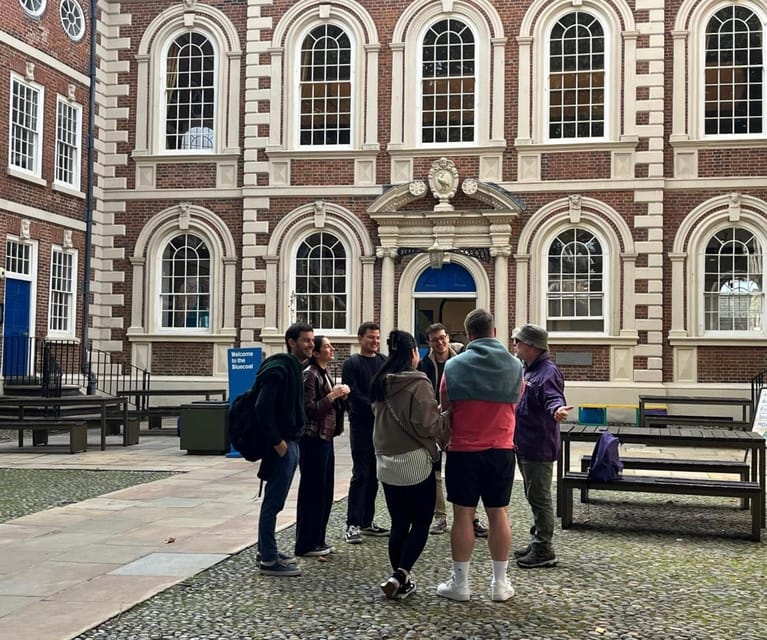
Meet outside the front gates of the Bluecoat Chambers at 8 School Lane, not at the Blue Coat School. The entrance has black metal railings, and Castle Fine Art is opposite. The three-word location supplied for navigation is Soccer Trial Cuts, which is useful if your phone map sends you toward the wrong part of the city centre.
The Bluecoat is a fitting departure point. From here, your guide can place modern Liverpool in the setting of its older commercial and civic centre. The route then moves toward Liverpool One, where the city’s rebuilt retail quarter shows how Liverpool has changed in recent years.
This opening stretch is not about collecting big photo stops. It is about getting your bearings. A guide can explain how the city developed, where its older buildings sit, and how newer construction fits beside them. That matters because Liverpool’s centre is not one preserved historic district. It is a working mix of old streets, grand civic buildings, shopping areas, public art, and newer architecture.
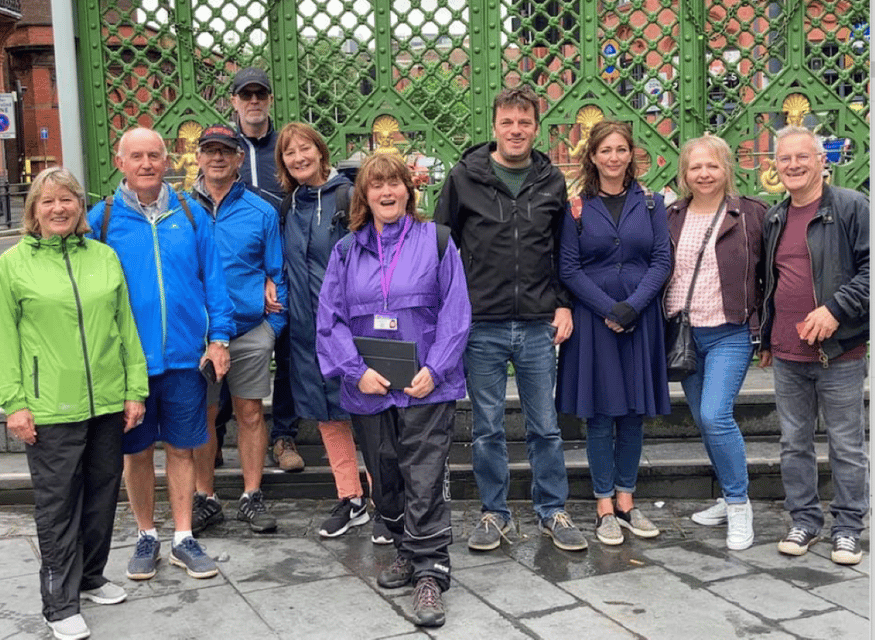
Guides have different personalities, but the strongest pattern is clear. Mike is described as witty, warm, and full of surprising facts. Pam brings facts, opinions, humor, and personal stories. Allan is praised for a steady pace and professional manner. Carl is warm and patient. You should expect a live, conversational tour rather than a recorded script.
More History Tours in Liverpool
- Liverpool: Haunted History Guided City Tour
★ 4.9 · 404 reviews - Liverpool: A Walk Through Time: Full History Walking Tour
★ 4.8 · 184 reviews - Liverpool: St James’ Cemetery Historical Ghost Tour
★ 4.9 · 169 reviews
From Derby Square to Liverpool One
As you leave the Bluecoat, the tour takes in parts of the central city, including Derby Square. This is where you hear about Liverpool Castle, which once occupied the area but no longer survives. The present-day focal point is the imposing monument to Queen Victoria.
That contrast is one of the useful ideas running through the walk. Liverpool is full of places where the visible city does not tell the whole story. A statue, courtyard, or broad street may sit on ground that once served a very different purpose. Your guide fills in those missing layers.
The route includes Liverpool One for roughly 10 minutes of guided sightseeing. You will not have time for serious shopping, and that is not the point. Instead, this section helps connect the older centre with the newer commercial district. If you are visiting Liverpool for the first time, this quick orientation can save you from treating Liverpool One, the waterfront, and the Cavern Quarter as separate places with no relation to one another.
I would pay attention here to the guide’s explanation of how Liverpool grew and changed. One recent participant found the tour especially useful for understanding the city’s development and changes in its physical ground. That is a good clue about the tour’s strength: it explains not only what you are looking at, but why the city took its present shape.
The first dry dock and the road to the Royal Albert Dock
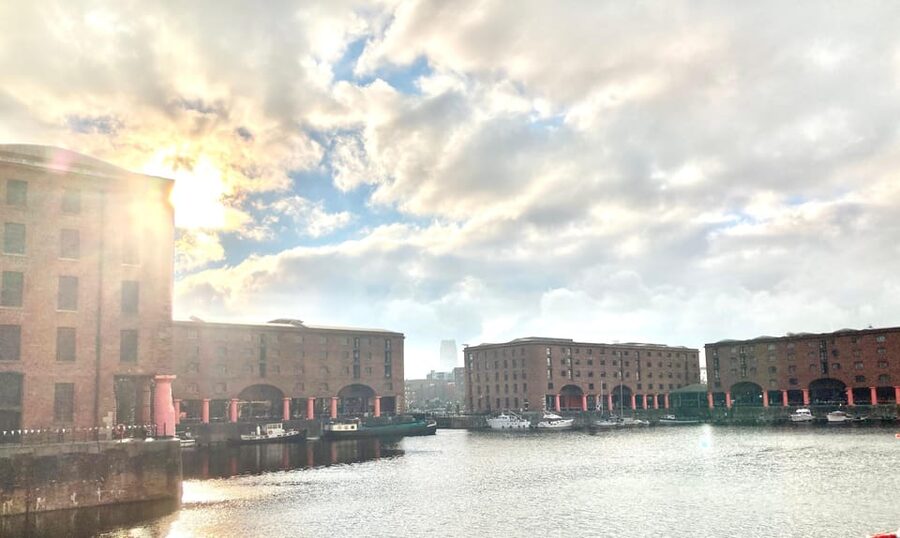
The walk then turns toward the waterfront. Near the site of Liverpool’s first dry dock, a large water fountain recalls the city’s connection with the sea. You will also see the oversized LIVERPOOL sign, whose colors change for seasons and events.
The sign is an easy photo stop, but the dry dock story gives the area more weight. Liverpool’s fortunes were tied to shipping, trade, and the movement of people and goods. The tour does not present that past as a simple success story. It includes Liverpool’s part in the slave trade, an essential subject if you want an honest introduction to the city.
This is one reason a guided walk can be more useful than a self-guided photo route. You can photograph a dock in seconds, but it takes explanation to understand what the dock meant for the city, who benefited from its growth, and what human cost sat behind some of that wealth. The treatment here is necessarily brief, but it gives you a starting point for further visits and reading.
The Royal Albert Dock receives about 30 minutes, the longest single stop on the route. That feels right. The dock is visually impressive, but its importance is not just architectural. Your guide explains how the docks helped Liverpool develop and how the Titanic story became part of the city’s maritime identity.
The Titanic never sailed from Liverpool, yet the city had a close connection with the ship through its registration and maritime world. The tour uses that connection to show how Liverpool’s identity reached far beyond the buildings directly in front of you.
The dock is also practical for photographs. Water, brick warehouses, open views, and large public spaces give you room to look around. Still, the route may include uneven surfaces and cobbles, so comfortable shoes are essential. Bring water, especially if the weather is warm, since no food or drink is included.
The Beatles Statue and Liverpool’s public face
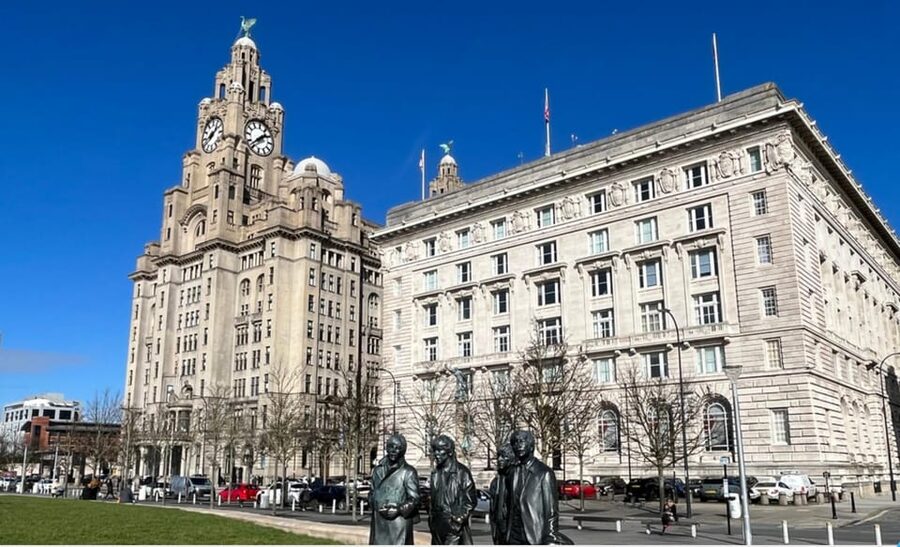
From the waterfront, the walk reaches the Beatles Statue for about 10 minutes. Sculpted by Andrew Edwards, the statue gives you the classic opportunity to pose with the Fab Four.
This stop works best when treated as part of a larger Liverpool story. The Beatles are the city’s most famous musical export, but the tour places their legacy beside shipping, architecture, civic life, and working streets. You get the expected photograph without spending the entire walk in a Beatles-only bubble.
If music is your main reason for booking, the statue is a useful first marker. Your guide can help you understand where the later Cavern Quarter fits into the city centre. If music is not your main interest, the stop is short enough that it should not take over the day.
One thing I appreciate here is the chance to ask questions. Several guides are praised for answering questions rather than rushing through a set speech. The two-hour format is still structured, but it appears to allow room for conversation, especially when the group is small.
More Walking Tours in Liverpool
- Liverpool: Beatles Highlights Walking Tour
★ 4.8 · 274 reviews - Liverpool: The Beatles and Cavern Quarter Walking Tour
★ 4.7 · 133 reviews - Liverpool: Guided City Walking Tour
★ 4.9 · 119 reviews - Liverpool: The Beatles and Waterfront Guided Walking Tour
★ 4.7 · 51 reviews
The Three Graces and Liverpool’s maritime power
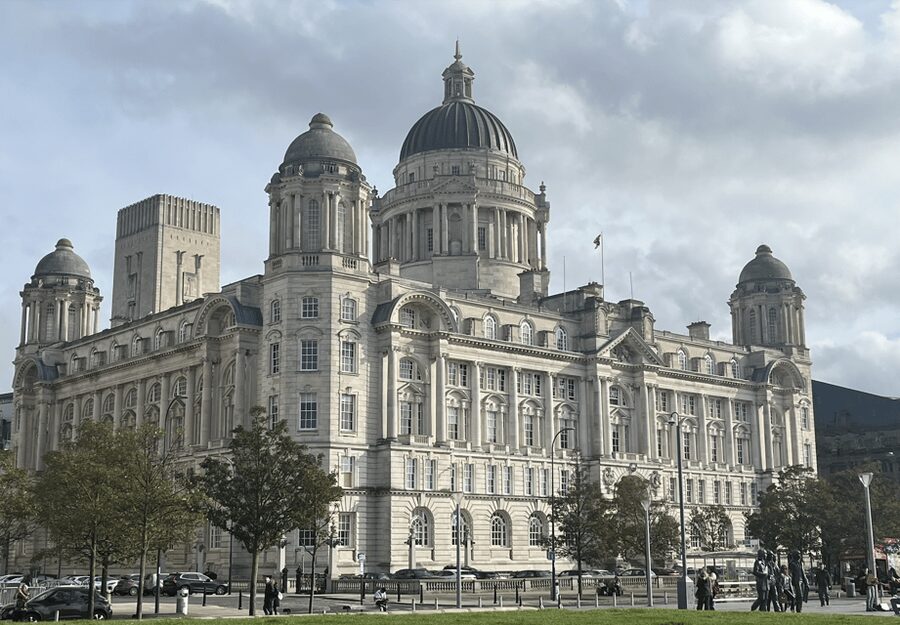
The Three Graces are the visual centerpiece of the waterfront. They are the Grade II listed Cunard Building, the Port of Liverpool Building, and the iconic Liver Building.
Your guide explains the role and background of each building, rather than treating them as three attractive façades. Together, they express Liverpool’s former importance as a port and a centre of international business. Their scale tells you something about the confidence of the city at the height of its commercial power.
This is a good place to slow down and look up. The buildings are large, detailed, and easy to photograph, but the guide’s explanation gives the view a purpose. You begin to see the waterfront as a civic statement, not just a row of old offices.
The stop lasts about 15 minutes, enough for a short explanation and photographs. It is not a building-inspection tour, so do not expect interior visits or detailed architectural analysis. You are getting a well-chosen introduction to the exteriors and their place in Liverpool’s story.
The route also passes Exchange Flags, a Grade II listed courtyard facing the Town Hall. This is a smaller but worthwhile architectural moment. It shows a different side of the city, with a formal civic setting tucked among the commercial streets.
Exchange Flags and the Town Hall’s long story
The walk continues toward the current Liverpool Town Hall, recognized as one of England’s finest surviving 18th-century town halls. The guide also discusses its predecessors, dating back to the 1500s.
This is the kind of detail that makes the tour useful beyond the obvious sights. You are not simply told that a building is old. You hear that civic life existed here in earlier forms, and that the present structure is part of a much longer sequence.
The itinerary gives about 10 minutes to this part of Liverpool. That is enough to understand the building’s significance, but not enough to tour the interior. If the Town Hall interests you, note it as a place to return to after the walking tour.
The route’s balance is helpful. It moves between public monuments, trade, architecture, music, and difficult subjects. That mix prevents the tour from becoming either a list of grand buildings or a Beatles-themed stroll.
Mathew Street, the Cavern Quarter, and Eleanor Rigby
The final major section takes you along Mathew Street, one of Liverpool’s best-known music streets. This is the Cavern Quarter, associated with the Cavern Club and The Beatles, along with many other musicians.
The area is lively and can be crowded. You will be walking in a group through busy streets, so keep close to the guide and leave room for pedestrians. The reward is atmosphere. Mathew Street feels like a place with an active identity, not a quiet museum display.
The tour allows roughly 20 minutes for the Cavern Quarter. Your guide connects the street to musical figures and the city’s wider cultural life. That is more useful than simply pointing toward the Cavern Club and moving on. You learn why this particular stretch became so strongly linked with Liverpool’s music story.
The walk finishes at the Eleanor Rigby Statue. This gives the ending a quieter musical reference than the Beatles Statue or Cavern Club. It also leaves you in a useful part of the city centre, where you can continue exploring independently.
The finish is not at the Bluecoat, so plan your day with that in mind. You are not being returned to the starting point, but the final location remains within the central sightseeing area.
What the guides do best
The strongest feature is the human delivery. Names vary by departure, but the guides praised most often include Mike, Mike D, Pam, Allan, Carl, Karl, Colleen, and Michael. The descriptions are consistent: clear voices, strong command of local facts, friendly conversation, humor, and obvious affection for Liverpool.
That does not mean every guide will tell the tour in exactly the same way. A local guide may spend more time on music, architecture, trade, or personal anecdotes depending on the group. That variation is usually a benefit on a city walk, though anyone wanting a fixed academic lecture may prefer a museum visit.
The guides also seem willing to adjust to the people in front of them. One small group received plenty of time for conversation and questions. Another guide extended the tour beyond the planned time. You should not count on extra time, but these details suggest a service that is not rigidly clock-focused.
The tour has a 4.9 rating from 52 reviews, with repeated praise for the guides’ enthusiasm and clarity. The most useful takeaway is not the number itself. It is the consistency of the comments across different guides and nationalities: the tour succeeds because the information is made personal, understandable, and entertaining.
Is $31 a fair price for two hours?
At $31 per person, this is a reasonable price if you want a structured first look at Liverpool. You are paying for two hours with a local English-speaking guide and a route that covers the city centre, waterfront, civic buildings, Beatles sites, and maritime subjects.
The value is strongest at the beginning of a Liverpool visit. You can use the walk to decide where you want to return for more time. The Royal Albert Dock may lead you toward museums and waterfront attractions. The Three Graces may encourage a closer look at the architecture. Mathew Street may be your starting point for further music-related sightseeing.
The value is weaker if you already know central Liverpool well or want long interior visits. This is an outdoor overview, not a museum tour. You will see many places, but most stops are short, and the two-hour limit means some stories remain brief.
The booking terms add flexibility. You can cancel up to 24 hours ahead for a full refund, and you can reserve now and pay later. Starting times vary, so check availability for your date.
Walking conditions and who should book
The route is described as an easy walking tour, but do not interpret that as completely effortless. You will walk in busy central areas and across surfaces that can include cobbles. Wear shoes with good support and bring water and a camera.
The information about accessibility needs careful reading. The locations are described as accessible for strollers and wheelchairs, but the tour also warns about group walking, crowds, uneven surfaces, and cobbles. The activity is marked wheelchair accessible, yet the same details say it is not suitable for wheelchair users or people with mobility impairments. If this affects you, contact the provider before booking and ask exactly how the route will work on your date.
Well-behaved dogs are welcome, with the same warning about crowds and group movement. Food and drink are not included. The Bluecoat building has a café and toilets when open, generally from 10am Tuesday through Saturday, but the tour departs outside its front gates.
This tour suits first-time visitors, short-break visitors, cruise passengers with time in the centre, and anyone who wants context before exploring alone. It is also a good choice if you like local stories more than a list of dates.
Should you book the Liverpool Heritage, History and Culture Walking Tour?
Book it if you want a strong two-hour introduction to Liverpool that connects the docks, civic buildings, difficult trade history, and Beatles landmarks. The guide quality appears to be the main reason to choose it, and names such as Mike, Pam, Allan, Carl, and Karl are associated with lively, personal explanations.
Skip it if you need a slow, fully accessible route, interior visits, or detailed time at each attraction. Also skip it if your sole aim is an extended Beatles tour.
For most first visits, I would book this early in your stay. Start at the Bluecoat, listen for places you want to revisit, and finish near Mathew Street with enough of the city in your head to explore the rest with purpose.
FAQ
How long is the Liverpool walking tour?
The tour lasts two hours.
How much does the tour cost?
The listed price is $31 per person.
Where does the tour start?
It starts outside the black metal railings and front gates of Bluecoat Chambers, 8 School Lane, Liverpool L1 3BX. This is not the Blue Coat School. Castle Fine Art is opposite the entrance.
Where does the tour finish?
The tour finishes at the Eleanor Rigby Statue.
What language is the tour in?
The live guided tour is in English.
Which Liverpool sights are included?
The route includes the Bluecoat, Liverpool One, Royal Albert Dock, the Beatles Statue, the Three Graces, Exchange Flags, the Cavern Quarter, Mathew Street, and the Eleanor Rigby Statue.
Does the tour include food or drinks?
No. Food and drinks are not included.
What should I bring?
Bring comfortable shoes, water, and a camera.
Can I cancel or pay later?
You can cancel up to 24 hours in advance for a full refund. Reserve now and pay later is also available, so you do not have to pay at the time of booking.
More History Walks around Liverpool
- Liverpool: Theatrical History Tour and The Dead House
★ 4.9 · 37 reviews - History Guided Tour of Liverpool and the Beatles
★ 4.9 · 14 reviews - Liverpool Heritage,History & Culture Walking Shore Excursion
★ 5.0 · 3 reviews - Inspirational Women: Liverpool Past/Present History Tour
★ 5.0 · 3 reviews
Just added around Liverpool
- Ultimate Beatles Ticket to Ride Half Day -Small Groups★ 4.9 · 37 reviews
- THE HANGOVER BRUNCH | Benidorm Bingo & Drag Queens★ 4.5 · 15 reviews
- Soulful Sunday Roast Dinner with Drag Queens★ 4.6 · 3 reviews
- Liverpool: Private City Highlights Walking Tour★ 5.0 · 4 reviews
- From Liverpool: North Wales Sightseeing Tour Shore Excursion★ 4.3 · 34 reviews
- Liverpool: 1980s Music Walking Tour with Guitarist “Nasher”★ 5.0 · 6 reviews
- Liverpool: The Beatles Tour on Electric Pedal-Assist Ebikes★ 5.0 · 17 reviews
- Liverpool: Total Beatles Car Tour Casbah & Cavern Clubs★ 5.0 · 3 reviews
Historical Tours, compared.

J&M’s City Sightseeing and History Walking Tour
Read our review →Browse the lists this tour appears in