

Reviewed · STREET ART
London: East End Instagrammable Street Art & Graffiti Tour
London’s East End is an open-air gallery where walls change faster than any guidebook can keep up. This two-hour walk takes you from Whitechapel Gallery through Spitalfields, Brick Lane, and Shoreditch, with stops for Banksy, Stik, Thierry Noir, Ben Eine, and plenty of lesser-known work.
I like the wide mix of art and local stories, from a Stik mural tied to the area’s Muslim community to the strange broccoli pieces scattered around Brick Lane. I also like the chance to make your own street art, rather than only photographing someone else’s work. The main drawback is simple: this is a walking tour in a part of London where paintings can disappear under fresh work, so the exact sights and finish point can change.
Key points at a glance
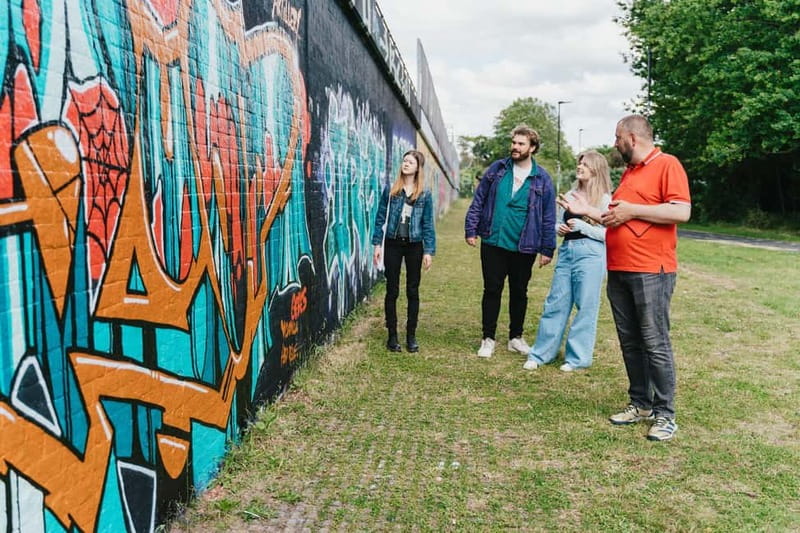
- See art by major names: Look for Banksy, Stik, Thierry Noir, Phlegm, Fanakapan, Ben Eine, Neon, and others.
- Walk through three East End districts: The route links Whitechapel, Spitalfields, Brick Lane, and Shoreditch.
- Get time for photographs: The guide stops at large walls, narrow yards, painted adverts, and changing graffiti spaces.
- Hear the stories behind the walls: Learn about the Muslim community in the area, the old Jewish quarter, Shakespeare’s Curtain Theatre, and London’s Graffiti Wars.
- Make your own mark: One stop offers the chance to leave a small creation of your own.
- Good guide-led pace: Guides such as Matt and Margaret explain the art clearly, answer questions, and adjust the walk to the group when possible.
Why East End street art works best on foot
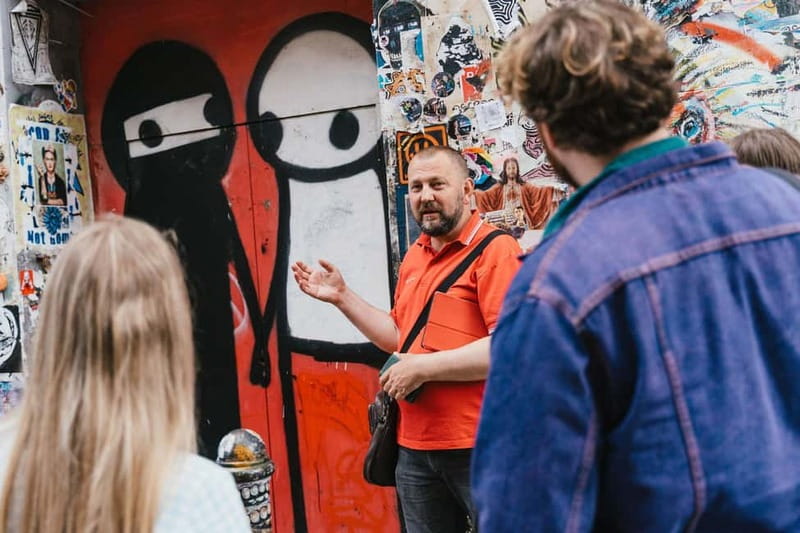
You can find photographs of Brick Lane murals online, but the real pleasure comes from seeing how the art fits into the streets around it. A narrow passage may hold a tiny stencil, a painted shutter, and a huge wall piece at the same time. Your guide helps you look up, around corners, and through side streets you might otherwise pass.
The East End also gives the art a useful setting. Whitechapel and Spitalfields carry stories of immigration, faith, trade, poverty, nightlife, and redevelopment. The murals are not presented as isolated decorations. They become part of a changing neighborhood, where one artist paints over another and a work may be gone within days.
This is a walking experience rather than a museum tour. You will spend most of the two hours outdoors, stopping often while the guide explains a piece or gives you time to take photographs. The route is compact, but the changing surface of the streets means comfortable shoes matter.
A few more London days worth weighing up
- From London: Harry Potter Warner Bros Studio Tour
★ 4.7 · 26,588 reviews - London: Westminster to Greenwich River Thames Cruise
★ 4.5 · 22,836 reviews - Magical London: Harry Potter Guided Walking Tour
★ 4.7 · 22,044 reviews
Starting at Whitechapel Gallery
The meeting point is directly outside Whitechapel Gallery at 80 Whitechapel High Street. This is a useful starting place because you begin near the edge of the East End and move naturally toward Spitalfields and Shoreditch.
The opening section includes Whitechapel itself, an area made famous by the Whitechapel Murders associated with Jack the Ripper. That subject is part of the local context, but the main focus quickly turns to street art, neighborhood culture, and the area’s older communities.
From here, you move into Spitalfields. The walk includes the old Jewish quarter and Paul Bommer’s Huguenot plaque, a small stop that adds scale to the tour. Not every important piece of East End art takes up an entire building. Small plaques and compact works help show how many layers of local identity sit behind the larger murals.
Henage Street and the art of looking up
Henage Street brings two large works painted across entire building walls. One is by Phlegm, whose thin, strange creatures are easy to recognize once your guide points out his style. The other is by Fanakapan, known for silver balloon images.
These are strong early photo stops because size does part of the work for you. You do not need to know much about street art to appreciate how the paintings alter a plain wall. Still, the guide adds the useful details: who made the work, what visual habits identify the artist, and why a particular wall became a suitable canvas.
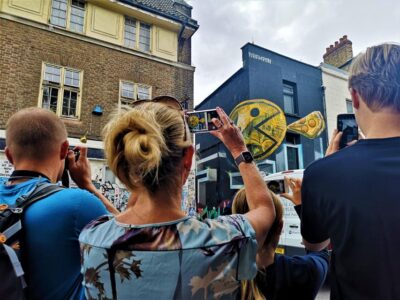
The route also teaches you how to photograph street art. On Brick Lane, a wall may need to be viewed from more than one angle. A straight-on photo can flatten the image, while a step to the side may reveal its scale or relation to the surrounding buildings.
Brick Lane, where the walls keep changing
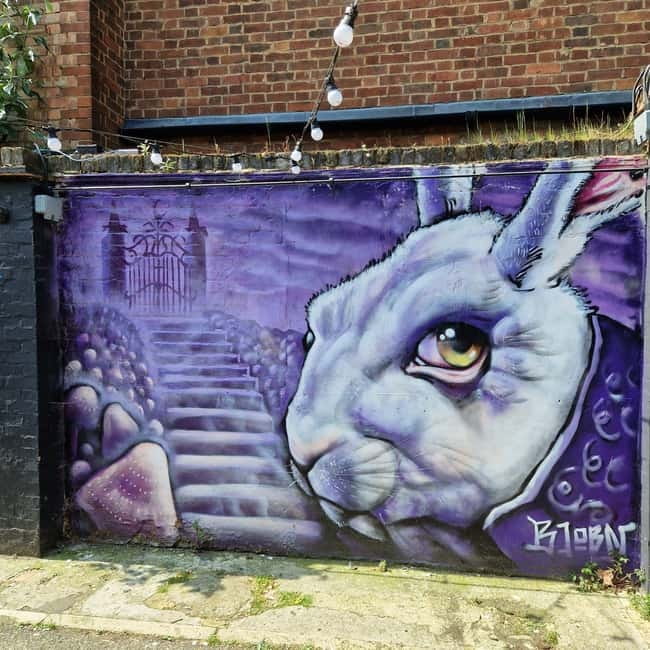
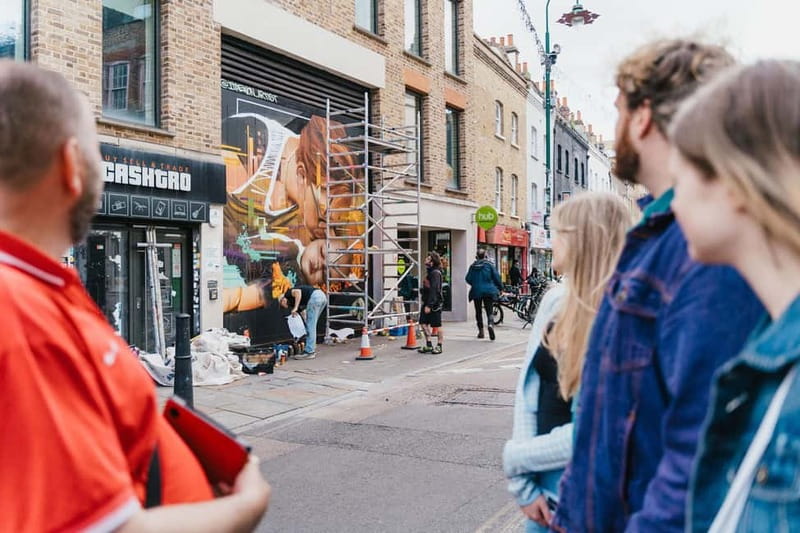
Brick Lane is the tour’s main artery. It is busy, colorful, and full of competing visual claims. Here you find large murals, small tags, painted adverts, stencils, collaborations, and pieces that may be replaced soon after your visit.
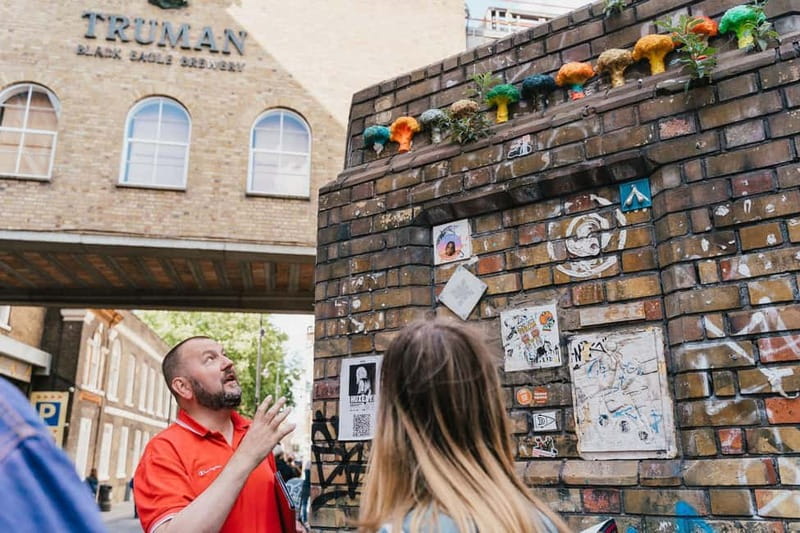
Dray Walk is known for its scattered broccoli images. Some look fairly realistic, while others appear in bright, unexpected colors. The artist who began that trend now has a gallery, a useful reminder that street art can move between walls, commercial spaces, and the formal art world.
In Allen Gardens, the walls are covered with work that changes often. This is one of the best places to take photographs promptly. A painting that catches your eye may be covered by something new before you return to London.
That constant change is both a strength and a limitation. You get a living art scene rather than a fixed display, but you cannot treat the route like a guaranteed checklist. If you have come for one particular mural, ask your guide at the start what is currently visible.
More street art walks in London:
- London: Street Art and Graffiti Guided Walking Tour
★ 4.9 · 1,354 reviews - London: Landmarks & Secrets Bike Tour with Pub & Street Art
★ 4.9 · 314 reviews - London: East End Street Art Tour and Spray Painting Workshop
★ 4.8 · 297 reviews - London: Half-Day Street Art Tour and Workshop
★ 4.9 · 172 reviews
Princelet Street and a mural with a message
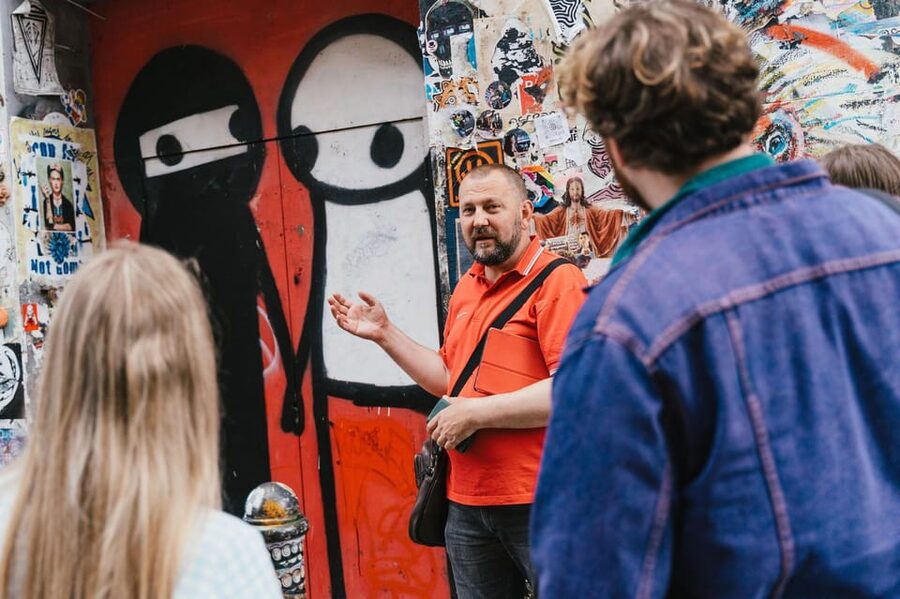
Princelet Street brings a more direct social and cultural story. A work by Stik is dedicated to the Muslim community and reflects its long connection with the area.
The mural has been defaced and repainted several times. That detail gives the stop more weight than a simple photo opportunity. The repeated repainting shows how public art can become a point of conflict, pride, and persistence. Your guide can explain the image in its neighborhood setting, which is much more useful than seeing it as a random wall on a social media feed.
This section also helps balance the tour. You are not only looking for famous signatures or the most photogenic colors. You are also considering who is represented, who claims a public space, and why certain works remain important after damage.
Narrow yards, large letters, and local styles
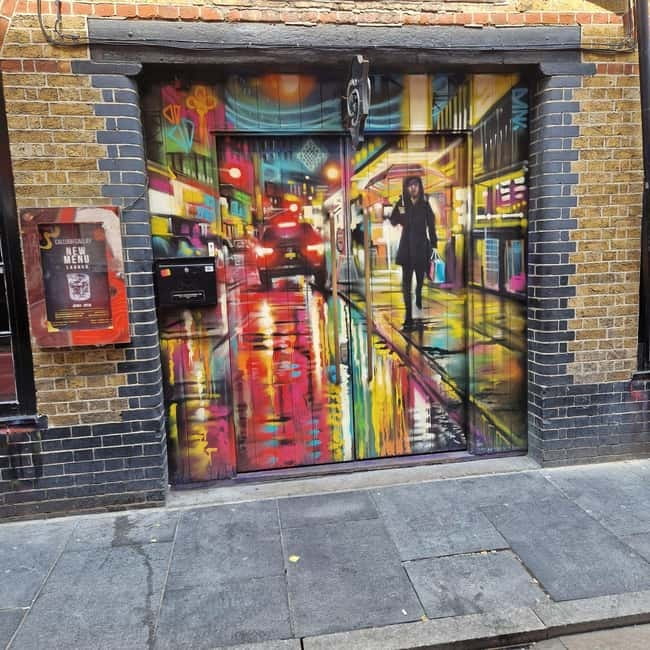
At 7 Stars Yard, the setting becomes tighter and more enclosed. The yard can feel intimidating at first, but the point is to look closely. Small spaces often reward attention because several pieces compete for your eye at once.
You may also get the chance to become the eighth star by making your own street art. This is a lighthearted part of the experience, but it gives you a better sense of the act itself. Street art is not only something to consume through a phone camera. It is a physical process involving a wall, a surface, an idea, and a limited amount of time.
Ebor Street offers another useful comparison. You will see large-format adverts painted by graffiti artists alongside smaller pieces by Neon. Ben Eine’s bold lettering adds a different visual language, built around letters rather than creatures, portraits, or political symbols.
If you enjoy comparing styles, this may be one of the most rewarding stretches. You can move from detailed imagery to oversized text within a few minutes. The guide’s explanations help you notice those differences instead of filing everything under the single label of graffiti.
Rivington Street and the Banksy stop
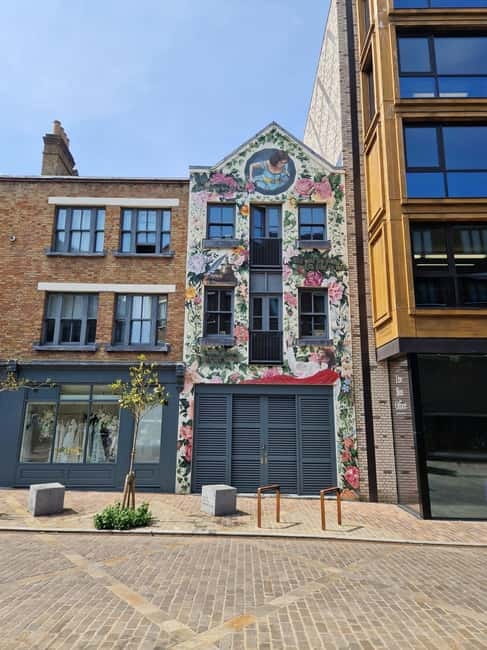
No East End street art walk would feel complete without a Banksy sighting, and Rivington Street includes a secret place where the guide can show you his work.
The value here is not just the name. Banksy’s work has become so familiar that it is easy to forget how much of its appeal depends on location, surprise, and scale. A guide can provide the missing context and point out how the piece relates to the street around it.
Rivington Street also includes work by Thierry Noir, the French artist best known for painting on the Berlin Wall in the 1980s. Seeing his London work gives you a chance to compare a major European street art figure with artists who are more closely tied to Shoreditch.
The guide may not be able to promise the same Banksy or Noir work forever. Street art is exposed to weather, construction, vandalism, and new painting. That uncertainty is part of the subject, not a flaw in the tour, but it is worth keeping in mind when you book.
The art’otel and a changing public collection
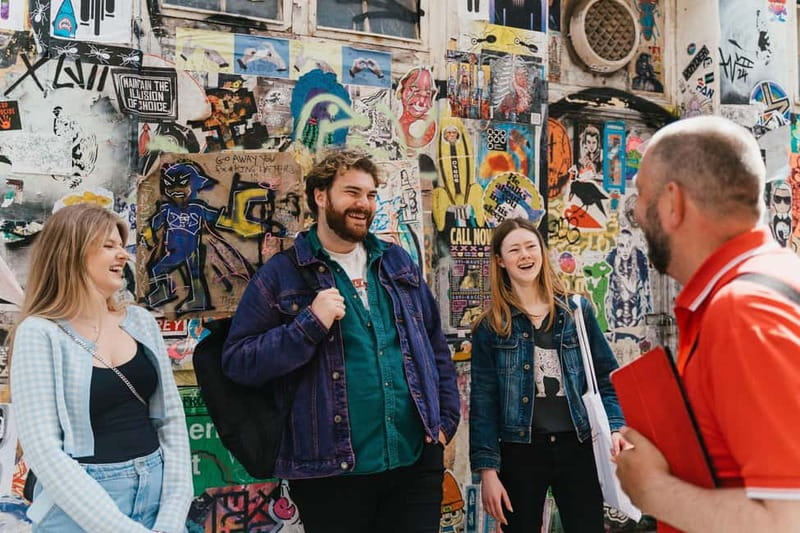
An older Banksy piece is now part of the art’otel London Hoxton. You do not need to book a room to see it, which makes this a practical stop for anyone interested in how street art enters more polished commercial settings.
The contrast is useful. A work that began on an ordinary urban wall now sits beside a modern hotel. The art has not lost its history, but its setting has changed. Your guide can help you think about questions of ownership, preservation, and what happens when street art becomes an attraction in its own right.
The route does not treat every wall as equal. Some pieces are famous because of the artist. Others matter because they fit the street, use an unusual technique, or show how quickly the neighborhood’s visual scene moves.
Shakespeare, painted walls, and the final stories
Near New Inn Broadway, the tour reaches the site of Shakespeare’s Curtain Theatre. A nearby Romeo and Juliet artwork gives the stop a clear link to London’s theatrical past.
The surrounding graffiti creates a kind of painted wallpaper, with different color palettes and styles packed together. You might also notice a small policeman among the imagery. This is a good example of why a guide helps. At first glance, you may see only a busy wall. With a little direction, you begin to pick out individual artists and small details.
The final section reaches Shoreditch High Street and brings in the story of London’s Graffiti Wars. The name sounds dramatic, and the disputes did produce some striking art. This closing story gives the tour a useful ending because it connects individual works to larger arguments about public space, ownership, cleaning, painting, and commercial development.
The walk is scheduled to finish at Liverpool Street Station, listed at Stop G on Liverpool Street. The exact finish can shift because the art changes, so treat the station as the expected endpoint rather than an absolute guarantee. The meeting information also describes the activity as ending back at the meeting point, so confirm the current finish details when you book.
How the guides shape the experience
The guide matters a great deal on this tour. Matt has led groups with a clear, enthusiastic style, and he is comfortable explaining the subject in understandable English. That is helpful if English is not your first language.
Margaret has also led the walk with a strong focus on the culture of London street art. The best guide approach here is not a long lecture. It is a short explanation at the right wall, followed by time for questions and photographs.
You should feel free to ask about an artist, a symbol, a technique, or why one work survived while another disappeared. The strongest part of the guide-led format is the ability to adjust the pace. The tour has received especially positive feedback for answering questions, allowing time for photographs, and moving at a comfortable speed.
A small-group or private departure may be possible, but group size is not specified, so do not book on the assumption that you will have a private guide. The experience is offered in English only.
Is $49 a fair price for two hours?
At $49 per person, this is not the cheapest way to see Brick Lane. You can walk through the area on your own for free. The price pays for interpretation, route planning, access to less obvious corners, and the chance to understand what you are looking at.
I think the value is strongest if you are new to street art, short on London time, or want more than a collection of quick photographs. It is also useful if you are visiting with teenagers or adults who enjoy visual culture but might not want a traditional museum tour.
The value is weaker if you already know Shoreditch well or prefer to wander without a schedule. You may also find the two-hour format brisk if you want to stop at every wall. Since the art changes, the price should be judged by the quality of the guiding rather than by any promise of a permanent list of murals.
The tour includes street art, East End context, photo opportunities, and the chance to create your own work. It does not include food, transport, or entry to a gallery. Plan to eat before or after the walk rather than expecting a tasting tour along Brick Lane.
Practical details before you go
Tours run rain or shine, so bring clothing suited to London weather. The entire activity takes place outdoors, and wet walls, crowded pavements, or poor light can affect how much you enjoy the photography.
The tour is listed as wheelchair accessible. Because the route uses public streets, yards, and changing art locations, ask for current route details if you have specific mobility needs.
You can cancel up to 24 hours before the activity for a full refund. A reserve-now, pay-later option is also available, which helps if your London schedule is still shifting.
The overall rating is 4.9 from 22 reviews. The most consistent strengths are the guides’ enthusiasm, clear explanations, time for photographs, and willingness to answer questions. That is exactly what you want from a street art walk, since the quality of the interpretation matters more than simply reaching Brick Lane.
Who should book this East End walk?
I would choose this tour if you want a quick, guided introduction to Shoreditch and Brick Lane, especially if you are curious about artists but do not know their names yet. It suits photographers, first-time London visitors, families with older children, and anyone who likes local stories mixed with visual culture.
It is also a good pick for people who find museums too formal. You will learn about the East End while standing in the places where its art is made, altered, protected, and sometimes painted over.
I would skip it if you want a guaranteed Banksy photograph, a fixed route, or a slow art seminar. The city keeps changing, and the walk works best when you accept that uncertainty.
Book it if you want to see more than the obvious Brick Lane wall and would value a guide who can connect a silver balloon, a broccoli, a bold letter, and a Shakespeare mural to the neighborhood around them. For $49, that extra context is the real purchase.
FAQ
Where does the street art tour start?
The guide meets you directly outside Whitechapel Gallery at 80 Whitechapel High Street in London.
Where does the tour finish?
The route is scheduled to finish at Liverpool Street Station, Stop G, London EC2M 4RB. The exact finish point can change because the street art in the area changes.
How long does the experience last?
The tour lasts two hours. Check availability for the available starting times.
What language is the tour offered in?
The live guided tour is offered in English.
Is the tour wheelchair accessible?
Yes, the activity is listed as wheelchair accessible.
Does the tour run in bad weather?
Yes. Tours run rain or shine, so dress for the weather and expect to spend the experience outdoors.
Can I cancel for a refund?
You can cancel up to 24 hours in advance for a full refund.
Do I have to pay when I book?
A reserve-now, pay-later option is available, allowing you to book your place without paying immediately.
Will I see Banksy artwork?
The route includes a secret place on Rivington Street where the guide can show you Banksy’s work, plus an older Banksy piece at the art’otel London Hoxton. Street art can change, so the exact works visible may vary.
Just added around London
- London: Wimbledon Tennis Club and Westminster Walking Tour★ 4.5 · 86 reviews
- London: Westminster to Richmond River Thames Cruise★ 4.8 · 23 reviews
- Westminster Abbey Skip-the-Line Entry and Private Tour★ 4.6 · 4 reviews
- Best of London by LE GRAND – London’s Luxury Bus Tour★ 4.2 · 23 reviews
- London: Westminster Walking Tour & St Paul’s Cathedral Entry★ 4.7 · 7 reviews
- From London: Oxford, Stratford-upon-Avon & Cotswolds Trip★ 4.5 · 64 reviews
- From London: Warwick, Oxford, Stratford & Cotswolds Day Tour★ 4.0 · 270 reviews
- Warner Bros. Studios and 1-Day London Hop-on Hop-off tour★ 4.7 · 9 reviews
Street Art, compared.
Landmarks & Secrets Bike Tour with Pub & Street Art
Read our review →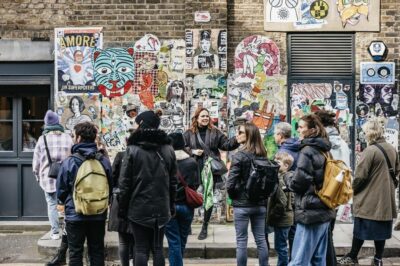
East End Street Art Tour and Spray Painting Workshop
Read our review →

Urban Canvas: Exploring Shoreditch’s Vibrant Street Art
Read our review →
Shoreditch: Street Art & Hidden Gems with a Local Host
Read our review →Browse the lists this tour appears in