
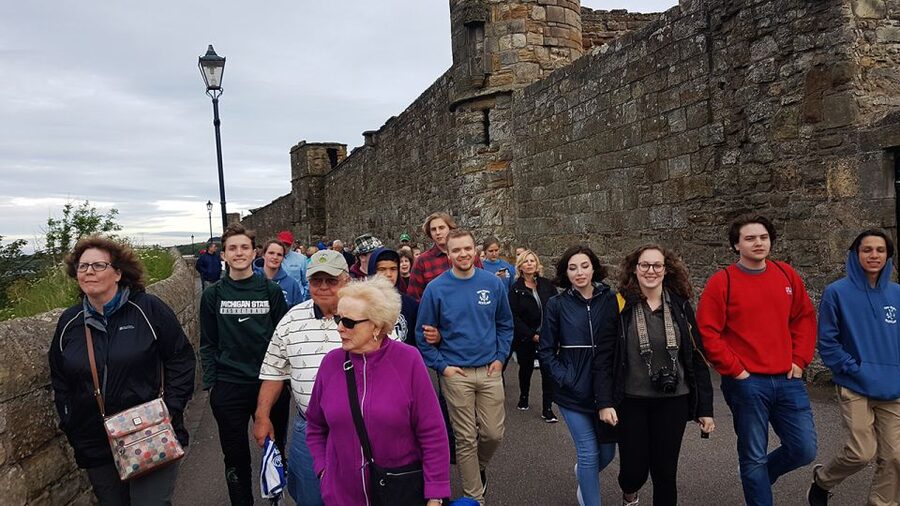
Reviewed · HISTORICAL TOURS
St Andrews: Town, Golf, and Old Course History Tour
St Andrews makes more sense when you connect its medieval ruins, university streets, and famous fairways in one walk. This 105-minute tour does exactly that, finishing at the Swilcan Bridge, where you can take the classic Old Course photograph, except on tournament days.
I like the way the tour serves both golfers and non-golfers, and I like the strong local storytelling from guides such as Richard and Jim. You’ll hear about Old and Young Tom Morris, William and Kate, the Open Championship, and even the marketing behind Nike’s golf image. The main drawback is pace: you walk from one end of town to the other, and one recent group found the guide hard to hear and keep up with.
Key points to know
- Golf history with a wider town story: The walk links the Old Course to the university, cathedral, castle, and local life.
- A real Old Course finish: You walk by the 18th green, 1st tee, and first fairway before photos on Swilcan Bridge.
- A good mixed-interest tour: Non-golfers still get university stories, royal connections, architecture, and medieval history.
- Strong guide-led experience: Richard is often the named guide, with Jim also leading tours. Both bring personal insight and humor.
- Expect nearly two hours on foot: Comfortable shoes are essential, and the tour is not suitable for wheelchairs or people with walking difficulties.
- Good value at $27: For a small cost, you cover several major St Andrews sights without paying separate admission for a standard walking tour.
Starting at T-Squared Social on North Street

Meet your guide outside the main entrance of T-Squared Social at 117 North Street. Arrive early. The tour starts on time and does not wait, and being even a minute late can mean missing the whole walk.
The opening conversation sets the modern scene. You’ll hear about Tiger Woods and Justin Timberlake’s new bar and restaurant, along with a little about the Dunhill Championship. This is a useful start because St Andrews is not simply an old town preserved under glass. Golf still shapes its businesses, visitors, and daily identity.
Your guide then begins tying current St Andrews to its older story. Richard, in particular, is known for a clear speaking voice, humor, and personal knowledge of the town. Several tours have also been led by Jim, who brings extensive knowledge of golf and local history.
The guide-led format matters here. St Andrews has plenty of plaques and attractive buildings, but the meaning behind them is not always obvious. A local guide can point out details you would likely pass without noticing.
A few more Britain days worth weighing up
- St Andrews: Golf Origins and Old Course History Tour
★ 4.7 · 322 reviews - St Andrews: Top Sights Guided Walking Tour
★ 4.7 · 223 reviews - Private St Andrews: Home of Golf Old Course Tour
★ 4.9 · 113 reviews
St Salvator’s College and the university story
The route heads toward St Salvator’s College, one of the most important parts of St Andrews University. You’ll see the quadrangle and visit St Salvator’s Chapel, while hearing how the university shapes the town around it.
This is one of the tour’s best sections for non-golfers. St Andrews is often sold as the Home of Golf, but it is also a university town with centuries of academic life. The university buildings give the walk a different mood from the fairways and add context to the modern town.
You’ll hear about William and Kate, who met while studying in St Andrews, and about the filming of The Crown. The tour also points out the residence where Prince William and Kate spent their first year as students. These details are popular because they connect familiar modern names to ordinary streets and buildings.
The guide may also let you peek inside one of the town’s less obvious places. The exact stop can depend on access and timing, so treat it as a pleasant extra rather than the main reason to book.
Traffic and street noise can make this portion harder to follow. If the group is large, stay close to the guide and ask him to repeat anything you miss. One recent group of 13 found that fast walking and street noise made some commentary difficult to catch.
Cathedral ruins and the graves of golf pioneers
From the university, the walk continues to St Andrews Cathedral. The ruined cathedral grounds are a major stop, not just a backdrop for photographs.
The cathedral was once a powerful religious center, and its remains help explain St Andrews before golf became the town’s international calling card. Nearby, you’ll also see the ruins of the Bishop’s Palace, a reminder of the wealth and authority once held by Scotland’s Catholic bishops.
The cemetery adds a direct link to golf. The grounds include the graves of 124 noted golfers, including Old Tom Morris, Young Tom Morris, Allan Robertson, and Jamie Anderson. These names matter because they belong to the formative years of the sport, when St Andrews was helping shape the rules, techniques, and traditions later carried around the world.
I like this part because it makes golf feel human. Instead of hearing only about championship winners and polished clubhouses, you encounter the people who built the sport over time. The graveyard is also one place where the 105-minute schedule can feel tight. If you want long, quiet time at each grave, you may wish for more time than the tour allows.
The cathedral and palace are primarily outdoor stops. Wear weatherproof clothing and expect uneven ground in historic areas. The tour does not include a luggage drop, so do not arrive carrying large bags, golf clubs, baby carriages, or other awkward equipment.
Along the Scores past old university buildings
After the cathedral, you walk along the Scores. This route brings together fine Victorian buildings, university views, and the coastal side of town.
You’ll pass the Principal’s House and the student residence associated with William and Kate. The buildings are attractive, but the guide’s commentary is what gives this section purpose. The route shows how university life, local history, royal interest, and tourism overlap in a compact town.
The walk also gives you a break from concentrated golf talk. If one person in your group knows every Open Championship winner and another has never held a club, this middle section keeps the experience balanced.
Still, this is not a gentle, stationary sightseeing tour. You continue walking between stops, and the overall route crosses much of central St Andrews. One guide was praised for slowing down for the group, but another recent experience felt too quick. Tell your guide early if you need a slower pace, and position yourself where you can hear clearly.
More history walks around Britain:
- London: Historic Pubs of Central London Walking Tour
★ 4.9 · 1,065 reviews - Portsmouth: Historic Dockyard Ultimate Explorer Ticket
★ 4.8 · 1,052 reviews - York: Witches and History Old Town Walking Tour
★ 4.7 · 928 reviews - London: Soho Music and Historic Pubs Walking Tour
★ 4.9 · 836 reviews
Passing St Andrews Castle
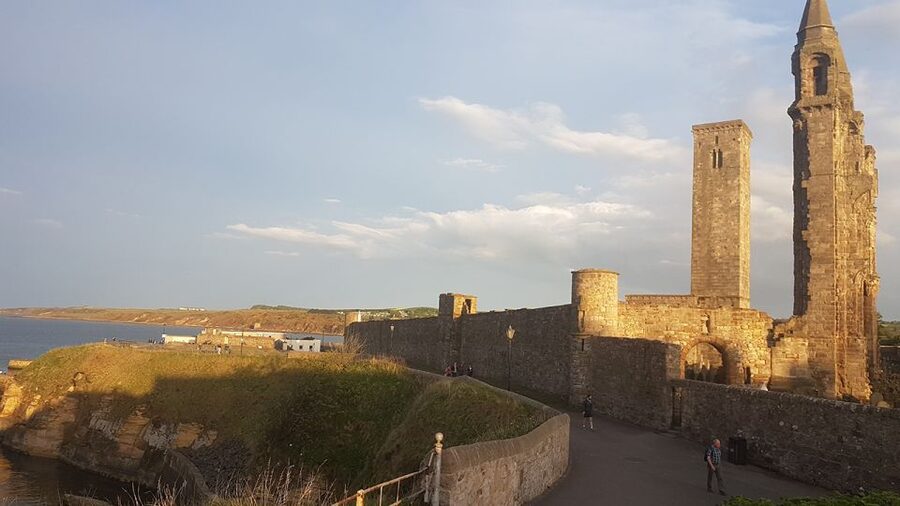
St Andrews Castle appears as a photo stop and scenic pass-by rather than a full castle visit. You’ll see the ruins along the route and hear about their place in the town’s past.
That distinction matters. This experience does not promise time inside every attraction, and it does not replace a dedicated visit to the castle or cathedral. Instead, it gives you an informed overview while moving through the town.
For many people, that is the right trade. You can learn how the major landmarks fit together in under two hours, then return later to whichever site deserves more time. If you want to inspect ruins slowly, read every display, or spend a long stretch taking photographs, plan a separate visit.
Walking into the Home of Golf
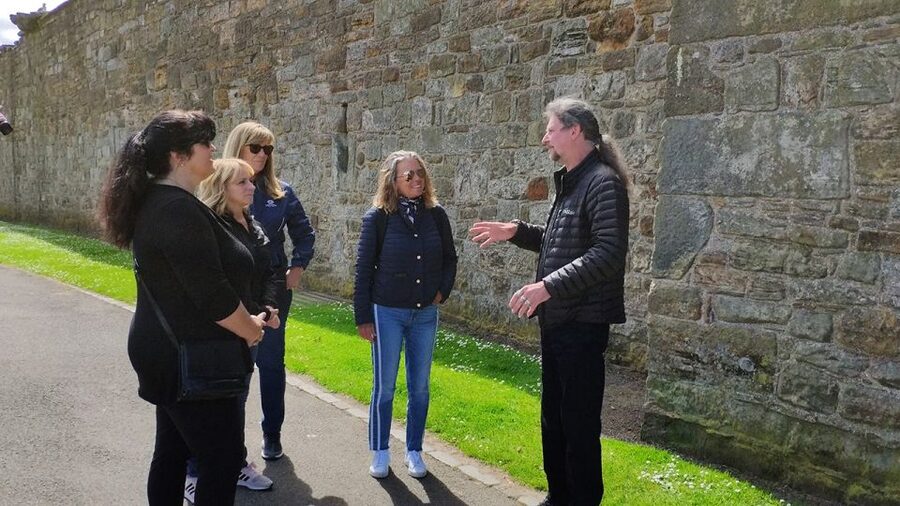
The Old Course is the tour’s main event for golf fans. You’ll walk toward the course and hear how the Open Championship developed, how golf grew in St Andrews, and why the town became known as the Home of Golf.
The guide explains features that can look strange to first-time visitors. You’ll hear how the Links came to have 18 holes, along with details about the buildings overlooking the course and memorable moments from golf history. The commentary gives meaning to the layout rather than simply showing you a famous patch of grass.
The route includes the 18th green, the 1st tee, and the first fairway. You may walk by and across the 1st and 18th fairway, but this is a live golf course. You must watch for golf balls and accept that crossing happens at your own risk. Keep children close and follow the guide’s instructions.
This is also the part where conditions can affect the experience. Tournament days exclude the Swilcan Bridge photo opportunity, and activity on the course can change how long you can pause. One recent group happened to have sunshine, which made the final photographs especially successful. Scottish weather may not be so cooperative, so bring a waterproof layer even when the morning looks bright.
The Swilcan Bridge photo finish
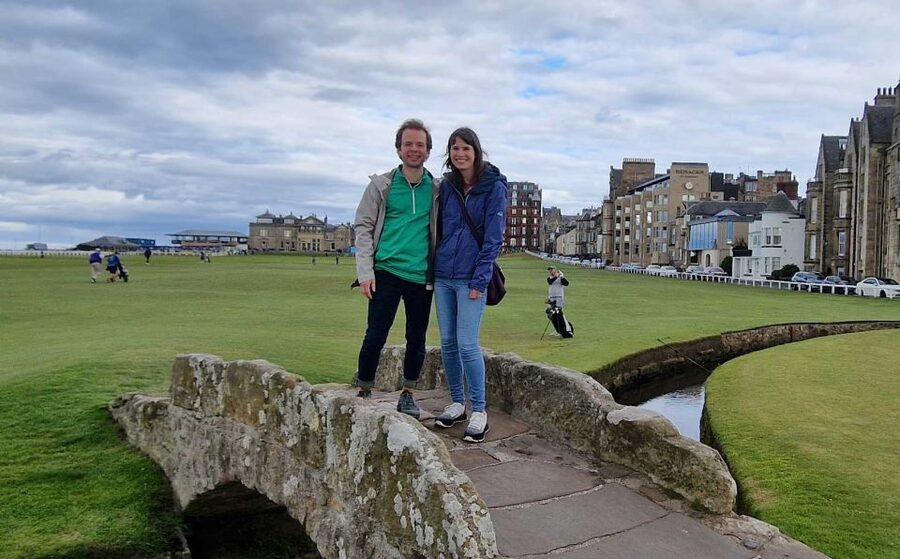
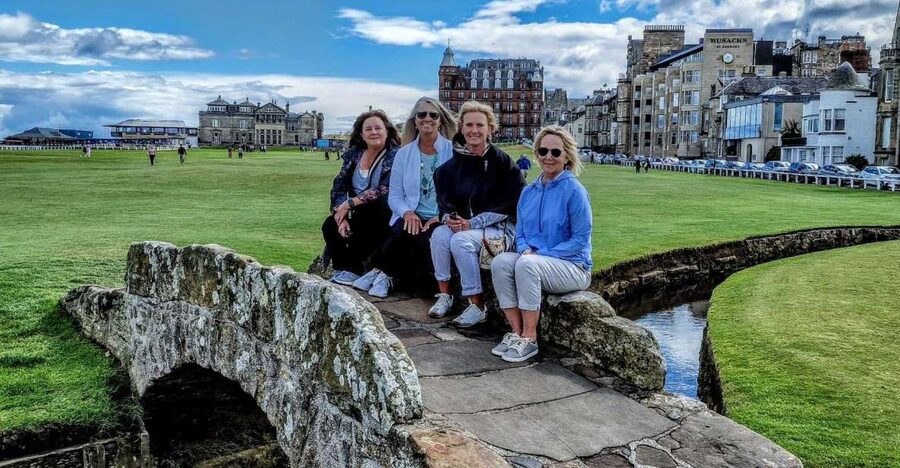
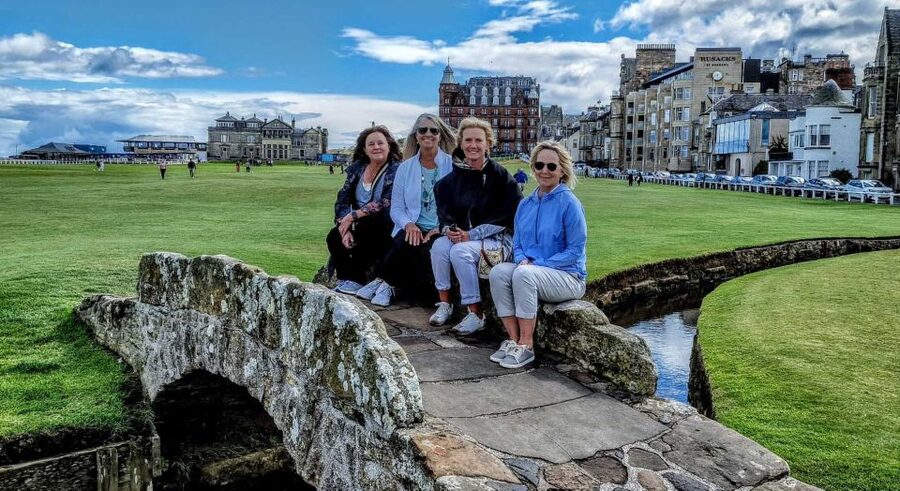
The tour ends at Swilcan Bridge, the small stone bridge on the Old Course that has become one of St Andrews’ most recognizable photo spots.
Your guide takes the photographs, which is a useful touch for couples and families who otherwise have to rely on a stranger or a timer. One family particularly valued having several good vacation photos, and the bridge gives golf fans the picture they came for.
The photo stop is not available on tournament days. It is also not necessarily a long session, especially if the group is large or the course is busy. If taking pictures is your top priority, tell the guide early and keep your camera or phone ready.
Afterward, you can continue to the Jigger Inn or Old Course Hotel to relax and enjoy views connected with the course. That stop is not included as part of the tour, and food or drinks are your own expense, but it makes a natural ending.
What the $27 price delivers
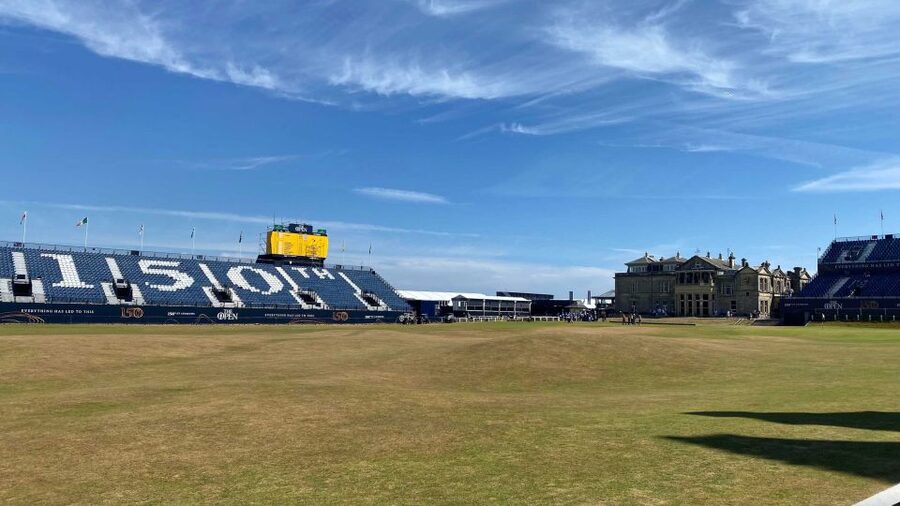
At $27 per person, this is good value if you want an introduction to St Andrews rather than a single-site admission. In 105 minutes, you cover the university, chapel, cathedral ruins, Bishop’s Palace, castle views, the Scores, and key sections of the Old Course.
You also get a professional historian guide and a narrative that ties the stops together. That is the main value. You are paying for local explanation, not entry to a museum or a reserved place inside the Old Course.
Golf fans receive a useful overview of the course and its traditions. Non-golfers get a town walk with enough university, royal, architectural, and medieval material to keep the focus from becoming one long discussion of clubs and championships.
The trade-off is depth. You will not have time to linger at every grave, examine every ruin, or spend a long period around the beach. One participant wanted more time in the cemetery and on the course. Think of this as a well-packed introduction, then use the rest of your day for the places that caught your interest.
Who should book this walk?
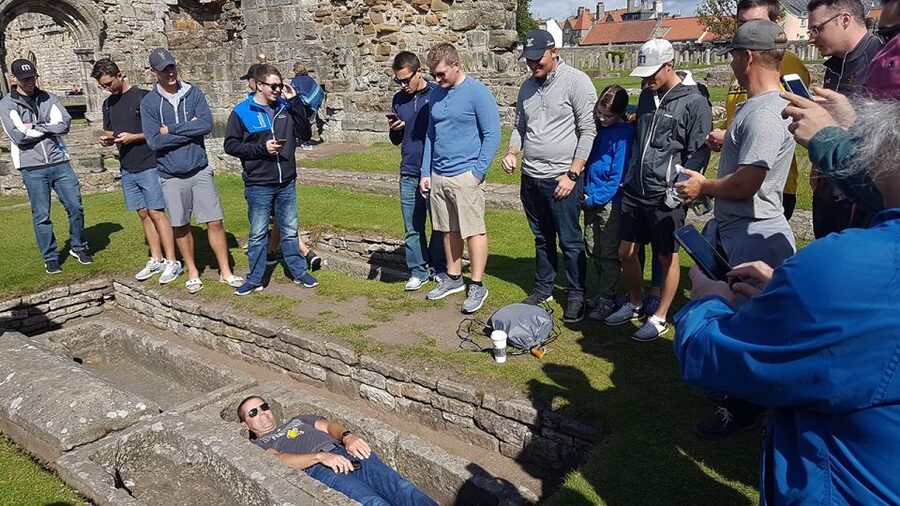
I’d recommend it to first-time visitors who want to understand how St Andrews fits together. It is especially useful early in your stay because the guide can help you get your bearings and suggest places to revisit, including the Old Course Hotel for views.
Golfers will appreciate the focus on the Open Championship, the development of the Links, famous players, and course traditions. Dedicated golf historians should keep expectations in check, since this is a town-and-course overview rather than a specialist lecture.
Non-golfers can book with confidence. The university, cathedral, castle, royal connections, architecture, and cemetery give the walk plenty of variety. Several mixed groups enjoyed it because one person could follow the golf while another concentrated on the town.
The tour is less suitable if you walk slowly, need a wheelchair, use a mobility scooter, or have difficulty with uneven outdoor ground. It is also not suitable for children under two. Children under 16 must be accompanied by an adult, and unaccompanied minors are not accepted.
You need fluent English to follow the tour. The provider states that slow speaking or translation is not suitable for participants who cannot understand English well. Bring comfortable shoes, clothing for Scottish weather, and no alcohol. Anyone under the influence or behaving disruptively may be removed without a refund.
My booking advice
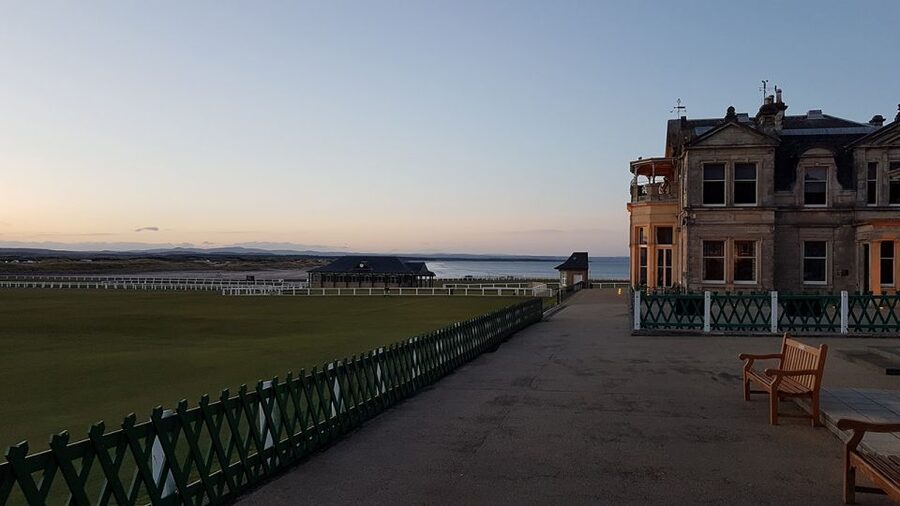
Book this tour if you want a lively introduction to both St Andrews and golf, especially if your group has mixed interests. The guide quality is a major strength, with Richard receiving repeated praise for clear explanations, humor, local insight, and a considerate pace, while Jim is also noted for his golf expertise.
Skip it if you want extended time inside the cathedral, castle, cemetery, or golf course, or if a brisk town walk is not realistic for you. For everyone else, the combination of medieval ruins, university life, golfing pioneers, and a Swilcan Bridge photograph makes $27 a sensible way to spend your first 105 minutes in St Andrews.
FAQ
How long does the St Andrews Town, Golf, and Old Course History Tour last?
The tour lasts 105 minutes, or about one hour and 45 minutes. It is a continuous walking experience through town and around key parts of the Old Course.
Where does the tour start?
Meet your guide outside the main entrance of T-Squared Social at 117 North Street, St Andrews, KY16 9AD.
Where does the tour finish?
The tour finishes at Swilcan Bridge on the Old Course. From there, you can go to the Jigger Inn or Old Course Hotel independently.
Is the tour available in languages other than English?
No. The live tour guide speaks English, and fluent English is essential for all participants.
Will I get a photo on Swilcan Bridge?
The tour includes a photo opportunity at Swilcan Bridge, but the photo stop is excluded on tournament days.
Does the tour enter the cathedral and castle?
The cathedral grounds are a visit stop. St Andrews Castle is described as a photo stop and pass-by with scenic views, not a full castle visit.
Is the tour suitable for people with mobility difficulties?
No. The tour is not suitable for people with mobility impairments, wheelchair users, or those who use mobility scooters, walking frames, or crutches.
Can I bring luggage, a stroller, or golf clubs?
No luggage drop is available. You cannot leave luggage, baby carriages, scooters, or golf clubs during the tour, so arrive without items that need storage.
Just added around Britain
- London: Wimbledon Tennis Club and Westminster Walking Tour★ 4.5 · 86 reviews
- London: Westminster to Richmond River Thames Cruise★ 4.8 · 23 reviews
- Winchester: Historic Castles and Cathedrals Walking Tour★ 4.9 · 154 reviews
- Best of London by LE GRAND – London’s Luxury Bus Tour★ 4.2 · 23 reviews
- Whitby: Guided Distillery Tour with Gin Tasting★ 5.0 · 28 reviews
- Westminster Abbey Skip-the-Line Entry and Private Tour★ 4.6 · 4 reviews
- London: Westminster Walking Tour & St Paul’s Cathedral Entry★ 4.7 · 7 reviews
- Warwick: Entry Ticket for Warwick Castle★ 4.7 · 215 reviews
Historical Tours, compared.



J&M’s City Sightseeing and History Walking Tour
Read our review →Browse the lists this tour appears in