
Reviewed · MUSEUMS
London: Natural History Museum Private Guided Tour
London’s Natural History Museum saves its biggest crowd-puller for early in the story: the dinosaurs. A private guide takes you from T-Rex and Triceratops to fossils, gems, Hope the blue whale, and the scientists who changed how we understand nature.
I like the private format, which keeps the tour focused on your group of up to six. I also like the mix of huge creatures and small scientific details, from the fastest fish in the oceans to precious minerals. The main thing to consider is time: two hours gives you a strong introduction, not a full museum visit.
Key points at a glance
- Dinosaurs lead the way: Meet T-Rex, Triceratops, and other prehistoric giants while learning about their reign and extinction.
- Science has a human face: The guide introduces the men and women whose ideas changed our view of the natural world.
- Hope the blue whale adds scale: The famous whale helps show the vast range of life on Earth.
- A private group of up to six: You can ask questions and adjust the pace more easily than on a large group tour.
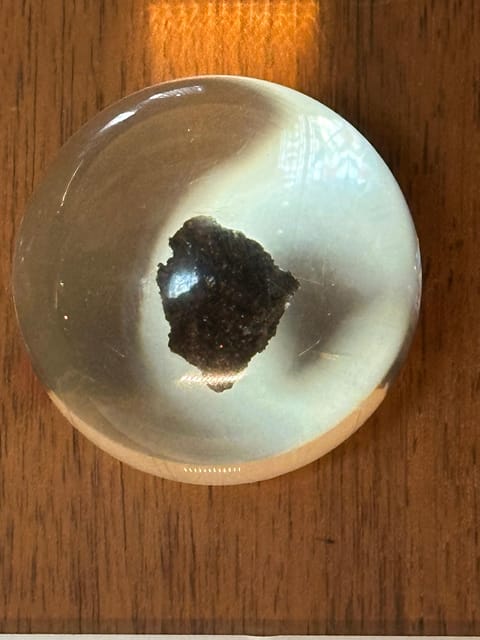
- Precious stones are part of the route: Fossils, minerals, and gems bring the planet’s long story down to hand-sized objects.
- Good access planning matters: Lifts are available, but tell the guide in advance if you need to avoid stairs.
Beginning at the East Entrance by Exhibition Road
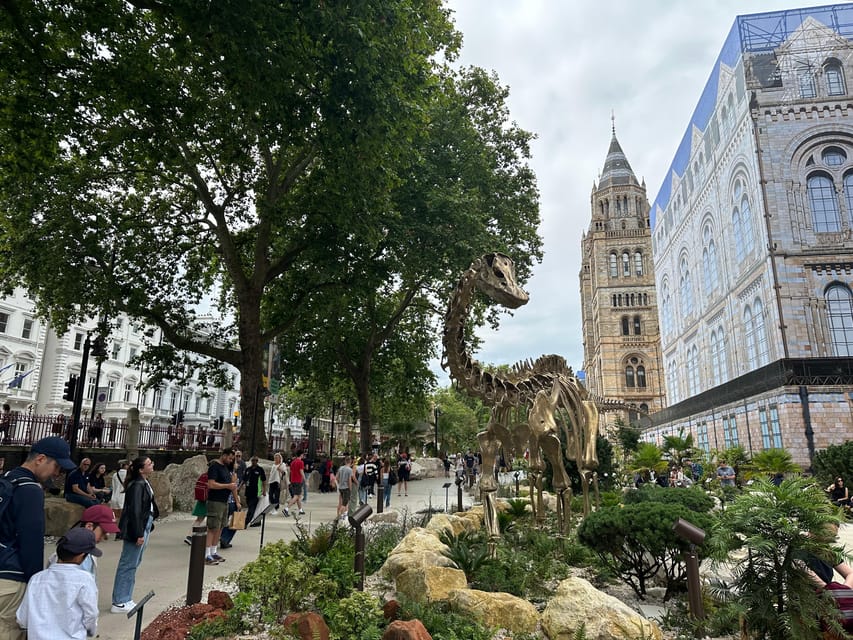
Your meeting point is on the east side of the museum garden, where Cromwell Road meets Exhibition Road. Look for the guide holding an Excellent Walks of London sign.
This detail matters because the Natural History Museum has several entrances and the surrounding museum quarter can feel confusing when you first arrive. You do not need to wander around the grand facade looking for the group. Head to the garden-side meeting point and check for the sign.
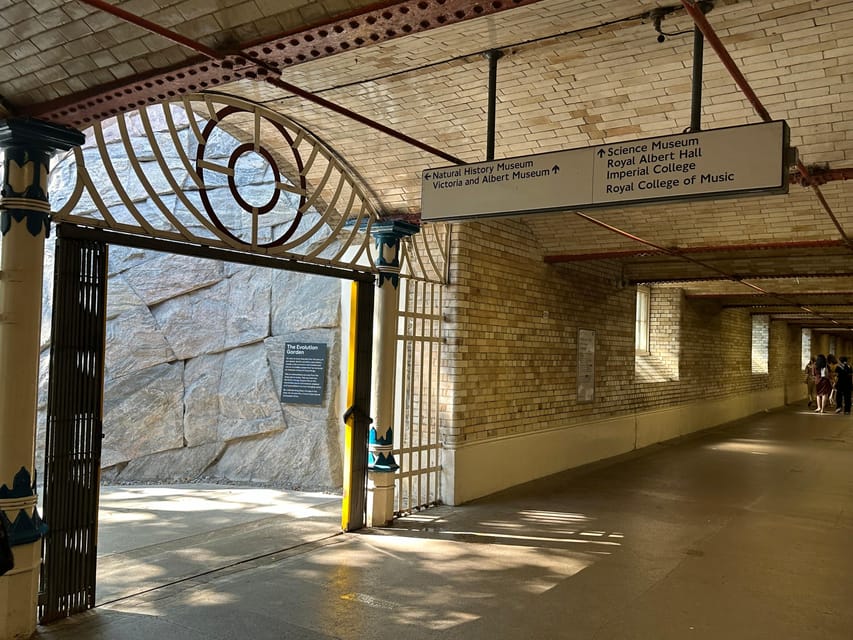
Rain need not spoil the start. From South Kensington Underground station, a tunnel leads toward the museums. In wet weather, the guide waits at the Natural History Museum exit, which is also the underground East Entrance to the garden. If you are carrying coats, umbrellas, or a tired child, this covered route is useful.
The tour lasts two hours. That is a sensible length for a first visit, especially with children, but you should arrive ready to keep moving. The museum is large, and the tour gives you selected highlights rather than every gallery.
More History Tours in London
- London: Historic Pubs of Central London Walking Tour
★ 4.9 · 1,065 reviews - London: Soho Music and Historic Pubs Walking Tour
★ 4.9 · 836 reviews - London: Rock ‘n’ Roll History Tour
★ 4.6 · 645 reviews
Dinosaurs first, with more than movie monsters
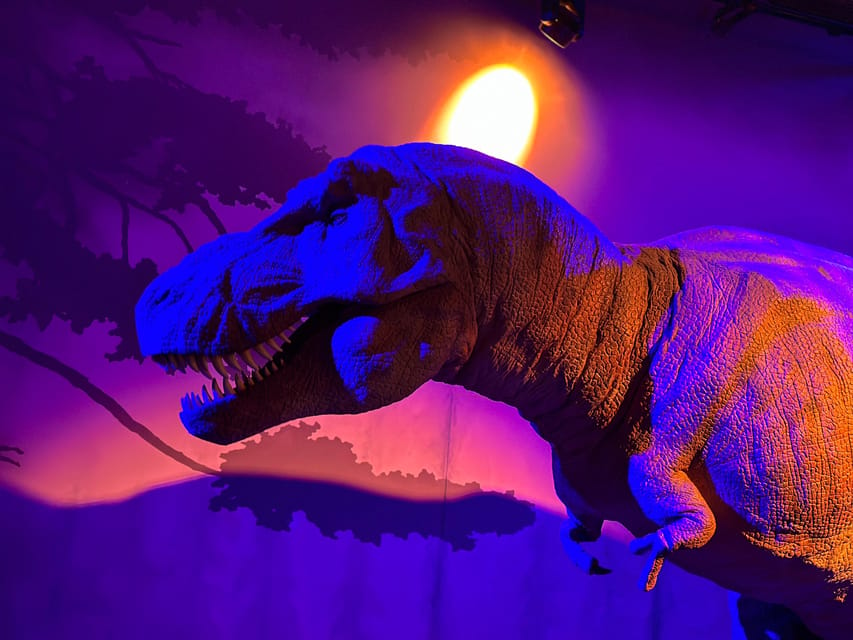
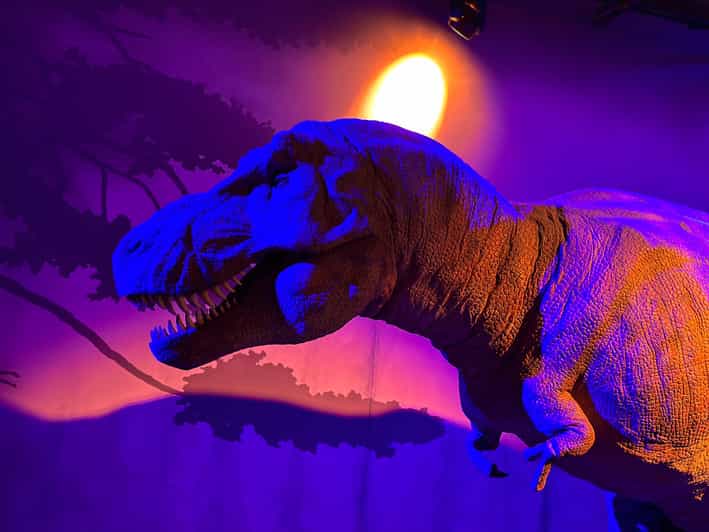
The dinosaur section supplies the obvious thrill. You can expect to see T-Rex, Triceratops, and other prehistoric giants while the guide explains their time on Earth and their extinction.
A private guide makes this part more useful than simply walking past bones and labels. You can ask why a particular fossil matters, how scientists interpret the evidence, or what separates one prehistoric animal from another. The point is not only to see a famous skeleton. It is to connect the creature to the larger story of changing life on the planet.
This is likely to be the strongest part of the tour for young visitors. Dinosaurs offer an instant hook, and the guide can then use that interest to lead into fossils, geology, extinction, and scientific thinking. Adults get more than a parade of big teeth and claws, while children have a clear visual anchor for the museum’s harder ideas.
The drawback is that dinosaur displays can attract crowds. A private tour does not mean you have the museum to yourself, and the guide cannot remove every busy moment. Still, the small group lets you stay together and ask questions without trying to catch a guide’s voice across a large gallery.
The people behind changing ideas
One of the more valuable parts of this experience is its focus on the people who shaped natural science. The tour does not treat discoveries as if facts simply appeared on museum shelves. It links ideas to the men and women who studied, argued about, and recorded the natural world.
That human angle helps you understand why museum objects matter. A fossil is not only an old piece of rock. A specimen can challenge accepted ideas, offer evidence about extinction, or change the way people classify life.
The supplied information does not promise a fixed list of scientists or a set script for every departure. That is useful in one way: your guide can adjust the explanation to your group. A family may want clear, lively context, while adults with a stronger interest in science may ask for more detail.
Hélène is one guide associated with the experience, and a French-language tour is available as well as English. If you have a preference, select the right language when checking availability. The guide’s ability to explain the museum’s ideas clearly is central to the value here, and the strongest feedback specifically praises the guide’s museum knowledge, flexibility, and generous explanations.
Hope the blue whale and the scale of life
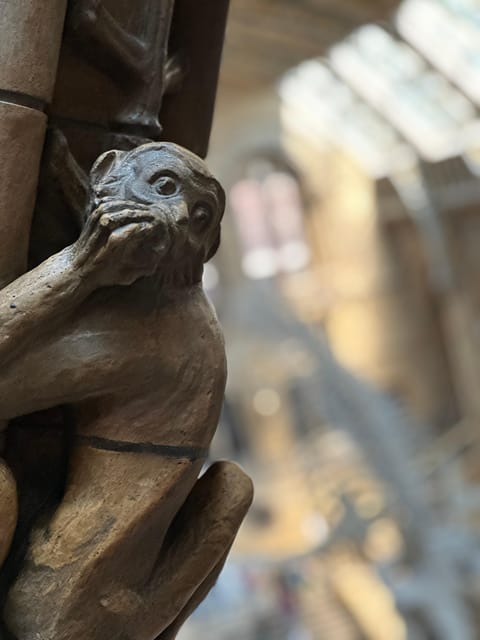
The route also takes you through the museum’s broad view of life on Earth. Hope, the blue whale, is a key sight. A whale gives the tour a different kind of drama from the dinosaurs: instead of an extinct giant from the distant past, you encounter a modern animal whose size is difficult to grasp until you see it overhead.
From there, the tour presents the range of living things, including towering giraffes and the fastest fish in the oceans. These examples help prevent the visit from becoming only a fossil tour. You are looking at present-day animals, extinct species, and the forces that connect them.
I like this balance. The museum can easily become a greatest-hits march from dinosaur to dinosaur. By adding animals from different habitats and eras, the guide gives you a wider sense of the natural world. The result is less about collecting famous sights and more about seeing how varied life can be.
The descriptions do not name the specific giraffe display or fish specimen on the route, so you should treat these as examples of the museum’s range rather than guaranteed timed stops. Your guide may shape the selection around your interests and the flow of the galleries.
More Museum Tours in London
- London: Chelsea Football Club Stadium and Museum Tour
★ 4.8 · 4,576 reviews - London: British Museum Guided Tour
★ 4.3 · 1,182 reviews - London: Jack the Ripper Museum Tickets
★ 4.2 · 894 reviews - London: Tour of the British Museum
★ 4.1 · 678 reviews
Fossils, minerals, and precious stones
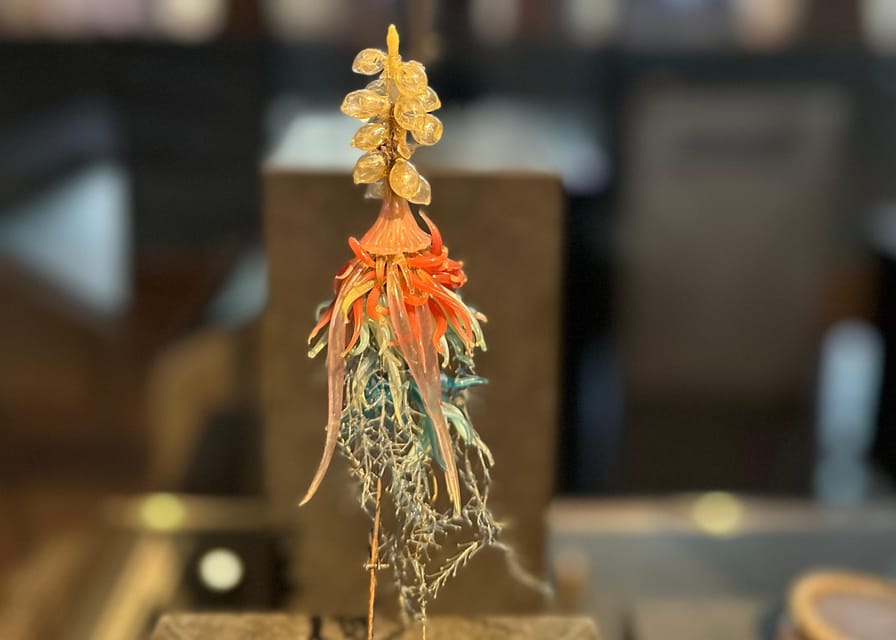
The tour’s geological side provides a quieter contrast to the animal displays. Fossils show traces of earlier life, while minerals and gems reveal the physical materials that make up the Earth.
This is where the visit can reward close attention. A precious stone is attractive, but its value in a natural history museum is not only visual. Minerals help explain how the planet forms, changes, and produces the materials people prize. Fossils offer evidence of vanished life. Together, they connect beauty with science.
The highlights specifically include treasures and precious gems, so this is a good tour for anyone who likes objects that work on two levels: they look striking, and they carry a scientific story. You may find yourself moving from an enormous animal to a small mineral specimen, with the guide showing how both belong in the same account of the planet.
The range can also be a challenge. Two hours is not enough to give equal attention to dinosaurs, mammals, whales, fossils, minerals, gems, and scientific figures. If one area matters most to you, say so at the beginning. A private tour is worth more when the guide knows what you want from it.
How the private format changes the visit
The group limit is six people. That is small enough for direct conversation and large enough to suit a family or a compact group of friends.
I especially like the ability to ask questions without worrying about holding up a large crowd. If your child wants to know how a dinosaur disappeared, or you want to spend longer with a gem display, you can raise the point at once. The guide can also adjust the explanations instead of delivering the same level of detail to everyone.
The private setup does not guarantee a completely custom route. The museum’s layout, crowds, stairways, and the two-hour limit still shape the visit. But it gives you much more control than a standard large-group walk.
The tour is offered by Walkport Limited, with English and French guides. One French-speaking guide named Hélène received especially warm feedback for creating a fascinating and enjoyable visit. The overall rating is 4.8 out of 5 from five published bookings, with praise centered on informative guiding, museum knowledge, and flexibility. That is a small sample, so I would treat it as a useful signal rather than a guarantee of every guide’s style.
Stairs, lifts, and the pace of the route
You will be walking up and down stairs during the tour, although lifts are available in the museum. If you know that you will need to use a lift, tell the guide before the tour so the route can be arranged accordingly.
This is worth doing early, not at the meeting point. The museum is big, and a route planned around lift access can save unnecessary backtracking. The experience is wheelchair accessible, but the practical details still depend on advance communication and the route selected.
Two hours can pass quickly here. Expect a guided introduction rather than a slow, room-by-room examination. Comfortable shoes make sense, and you should avoid planning another appointment immediately afterward if you want time to continue looking around once the guided portion ends.
Food and drinks are not included. Transport is also not included, though the museum’s connection to South Kensington station makes the meeting point relatively straightforward. Tickets for special exhibitions are separate, so this tour should be viewed as a visit to the main museum rather than a package covering every temporary show.
Is $134 good value for up to six people?
The price is $134 per group, not per person, for up to six participants. That changes the calculation.
For six people, the cost works out to about $22.33 per person. For four people, it is $33.50 each. For two people, the individual cost is higher, but you still receive a private guide and museum entrance for two hours.
The value is strongest when you want structure, context, and a focused introduction. The Natural History Museum has enough material to overwhelm a first-time visitor. A guide helps you choose what deserves attention and turns disconnected displays into a story about life, science, and the planet.
The value is weaker if you prefer to wander alone, read every label, or spend half a day in one gallery. The two-hour format has a clear limit, and the cost covers the main museum entrance but not food, transport, or special exhibitions.
For a family of four to six, I think the price is easier to justify. You are paying for the guide’s time, not simply entry. For a couple, I would book it mainly if you want an expert-led visit or have limited time in London.
Who will get the most from this tour?
This experience fits families, small groups, and curious adults who want help making sense of a large museum.
Children who come for dinosaurs can be drawn into fossils and extinction. Adults can focus on scientific ideas, precious stones, or the people behind major discoveries. The private setting also suits groups with mixed interests because you can ask the guide to balance animals, geology, and science.
It is a particularly good choice for a first museum visit. You will leave with a map of the main themes, even if you have not seen every room. You can then return on your own to the displays that caught your attention.
I would be more cautious if your main goal is a special exhibition. Those tickets are not included. I would also think twice if you have only a short window and want a completely relaxed pace, since the route covers a lot in two hours.
Booking and cancellation details that matter
You can cancel up to 24 hours before the tour for a full refund. You can also reserve now and pay later, which helps if your London schedule is still shifting.
Check the available starting times before booking, since the tour lasts two hours and departure slots can vary. Confirm your preferred language as well. English and French are available.
At the meeting point, look for the Excellent Walks of London sign. In rain, use the underground route from South Kensington station and meet the guide at the Natural History Museum exit, the underground East Entrance to the garden.
Should you book the Natural History Museum private tour?
Book it if you want a clear, lively introduction to the museum and can gather a small group. The combination of dinosaurs, Hope the blue whale, fossils, minerals, gems, and scientific figures gives you a broad visit without asking you to plan the route yourself.
I would especially recommend it for families and groups of four to six, where the per-person cost is reasonable. The private format, English or French guiding, and advance planning for lift access add real practical value.
Skip it if you prefer unhurried solo wandering, need a full-day museum visit, or mainly want a special exhibition. For everyone else, this is a focused way to see the museum’s major themes and understand why its objects matter.
FAQ
How long does the Natural History Museum private tour last?
The tour lasts two hours.
How many people can join the private group?
The price covers a private group of up to six people.
What is included in the price?
A private guide and entrance to the Natural History Museum are included.
Are special exhibition tickets included?
No. Tickets for special exhibitions are not included.
Is the tour available in French?
Yes. The tour is offered in English and French.
Where is the meeting point?
Meet at the east side entrance to the museum garden, at the crossing of Cromwell Road and Exhibition Road. The guide will hold an Excellent Walks of London sign.
Where should I meet the guide if it rains?
A tunnel leads from South Kensington Underground station to the museums. In rainy weather, meet at the Natural History Museum exit, which is also the underground East Entrance to the garden.
Is the tour wheelchair accessible?
Yes, the experience is wheelchair accessible. The tour includes stairs, but lifts are available. Tell the guide in advance if you need to use the lifts so the route can be arranged accordingly.
Can I cancel the booking?
Yes. You can cancel up to 24 hours in advance for a full refund. You can also reserve now and pay later.
More Museums in London
- London: British Museum Audio Tour & Priority Entrance Ticket
★ 4.5 · 631 reviews - Afternoon Tea at the British Museum
★ 4.2 · 511 reviews - London: Paradox Museum Entry Ticket
★ 3.9 · 441 reviews - London: National Gallery Guided Tour with Art Expert Guide
★ 4.7 · 440 reviews
More Private Tours in London
- London: Tower of London Entry & Beefeater Private Audience
★ 4.4 · 1,441 reviews - London: Private Photoshoot with Video Clip Option
★ 4.8 · 182 reviews - London: Private Walking Sightseeing Tour
★ 4.2 · 175 reviews - London Private Welcome Tour with a Local Guide
★ 4.6 · 142 reviews
Just added around London
- London: Wimbledon Tennis Club and Westminster Walking Tour★ 4.5 · 86 reviews
- London: Westminster to Richmond River Thames Cruise★ 4.8 · 23 reviews
- Westminster Abbey Skip-the-Line Entry and Private Tour★ 4.6 · 4 reviews
- Best of London by LE GRAND – London’s Luxury Bus Tour★ 4.2 · 23 reviews
- London: Westminster Walking Tour & St Paul’s Cathedral Entry★ 4.7 · 7 reviews
- From London: Oxford, Stratford-upon-Avon & Cotswolds Trip★ 4.5 · 64 reviews
- From London: Warwick, Oxford, Stratford & Cotswolds Day Tour★ 4.0 · 270 reviews
- Warner Bros. Studios and 1-Day London Hop-on Hop-off tour★ 4.7 · 9 reviews
Museums, compared.

Liverpool Football Club Museum and Stadium Tour
Read our review →
Chelsea Football Club Stadium and Museum Tour
Read our review →




British Museum Audio Tour & Priority Entrance Ticket
Read our review →Browse the lists this tour appears in