
Reviewed · BRITISH MUSEUM TOURS
London: British Museum Guided Tour with Priority Entrance
The British Museum is so large that a first visit can feel like opening ten history books at once. This two-hour guided tour gives you a clear route through the biggest rooms, from the glass-roofed Great Court to Egyptian mummies, the Parthenon Sculptures, and the Sutton Hoo treasures. I like the way it gives you a useful map of the museum rather than pretending you can see all 8 million objects in one morning.
I also like the priority entrance with an allocated time and the headsets, which matter in crowded galleries. Guides including Antonio, Mira, Alex, Tony, and Tara are praised for clear explanations, good pacing, and lively stories. The catch is simple: two hours only covers the highlights, and the tour is not suitable for wheelchair users, people with mobility impairments, babies under one, or people with hearing impairments.
Key points to know before you book
- The route covers major civilizations: Ancient Egypt, Greece, Anglo-Saxon England, China, Southeast Asia, and the Enlightenment era all appear within two hours.
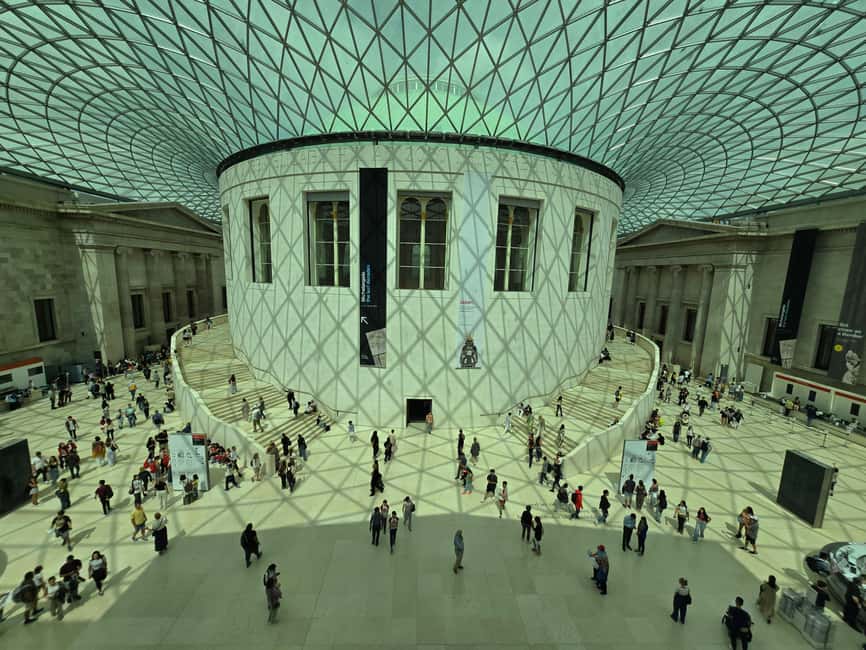
- The Great Court is your visual opening act: Its sweeping glass ceiling gives you an immediate sense of the museum’s scale.
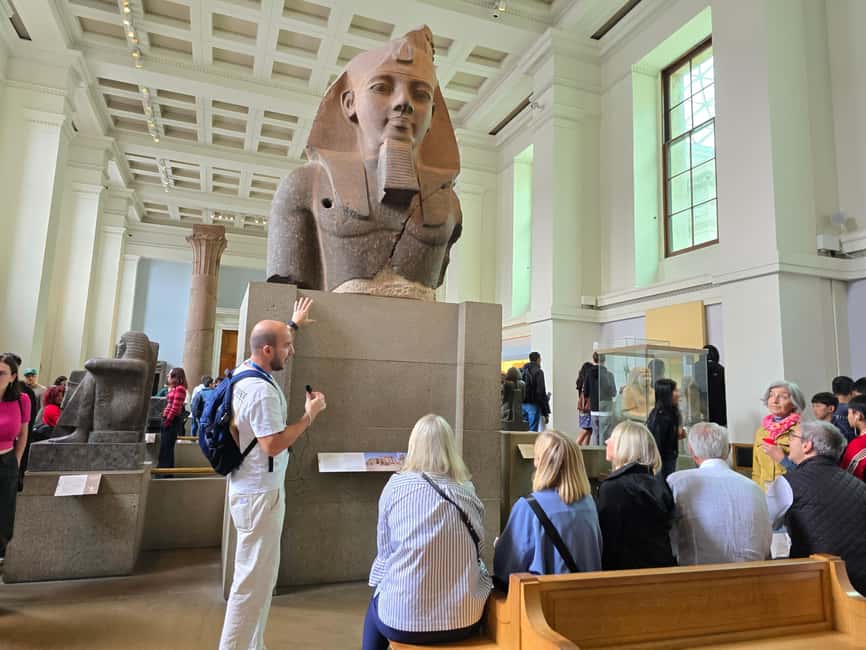
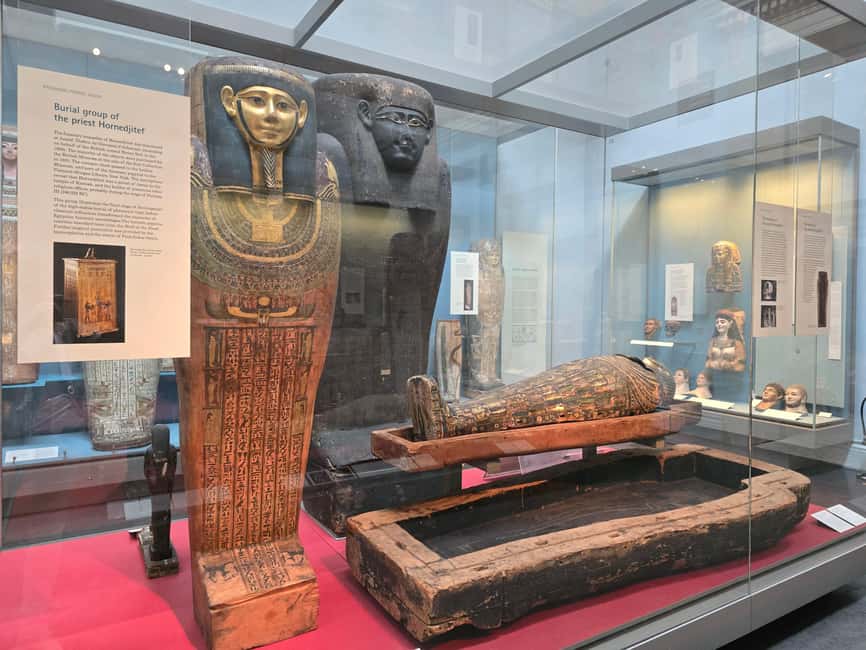
- The Rosetta Stone and Egyptian collection anchor the visit: Expect mummies, the Book of the Dead, and the bust of Ramesses II.
- Sutton Hoo adds an English chapter: The helmet, shield, and burial objects bring early medieval England into a tour otherwise focused heavily on ancient cultures.
- Headsets help in busy rooms: You can hear the guide without needing to crowd around.
- The tour is best as an introduction: Plan to stay longer afterward if you want time with less famous galleries.
Why a guided route helps inside the British Museum
The British Museum is free to enter in general, but this experience charges $53.87 per person for a guided visit and priority access. That price makes sense only if you want structure, interpretation, and a fast introduction to the collection. If you enjoy wandering on your own and have plenty of time, you may prefer an independent visit.
I think the guide earns the fee by solving the museum’s main problem: scale. With more than 8 million objects and over 70 galleries, you can spend an entire day walking without understanding how the pieces connect. A good guide turns a long list of famous objects into a story about belief, power, science, art, and burial.
The strongest part of this experience is not simply getting to the objects. It is learning why they matter. You might hear a myth tied to a Greek sculpture, a detail about Egyptian burial practice, or a fact about the way an object was found and displayed. That context helps you remember what you saw after you leave.
The guides named in the feedback include Antonio, Mira, Alex, Tony, Tara, and James. Their approach appears to vary in personality, but the repeated strengths are clear: friendly delivery, strong subject knowledge, useful museum orientation, and a willingness to answer questions. Antonio is praised for placing objects in a wider world-history setting, while Mira and Alex are noted for keeping groups together, timing the route well, and adding humor.
More Museum Tours in London
- London: Chelsea Football Club Stadium and Museum Tour
★ 4.8 · 4,576 reviews - London: British Museum Guided Tour
★ 4.3 · 1,182 reviews - London: Jack the Ripper Museum Tickets
★ 4.2 · 894 reviews
Meeting at 52 Great Russell Street
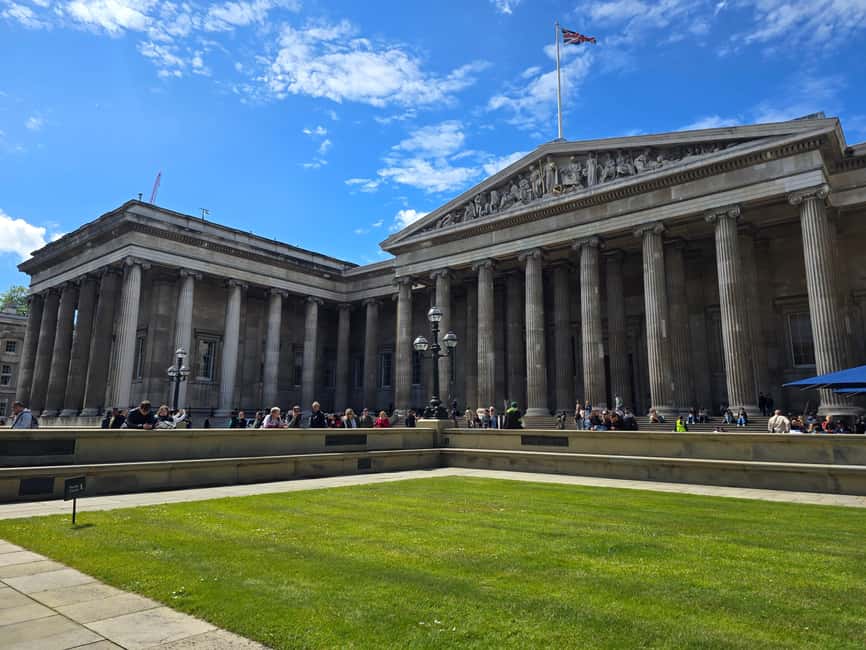
The tour begins at 52 Great Russell Street. Your guide waits inside the museum next to the information desk, not outside on the pavement. That detail matters, especially if you arrive at the main entrance expecting to see a guide holding a sign.
You receive a priority ticket for the main entrance with an allocated time slot. The activity information also describes a separate entrance for skipping the line. Follow the instructions attached to your booking carefully, since the meeting point is inside and the entry procedure may require you to pass through museum security first.
The tour returns to the same meeting point after two hours. Transportation is not included, so you will need to make your own way to the museum and continue independently afterward. Food and drinks are also not included.
The museum can be crowded, and this is where the headset option becomes useful. You do not have to stand shoulder to shoulder with the guide to hear the explanation. A good headset also lets you look at the object while listening, instead of constantly turning toward the person speaking.
The Great Court gives you your bearings
The Great Court is a memorable start because it shows you the building’s modern public heart before you move into the collection galleries. The glass roof is a work of art in its own right, spreading light over the central space and giving the museum an airy feel.
I like beginning here because it makes the museum less confusing. You can see how grand the institution is, then move into smaller galleries with a better sense of direction. Your guide can also use this opening to explain the plan for the next two hours.
Do not expect a long architectural talk. The point is to get oriented and begin the museum’s larger story. From this central space, the tour moves toward objects that represent different periods and parts of the world.
This is also a good place to adjust your expectations. The museum is not a single, tidy timeline. Its collections cover many cultures and centuries, so the route jumps between regions. A guide helps those changes feel intentional rather than random.
Egyptian mummies and the Rosetta Stone
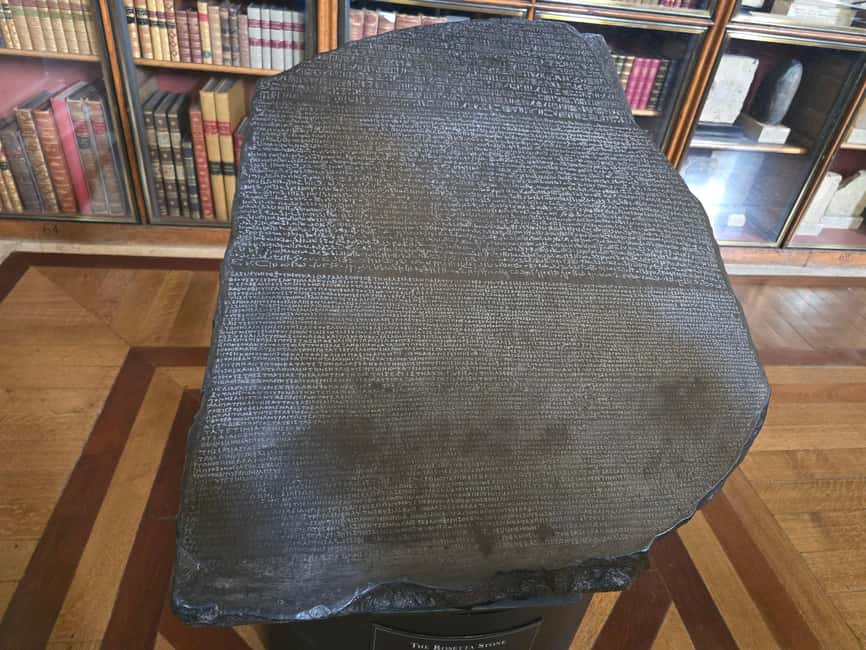
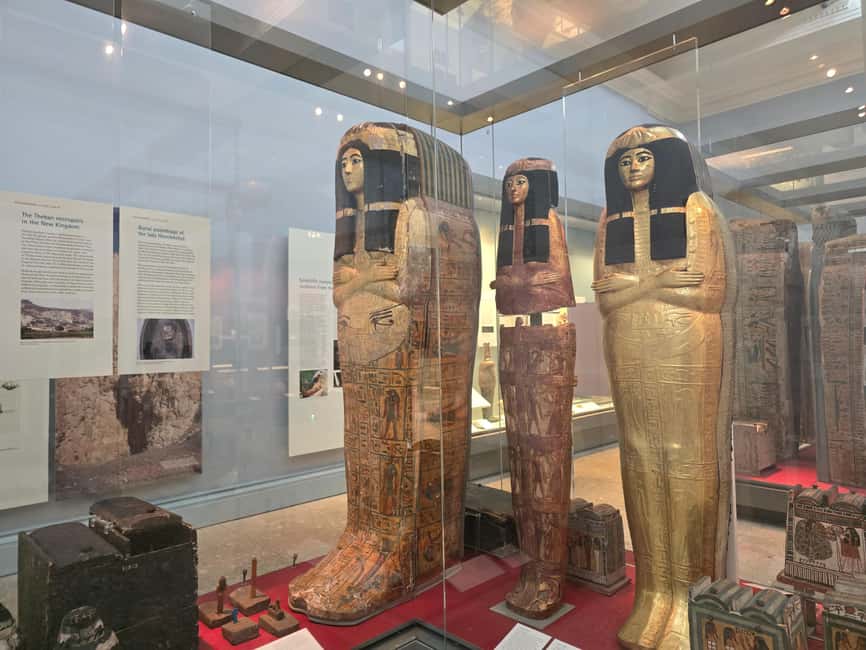
Ancient Egypt is one of the tour’s main anchors. You will see Egyptian mummies, the Book of the Dead, and the large bust of Ramesses II. These displays offer more than a look at famous objects. They open questions about death, religion, kingship, writing, and the afterlife.
The mummies are likely to be one of the most memorable stops, but they can also be intense for younger children or anyone uncomfortable with human remains. The guide gives the objects meaning by explaining burial customs and religious beliefs rather than treating them as mere curiosities.
The Rosetta Stone brings a different kind of excitement. Its importance comes from the writing on its surface and the role it played in understanding Egyptian hieroglyphs. A guide can help you notice why the stone matters, even if you arrive knowing only that it is famous.
The bust of Ramesses II gives you a powerful image of royal authority. Look for the contrast between the scale and polish of the sculpture and the smaller objects nearby. In a short tour, this kind of contrast helps show how Egyptian society expressed power through both monumental art and personal burial objects.
The guides are especially praised for explaining hieroglyphics and for making the Egyptian section engaging. If this is the part of the museum you most want to understand, ask questions when the group pauses. The exact time available at each object can depend on the crowd and the guide’s route.
More guided runs through the British Museum:
- London: Tour of the British Museum
★ 4.1 · 678 reviews - London: British Museum Audio Tour & Priority Entrance Ticket
★ 4.5 · 631 reviews - Afternoon Tea at the British Museum
★ 4.2 · 511 reviews - London: British Museum Guided Tour
★ 4.5 · 267 reviews
Greek myths in the Parthenon Sculptures
The Parthenon Sculptures, also called the Elgin Marbles, bring ancient Greece into the route. They are classical masterpieces, but the visit is not only about beauty. The sculptures also raise questions about ancient religion, architecture, collecting, ownership, and the modern politics surrounding cultural objects.
Your guide can point out figures, movement, and stories from Greek myth that are easy to miss when you see the sculptures without context. The scale of the gallery makes the pieces easier to appreciate as part of a temple decoration rather than as isolated statues.
This is a useful stop for first-time visitors because the sculptures are among the museum’s best-known displays. It also gives the tour a change of mood after the Egyptian galleries. You move from funerary belief and royal imagery to gods, heroes, and public art.
You should not expect a full discussion of the Parthenon’s history in one short stop. Two hours must be shared among many galleries. Still, a clear explanation here can give you enough background to return later and look more closely.
The Enlightenment Room and the pursuit of knowledge
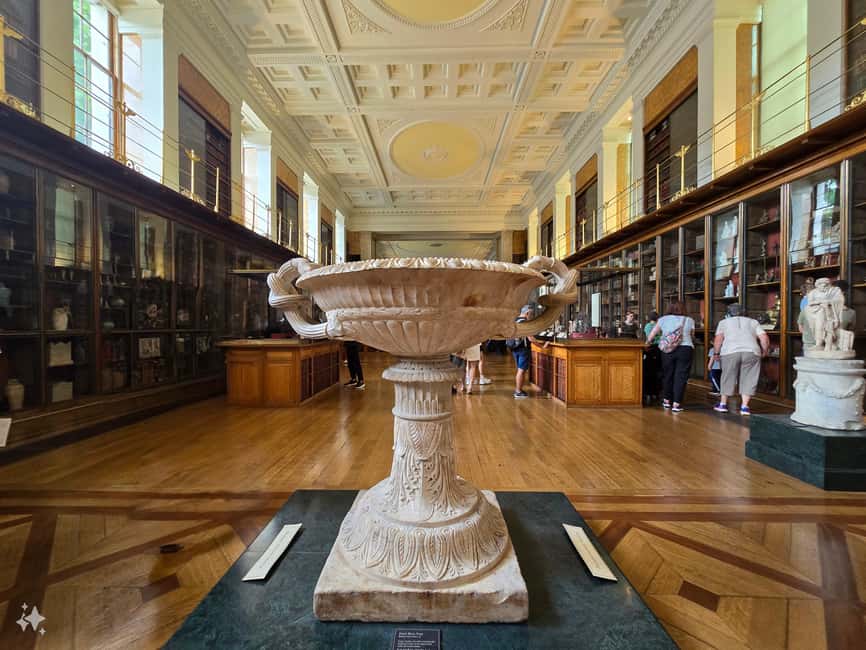
The Enlightenment Room reflects the intellectual curiosity and scientific progress of the 18th century. Its objects represent an age when collecting, classification, travel, and study were closely linked.
I find this section valuable because it broadens the tour beyond temples, tombs, and royal treasures. The museum is also about the human desire to record and understand the world. Objects in this room can show how people in that period organized ideas and viewed new discoveries.
The room works best when the guide connects separate objects into a larger story. You may see items from different fields placed together, and without explanation they can seem unrelated. With a guide, the room becomes a picture of how science and culture were developing at the same time.
This stop may appeal most to adults and older students who enjoy the history of ideas. It is less immediately dramatic than a mummy or a famous stone, but it gives the museum’s collections a useful layer of meaning.
Chinese and Southeast Asian collections
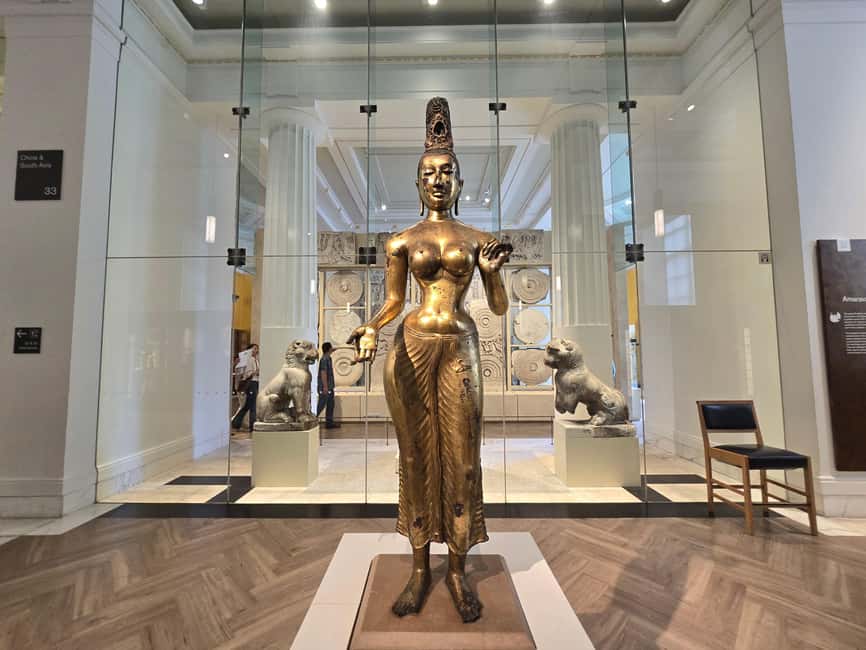
The route also includes Chinese objects and beautifully crafted pieces from Southeast Asia. These galleries keep the tour from becoming an Ancient Egypt and Greece greatest-hits walk.
Here, you can look at artistic traditions, materials, religious ideas, and regional connections across Asia. The objects may be easy to rush past if you do not know what to look for. A guide can draw your attention to craftsmanship and explain how the pieces fit into wider cultural settings.
The information does not promise a complete survey of Asian art, and two hours would not allow one. Think of this as a carefully chosen introduction. If one object or gallery catches your eye, note its location and return after the guided portion ends.
This is one reason I like the tour’s broad route. You get a sense of the museum’s worldwide reach instead of spending the entire visit in only the most crowded famous galleries. The tradeoff is that each region receives limited time.
Sutton Hoo and Anglo-Saxon England
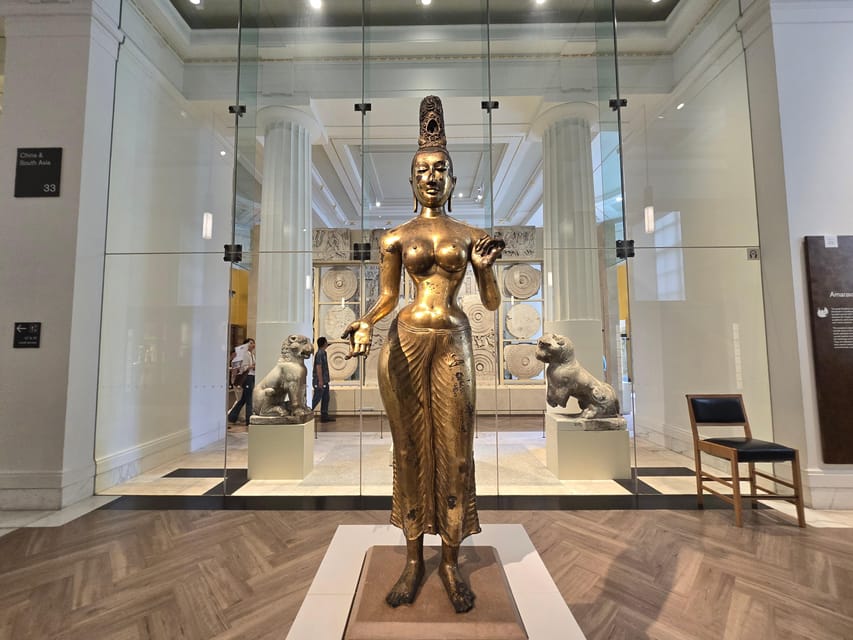
Sutton Hoo gives the tour a strong British chapter. The ship burial is linked to Anglo-Saxon England, and the helmet, shield, and other objects reveal the skill and status of the people connected with the burial.
The helmet is the star here, but do not ignore the other pieces. Together, the objects show how craftsmanship, warfare, ceremony, and burial came together in early medieval England. The display feels different from the Egyptian and Greek collections, which makes it a welcome change of pace.
This stop is especially helpful if you want the museum to connect with the history of Britain itself. The British Museum can sometimes feel like a world tour with London as the address. Sutton Hoo reminds you that the institution also holds major objects from the country where you are visiting.
A guide can also explain how the ship burial was interpreted and why the objects matter. You may want to spend extra time here after the tour, since the two-hour route gives only a compact introduction.
How the two-hour pace feels
Two hours is the right length for a first orientation, but not enough for a full museum visit. The tour moves between major galleries and covers a wide range of cultures. You will see important objects, hear stories, and finish with a plan for returning to the rooms that interest you most.
The best guides manage the pace carefully. Mira and Alex are specifically praised for keeping people together, using time well, and adjusting when needed. Other guides, including Antonio, Tony, Tara, and James, are praised for choosing key objects and explaining how to move around the museum.
Headsets make the pace easier to handle. In a large group, you can lag a few steps behind to examine a display and still hear the guide. The small-group option is worth considering if you prefer more room for questions and a more personal exchange.
Do not book this expecting a quiet, slow look at every object. It is a highlights tour. You may leave with several galleries still unseen, but that is the point: the tour gives you a sensible first pass, then lets you choose your own second pass.
Is $53.87 good value?
At $53.87 per person, this is not the cheapest way to enter the British Museum. The value comes from the combination of priority access, a live guide, a planned route, and commentary in a museum where it is easy to lose time.
I would call it good value for a first-time visitor with only a few hours in London. It is also useful if you want help connecting objects from different civilizations. A guide can save you from spending your entire visit searching for the Rosetta Stone or wandering past the Sutton Hoo display without realizing what you missed.
The price is harder to justify if you already know the museum well, prefer audio guides or printed information, or plan to spend a full day studying a handful of galleries. You are paying for selection and interpretation, not exclusive access to the objects.
The ability to reserve now and pay later gives you some planning flexibility. Free cancellation is available up to 24 hours before the activity for a full refund. Check the available starting times before building the rest of your day around the tour.
Who should book this experience?
I would choose this tour for a first visit, a short London stay, or anyone who wants the museum’s famous objects explained in plain language. It suits people who like stories, ask questions, and want a route that covers several civilizations rather than one specialist collection.
It is also a good match for families with older children, provided they are comfortable with mummies and a fast museum pace. The guide’s myths, burial customs, and discoveries can make the objects easier to remember than a series of display labels.
You should think twice if you need step-free access or cannot use an audio headset. The activity is listed as unsuitable for wheelchair users, people with mobility impairments, babies under one, and people with hearing impairments. Flash photography is not allowed.
Languages listed for the live guide are English, Italian, and Chinese. The included commentary is described as English or Italian, so confirm the language and starting time when you book if that choice matters to you.
What to do after the guided tour
When the two hours finish, you are back at the meeting point. This is the ideal moment to return to one or two galleries rather than trying to conquer the entire museum.
If Egypt captured your attention, spend more time with the mummies and the Book of the Dead. If the Greek sculptures made the strongest impression, go back for a slower look at the figures and details. You might also return to Sutton Hoo, where the helmet and shield reward a closer examination.
The guide may point out rooms worth revisiting, which is one of the most useful practical benefits of the tour. Write down the names of objects or gallery areas as you go. Otherwise, the museum’s size can make it hard to retrace your steps.
I would leave some unscheduled time after the tour if your day allows. The guided route gives you the broad picture, while a second wander lets you follow your own interests.
Should you book the British Museum guided tour?
Book it if you want a lively, organized first look at the museum and do not want to spend your visit guessing which rooms matter most. The priority entry, headsets, broad route, and strong guide feedback make it a practical choice for a short London itinerary.
Skip it if you prefer total independence, already know the museum, or want to study a narrow collection at your own pace. At $53.87, it is a premium over simply entering the museum, but the guide can make those two hours far more useful.
For most first-time visitors, I would treat it as an orientation rather than the whole British Museum experience. See the highlights with Antonio, Mira, Alex, Tony, Tara, James, or another available guide, then stay on to follow your own interests. That combination gives you both direction and freedom.
FAQ
How long does the British Museum guided tour last?
The guided tour lasts two hours. Starting times vary, so check availability before booking.
Where does the tour begin?
Your guide waits inside the British Museum next to the information desk. The listed starting location is 52 Great Russell Street.
Where does the activity end?
The tour ends back at the meeting point inside the museum.
Which languages are available?
Live tour guides are listed as available in English, Italian, and Chinese. The included commentary is described as English or Italian, so confirm the available language for your selected time.
Are headsets provided?
Headsets are available as part of the experience information. They help you hear the guide clearly in crowded galleries.
Does the price include transportation or food?
No. Transportation, food, and drinks are not included.
Can I cancel for a refund?
Yes. You can cancel up to 24 hours in advance for a full refund. The activity also offers a reserve-now, pay-later option.
More Museums in London
- London: Paradox Museum Entry Ticket
★ 3.9 · 441 reviews - London: National Gallery Guided Tour with Art Expert Guide
★ 4.7 · 440 reviews - London: Postal Museum Entry Ticket and Underground Rail Ride
★ 4.6 · 363 reviews - London: Royal Museums Greenwich Day Pass
★ 4.5 · 309 reviews
Just added around London
- London: Wimbledon Tennis Club and Westminster Walking Tour★ 4.5 · 86 reviews
- London: Westminster to Richmond River Thames Cruise★ 4.8 · 23 reviews
- Westminster Abbey Skip-the-Line Entry and Private Tour★ 4.6 · 4 reviews
- Best of London by LE GRAND – London’s Luxury Bus Tour★ 4.2 · 23 reviews
- London: Westminster Walking Tour & St Paul’s Cathedral Entry★ 4.7 · 7 reviews
- From London: Oxford, Stratford-upon-Avon & Cotswolds Trip★ 4.5 · 64 reviews
- From London: Warwick, Oxford, Stratford & Cotswolds Day Tour★ 4.0 · 270 reviews
- Warner Bros. Studios and 1-Day London Hop-on Hop-off tour★ 4.7 · 9 reviews
British Museum Tours, compared.



British Museum Audio Tour & Priority Entrance Ticket
Read our review →
British Museum Archaeology Course and Guided Tour
Read our review →
British Museum Highlights Guided Small Group Tour
Read our review →
Browse the lists this tour appears in