
Reviewed · BRITISH MUSEUM TOURS
London: British Museum Guided Tour with Free Entrance Ticket
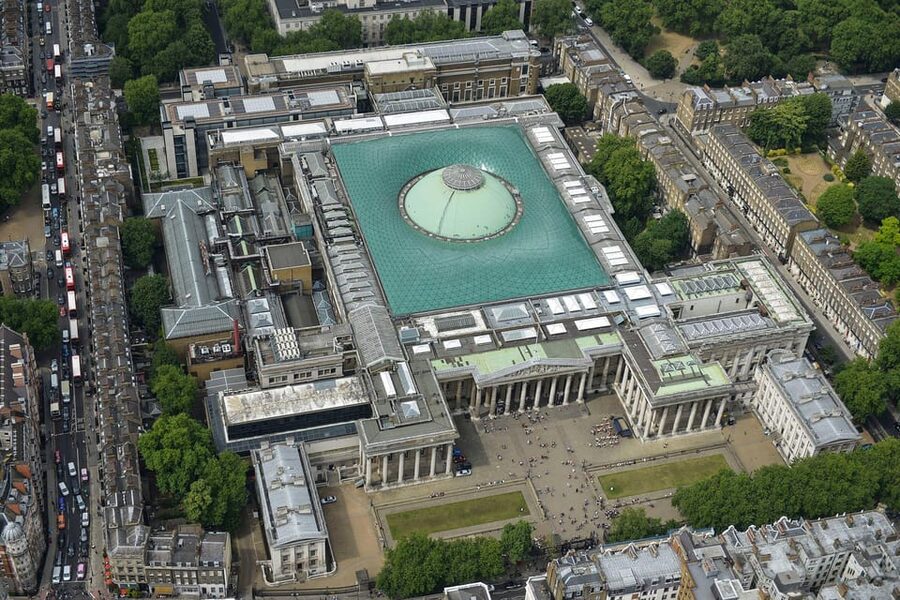
The British Museum tour brings you face to face with objects that changed how people understand the ancient world. In two hours, you can see the Rosetta Stone, the Parthenon sculptures, the Aztec double-headed snake, and the huge statue of Ramses II without wandering the museum’s enormous galleries alone.
I like the fast-track entry and the tight route through famous objects. I also like the storytelling angle: one guide, Angel, has been praised for sharing strong stories and for keeping guests informed when a train delay made him late. The main drawback is that the meeting point can change, and larger groups may need to enter through Montague Place instead of the front entrance.
Key points to know before you book
- Two hours, carefully focused: You see many of the British Museum’s best-known objects, but this is not a full museum tour.
- Fast-track museum entry: Your ticket includes entry, though you still pass through security and need to arrive early.
- Major ancient treasures: The route includes the Rosetta Stone, Ramses II, the Elgin Marbles, Assyrian winged lions, and the Aztec double-headed snake.
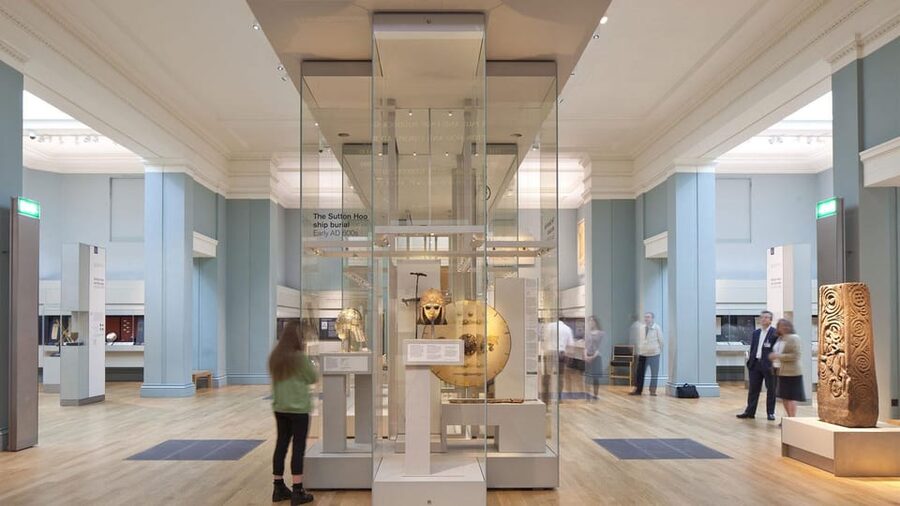
- More than Egypt and Greece: You also see the Moai, Sutton Hoo burial ship, Roman Britain, the Mold Cape, and Lewis Chessmen.
- English, Spanish, or Italian: Live guiding is available in these three languages, with private groups also offered.
- Plan around the entrance rules: Bring comfortable shoes and water, leave your backpack behind, and check WhatsApp for meeting-point changes.
Why a two-hour British Museum tour can be worth it
The British Museum is free to enter, but free does not mean simple. Its collection covers objects from many parts of the world and many periods, with enough galleries to turn a casual visit into a maze of attractive distractions.
This tour gives you a route and a purpose. At $35 per person, you are paying for the guide, the reserved activity arrangement, and a concentrated introduction to the museum’s major works. You are not paying for an all-day visit. You are paying to use two hours well.
That distinction matters. If you already know the museum, prefer reading labels at your own pace, or want to spend half a day with one collection, you may prefer to enter independently. If this is your first visit and you want the famous objects explained without spending time deciding where to go, the fee is reasonable.
The guided format also helps with scale. The museum’s best-known pieces are not all in one room, and each object raises different questions about archaeology, empire, religion, power, and ownership. A good guide turns a list of famous names into a connected visit.
More Museum Tours in London
- London: Chelsea Football Club Stadium and Museum Tour
★ 4.8 · 4,576 reviews - London: British Museum Guided Tour
★ 4.3 · 1,182 reviews - London: Jack the Ripper Museum Tickets
★ 4.2 · 894 reviews
Meeting your guide after security
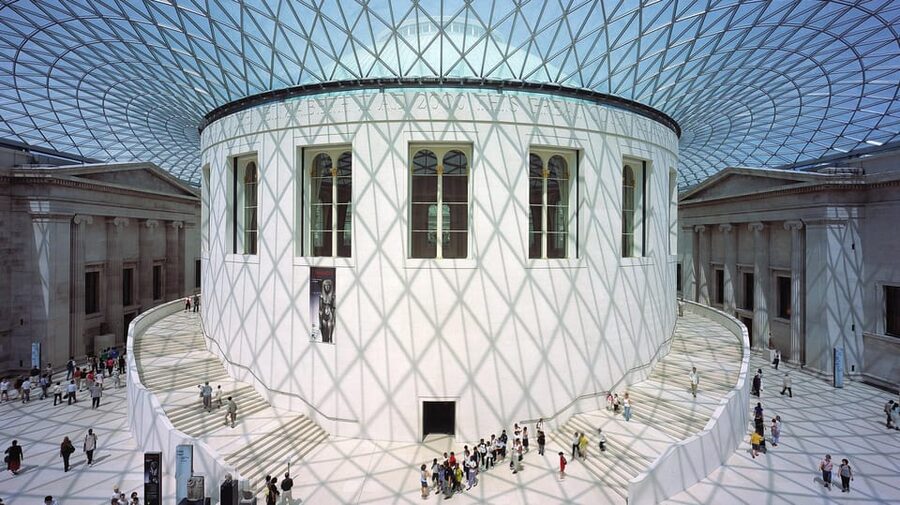
The stated meeting point is the main entrance, after the security check, on the staircase. Arrive at least 15 minutes before your scheduled start. That extra time is not just polite. The British Museum is extremely popular, and entry can take longer during busy periods.
Keep an eye on your WhatsApp messages before leaving for the museum. The entrance may change to Montague Place, particularly when conditions at the main entrance are difficult. One practical complication has already affected a larger group: groups of more than eight people may not be allowed to enter through the front route and may be directed around to the back entrance.
This is the sort of detail that can make a difference in London. Do not arrive at the last minute and assume the staircase is the only possible meeting spot. Read the latest message, allow time for security, and make sure your phone is charged.
The guide may not be waiting outside the museum before security. You meet after the bag check, so you need to get through that first stage on your own. Angel, one of the named guides, handled a train delay by contacting the group and explaining what to do while they waited. That kind of communication is useful when the start does not go exactly to plan.
The Rosetta Stone and the key to ancient Egypt
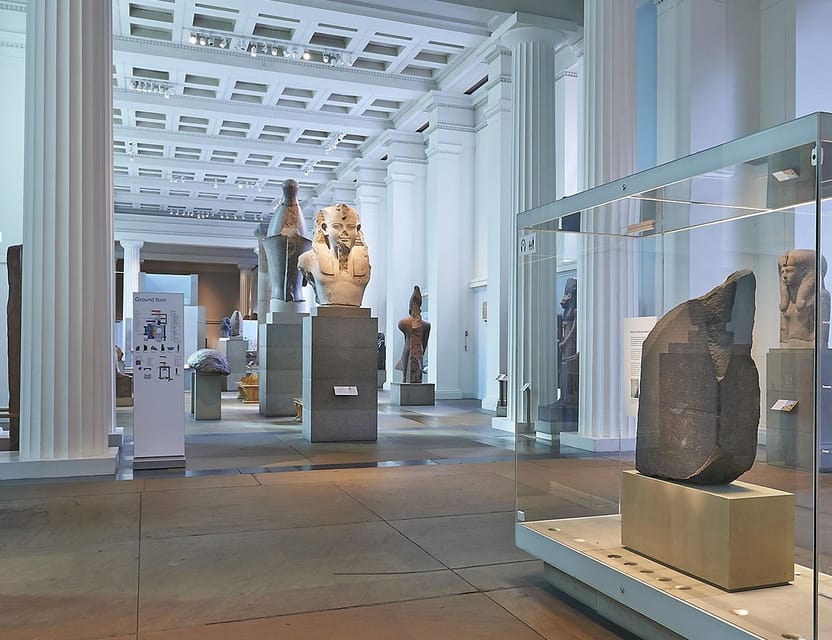
The Rosetta Stone is the natural early highlight. It is famous not because it is the largest or prettiest object in the museum, but because its inscriptions helped scholars read Egyptian hieroglyphs.
The stone carries the same decree in three scripts. Comparing those versions made it possible to connect the known Greek text with the Egyptian writing systems. A guide can make this object easier to appreciate by explaining the problem it solved: for centuries, the writing on Egyptian monuments was visible but not properly understood.
You should expect a crowd around this display. The stone is one of the museum’s most recognized objects, so your guide’s explanation is especially useful when you cannot stand directly in front of it for long. Listen first, then take your look when there is a clear opening.
The stop also sets the tone for the tour. You are not simply ticking off famous items. You are learning why a particular object matters and what changed because of it.
Ramses II, power carved in stone
The colossal statue of Ramses II gives you a very different experience from the Rosetta Stone. The Rosetta Stone is important because of its text. Ramses is immediately legible as a display of royal power.
The tour presents him as one of ancient Egypt’s most powerful pharaohs. The scale is the point. A colossal image of a ruler was designed to overwhelm, and the effect still works when you see it in a modern museum gallery.
This is a good place to pay attention to proportion and presentation. You are looking at a monument created to express authority, now viewed by people from around the world. That change of setting is part of the British Museum experience, and a guide can help connect the object’s original purpose with its present role.
Expect a short stop rather than an extended study session. With only two hours and several major areas to cover, the guide needs to keep the group moving.
More guided runs through the British Museum:
- London: Tour of the British Museum
★ 4.1 · 678 reviews - London: British Museum Audio Tour & Priority Entrance Ticket
★ 4.5 · 631 reviews - Afternoon Tea at the British Museum
★ 4.2 · 511 reviews - London: British Museum Guided Tour
★ 4.5 · 267 reviews
The Elgin Marbles and the museum’s difficult questions
The Parthenon sculptures, often called the Elgin Marbles, are among the most debated objects in the museum. They were taken from Athens and are connected to continuing arguments about cultural ownership and where major antiquities should be displayed.
The tour includes a glimpse of these controversial sculptures. That wording is important. You should not expect a long, specialist discussion of every claim surrounding them, but you will see the works and receive context for their importance.
These sculptures are valuable to the tour because they add a modern question to an ancient collection: who has the right to hold and display cultural heritage? The British Museum is not only a place to admire old objects. It also asks you to think about how those objects reached London.
If this issue is central to your visit, allow time after the tour to return to the galleries and read more on your own. The two-hour format can introduce the question, but it cannot settle it.
Assyrian lions and the Aztec double-headed snake
The Assyrian human-headed winged lions are among the tour’s most striking works. Their combination of human, animal, and bird features gives them an immediate visual force, even if you know little about Assyrian history.
These figures were not casual decoration. Their size and hybrid form communicated protection and authority. You can understand their impact quickly, which makes them a strong guided-tour stop.
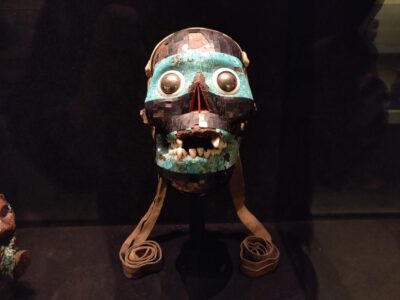
The Aztec double-headed mosaic snake offers another change of mood. It is described as one of the museum’s rarest objects, and its surface gives you a chance to look closely at materials as well as symbolism.
The contrast between the Assyrian sculpture and the Aztec mosaic is one of the tour’s strengths. You move from a monumental guardian to a smaller, intricate object made for a very different cultural setting. The guide’s job is to give each piece enough context without turning the visit into a lecture.
From Easter Island to medieval Britain
The itinerary continues beyond the most obvious ancient Mediterranean highlights. You see a Moai sculpture from Easter Island, a reminder that the museum’s collection reaches far beyond Egypt, Greece, and Rome.
The Moai is a useful correction to the idea that the British Museum is mainly about classical antiquity. Its presence opens a window onto the art and traditions of Rapa Nui, while also making you consider how an object from a distant island came to be displayed in London.
You also see the Sutton Hoo burial ship, one of the most spectacular discoveries in British archaeology. The object connects the museum to early medieval Britain and gives the tour a local chapter after so much attention to distant civilizations.
Roman Britain follows, showing how the island itself became part of the wider Roman world. The Mold Cape, linked to the Stonehenge area, adds a prehistoric object with a distinctly British connection.
The Lewis Chessmen finish this broad sweep with a set of medieval pieces from the Isle of Lewis. They are easier to relate to than a massive statue or ancient inscription, yet they also carry clues about craft, status, and everyday culture.
You will not receive equal time with every one of these objects. The list is broad by design. Think of the tour as a sampler of the museum’s finest rooms, not a complete study of each collection.
What the guide adds to the experience
The main reason to book a guided visit is interpretation. Labels tell you what an object is. A guide can explain why it was made, what problem it solved, how it was used, or why people still argue about it.
Angel has received particular praise for strong stories and a lively two-hour experience. His handling of a delayed arrival is also worth noting because it shows the practical value of direct communication when plans shift. Other guides may lead the tour in English, Spanish, or Italian, depending on the selected option.
The tone and depth may vary by guide. That is true of any live tour, so book this because you want a human-led overview, not because you expect a museum lecture with identical wording every time.
A private group option is available. That can be useful if you want a more personal pace or are traveling with people who prefer to ask questions. The supplied information does not specify the private-group price or exact group limits, so check those details before paying.
Is $35 good value for two hours?
At $35, the tour sits in a sensible middle ground. The museum itself offers free entry, so the value must come from the guide and the time saved, not from admission alone.
I would consider it good value for a first visit, especially if your London schedule is tight. You get a route through famous objects and a guide who can explain the stories behind them. Fast-track arrangements may also help you avoid a long wait, although you still need to pass security and arrive early.
The value is lower if you are happy to research the museum in advance and follow your own list. You can enter without paying for a tour, then spend as long as you like with the Rosetta Stone or the Lewis Chessmen.
The two-hour length is both a benefit and a limit. It fits neatly into a busy day and will not exhaust you, but it leaves little room for lingering. If you want quiet time with the Elgin Marbles or a detailed look at Roman Britain, plan to return after the tour.
Shoes, bags, photos, and access
Wear comfortable shoes. You will be inside the museum for two hours and moving between galleries, with time spent standing while the guide talks.
Bring water and a camera, but do not use flash photography. Backpacks are not allowed, so pack light and check the museum’s current bag arrangements before setting out. The supplied information does not give a cloakroom procedure, so do not assume a large bag will be easy to store.
This activity is not suitable for wheelchair users or people with mobility impairments. The meeting instructions involve stairs, and the tour requires movement through the museum. If access is important for your visit, contact the provider before booking rather than relying on the standard route.
Free cancellation is available up to 24 hours before the scheduled start, and you can reserve now and pay later. Those options help if your London plans are still shifting, but you should still check the exact start time when booking.
Who should book this British Museum visit?
I would choose this tour for a first-time visitor who wants the major objects explained in a clear order. It also suits anyone with only a morning or afternoon available, since the two-hour length leaves room for another London sight.
Families and mixed-interest groups may benefit from the variety. The tour moves from Egyptian writing and royal sculpture to Greek architecture, Assyrian guardians, Aztec mosaic work, Easter Island, early medieval Britain, and Roman Britain. That range gives different people something to enjoy.
It is less suitable for a specialist who wants one collection studied in depth. It is also a poor fit if you need step-free access or dislike fixed schedules.
Should you book it?
Book this British Museum tour if you want a focused introduction, fast-track entry, and stories that give famous objects a reason to matter. The Rosetta Stone, Ramses II, Elgin Marbles, Assyrian lions, and Aztec snake make a strong core, while Sutton Hoo, the Moai, Roman Britain, the Mold Cape, and Lewis Chessmen broaden the visit.
Skip it if you prefer free self-guided entry, long stops at a few objects, or a completely flexible route. For everyone else, $35 is a fair price for two hours of orientation in a museum that can otherwise feel too large to tackle.
FAQ
How long does the British Museum guided tour last?
The tour lasts two hours.
How much does the tour cost?
The listed price is $35 per person.
Is museum entry included?
Yes. Fast-track entry and access to the British Museum’s famous objects are included.
Where do I meet the guide?
Meet at the main entrance after the security check, on the staircase. The entrance may change to Montague Place, so check your WhatsApp messages before the tour.
How early should I arrive?
Arrive at least 15 minutes before your scheduled tour time.
Which languages are available?
Live guiding is available in English, Spanish, and Italian.
Can I book a private group?
Yes. A private-group option is available.
Which British Museum objects are included?
The tour includes the Rosetta Stone, the colossal statue of Ramses II, the Elgin Marbles, Assyrian human-headed winged lions, the Aztec double-headed snake, a Moai, the Sutton Hoo burial ship, Roman Britain, the Mold Cape, and the Lewis Chessmen.
Can I bring a backpack?
No. Backpacks are not allowed. Comfortable shoes, water, and a camera are recommended, and flash photography is not permitted.
Is the tour suitable for wheelchair users?
No. The activity is not suitable for wheelchair users or people with mobility impairments.
Can I cancel the booking?
Yes. You can cancel up to 24 hours in advance for a full refund. Reserve now and pay later is also available.
More Museums in London
- London: Paradox Museum Entry Ticket
★ 3.9 · 441 reviews - London: National Gallery Guided Tour with Art Expert Guide
★ 4.7 · 440 reviews - London: Postal Museum Entry Ticket and Underground Rail Ride
★ 4.6 · 363 reviews - London: Royal Museums Greenwich Day Pass
★ 4.5 · 309 reviews
Just added around London
- London: Wimbledon Tennis Club and Westminster Walking Tour★ 4.5 · 86 reviews
- London: Westminster to Richmond River Thames Cruise★ 4.8 · 23 reviews
- Westminster Abbey Skip-the-Line Entry and Private Tour★ 4.6 · 4 reviews
- Best of London by LE GRAND – London’s Luxury Bus Tour★ 4.2 · 23 reviews
- London: Westminster Walking Tour & St Paul’s Cathedral Entry★ 4.7 · 7 reviews
- From London: Oxford, Stratford-upon-Avon & Cotswolds Trip★ 4.5 · 64 reviews
- From London: Warwick, Oxford, Stratford & Cotswolds Day Tour★ 4.0 · 270 reviews
- Warner Bros. Studios and 1-Day London Hop-on Hop-off tour★ 4.7 · 9 reviews
British Museum Tours, compared.



British Museum Audio Tour & Priority Entrance Ticket
Read our review →
British Museum Archaeology Course and Guided Tour
Read our review →
British Museum Highlights Guided Small Group Tour
Read our review →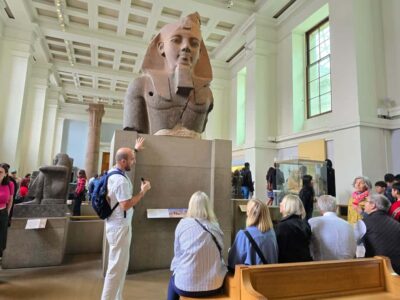
British Museum Guided Tour with Priority Entrance
Read our review →Browse the lists this tour appears in