

Reviewed · BRITISH MUSEUM TOURS
London: Private Kid-Friendly Tour of the British Museum
The British Museum can be a lot for a child. This private two-hour tour gives the visit a clear purpose: find eight famous objects, answer questions, and solve clues before the final prize. Julia Huber, a Blue Badge guide and mother of three, leads the adventure in English or German.
I like the small private group, which lets Julia adjust the pace instead of trying to hold the attention of a noisy crowd. I also like the way the activity sheet turns big museum subjects into simple missions, from spotting a merman to working out why the Rosetta Stone matters. The main drawback is the price: $559 for up to six people is good value for a full family, but costly for only two or three participants.
Key points at a glance
- Eight major objects in two hours: The route includes the Rosetta Stone, Parthenon Marbles, and a 5,000-year-old mummy.
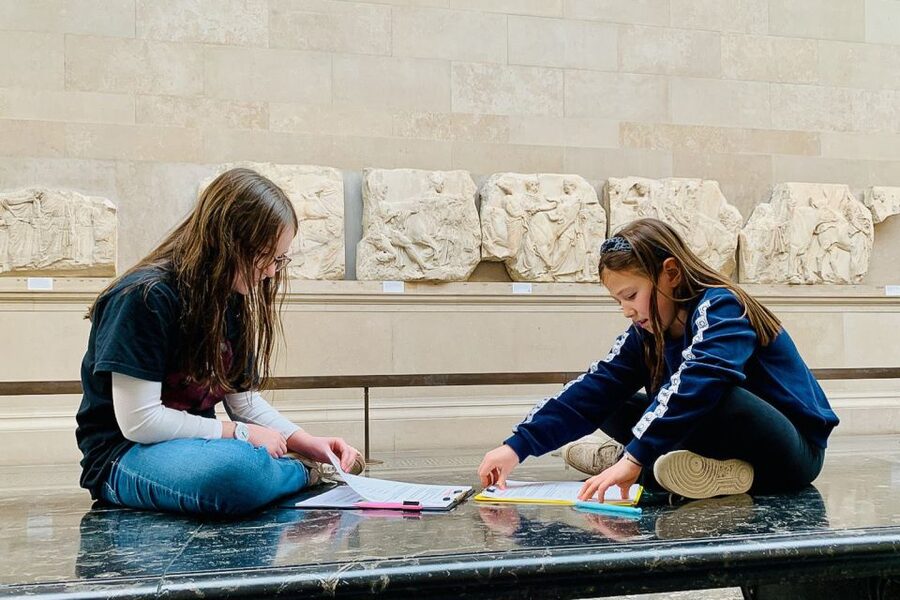
- A real game for children: Kids ages 6 to 12 use clipboards, answer questions, and collect clues for a small prize.
- A private family format: Your group can include up to six people, with no more than four children.
- Julia Huber leads the tour: She is an Austrian guide who has lived in London for almost 20 years and holds the prestigious Blue Badge qualification.
- English or German: Choose your preferred language when booking.
- Free museum admission: You pay for the guided experience, not for entry to the British Museum itself.
Turning a huge museum into a two-hour mission

The British Museum is free to enter, but that does not make it easy to visit with children. Its galleries cover thousands of years and many parts of the world. Without a plan, you can spend a lot of time walking between cases while younger children lose interest.
This tour solves that problem with a treasure-hunt format. Each child receives a clipboard with things to find and questions to answer. Julia then takes your family to eight selected highlights, explains what you are seeing, and helps the children spot the details needed to complete the clues.
That structure matters. Children are not asked to listen to a long lecture about ancient civilizations. They have a job to do. The questions give them a reason to look closely, and the prize gives the activity a clear finish.
The age range is important. This is designed for children from 6 to 12, not teenagers or toddlers. A six-year-old may need more help reading or connecting the clues, while an older child can take more responsibility for solving them. Adults can join in too, and one family with children aged 9 and 11 found the two hours varied enough to keep everyone involved.
More guided runs through the British Museum:
- London: British Museum Guided Tour
★ 4.3 · 1,182 reviews - London: Tour of the British Museum
★ 4.1 · 678 reviews - London: British Museum Audio Tour & Priority Entrance Ticket
★ 4.5 · 631 reviews
Meeting Julia outside the British Museum
You meet in front of the Starbucks opposite the main entrance to the British Museum. This is a practical meeting point, but pay attention to the wording: you do not meet inside the museum. Arrive with enough time to locate the café and gather your group before the start.
Julia Huber brings a useful mix of qualifications and family experience. She is Austrian, has lived in London for nearly two decades, and is qualified as both a City of London and City of Westminster Guide. She also holds a Blue Badge, one of the best-known guiding qualifications in Britain.
For this particular tour, her experience as a mother of three may matter just as much as the formal training. Keeping children interested in a museum is not only about knowing the objects. It is about changing pace, asking the right question, and noticing when a child needs a simpler explanation.
The tour is offered in English or German. If you are traveling with children who are more comfortable in German, that option can make the visit easier and more relaxed. Be sure to select the language you want when you book.
The clipboard clues and the eight selected objects

The exact order of the stops can vary, but the tour focuses on eight museum highlights. The objects named for this experience give you a good sense of the route: the Rosetta Stone, the Parthenon Marbles, and a 5,000-year-old mummy are among the headline discoveries.
The clipboard keeps the children active. They may need to find a particular figure, identify an animal, or answer a question based on what they can see. The clues are not just decoration. They guide children toward details they might otherwise miss.
Here are some of the questions built into the experience:
- Have you ever seen a merman?
- Why is the Rosetta Stone important?
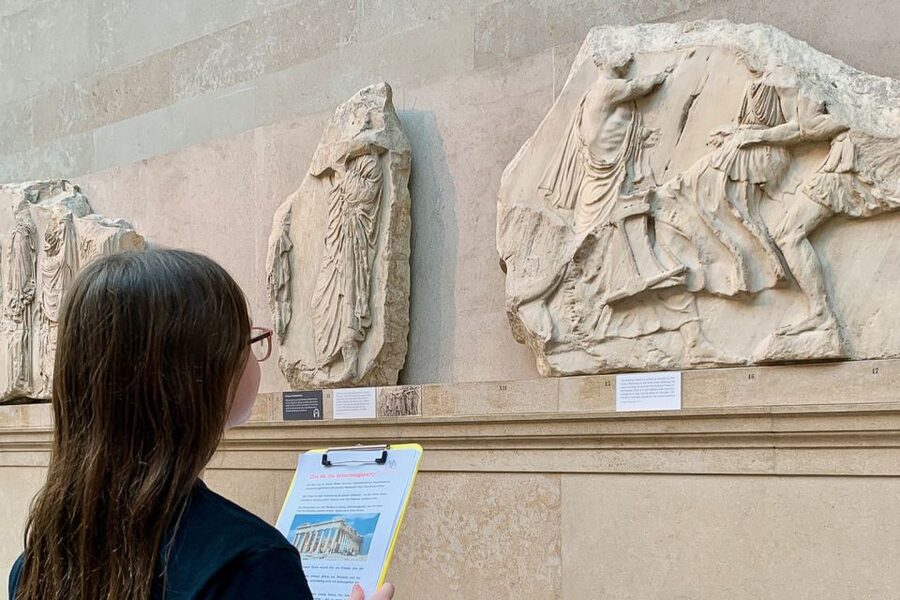
- Can you spot the birthday girl Athena among the Parthenon Marbles?
- Which animal does the golden belt buckle resemble?
These are good questions because they begin with curiosity rather than dates and names. A merman is memorable. A birthday figure gives a child a reason to look carefully at a crowded sculptural display. An animal-shaped buckle is easier to remember than a general explanation of metalwork.
The tour also gives adults a useful amount of context. One family specifically found that the children were entertained while the parents learned something too. That is the right balance for a family museum visit. You are not simply waiting for the children to finish their worksheet.
Why the Rosetta Stone works so well with children
The Rosetta Stone is one of the museum’s most famous objects, yet fame alone does not explain why it matters. Julia uses it as a puzzle about writing and translation. The stone carries the same decree in three scripts, including ancient Egyptian hieroglyphs, which helped scholars understand writing that had previously been difficult to read.
For a child, the key idea is simple: one message can act as a code breaker for another. That makes the object easier to grasp than a general lecture about ancient Egypt.
The Rosetta Stone is also a good stop for a short tour because it gives you an immediate landmark. Children know they are looking for one particular object, and the question on the clipboard helps them focus on its inscriptions and shape.
The practical limitation is that this is a famous display. Depending on museum conditions, you may need to look carefully among other visitors to see it well. A private guide can help your family make the most of the stop, but the tour cannot control how crowded a public gallery may be.
More museums and galleries in British Museum:
- Afternoon Tea at the British Museum
★ 4.2 · 511 reviews - London: British Museum Guided Tour
★ 4.5 · 267 reviews - London: British Museum Highlights Guided Small Group Tour
★ 4.9 · 113 reviews - London: British Museum Archaeology Course and Guided Tour
★ 4.7 · 113 reviews
Meeting Athena among the Parthenon Marbles
The Parthenon Marbles offer a different kind of challenge. Instead of one compact object, you are looking at large architectural sculptures and carved figures. The prompt about finding Athena gives children a specific task within a much larger display.
This is where a guide adds real value. The Parthenon sculptures can seem confusing when you first see them. Julia can point out the figure connected to the question, explain what the sculptures once belonged to, and help your child read the scene as more than a row of damaged stone figures.
The activity also encourages children to accept that museum objects do not always look complete. Missing pieces, weathered surfaces, and fragments become part of the story rather than a reason to lose interest.
The Parthenon Marbles can raise serious questions about ownership and removal from Greece. A two-hour child-focused tour will not turn that issue into a long debate, but the display gives families a chance to introduce the subject in age-appropriate terms. If you want a detailed discussion of the controversy, you will need more time after the tour or a separate visit.
Mummies, mermen, and a golden animal buckle
The 5,000-year-old mummy is likely to be one of the strongest visual moments for younger children. It gives the group a direct connection with ancient life and death, and it is easier to understand as a physical object than a broad explanation of Egyptian beliefs.
The merman adds a touch of strangeness and fun. That matters in a museum filled with serious-looking stone and metal. A surprising creature can reset a child’s attention and remind everyone that museums hold unusual objects as well as famous ones.
The golden belt buckle offers another useful lesson. The children are asked which animal it resembles, turning close observation into a game. They have to examine the design rather than glance at it and move on.
These stops also show why the route is not simply a list of the museum’s most famous objects. The most famous pieces help anchor the visit, while odd or visually distinctive pieces keep the children curious. A good family tour needs both.
A private group that keeps the pace flexible
The tour is private for your family, with up to six people and a maximum of four children. That arrangement suits families who want to ask questions without worrying about slowing down a larger group.
You can also expect the adults to be part of the activity. The format is built around children, but parents may help read the questions, compare answers, and follow Julia’s explanations. It is not a drop-off program, and children remain with their family throughout.
The two-hour length is sensible for the target age. It gives you enough time to see major objects without asking children to spend an entire morning in galleries. At the same time, it is not long enough to cover the British Museum in any broad sense. Think of this as a focused introduction, not a complete museum visit.
If your children are under 6, this may be too structured or too advanced. If they are well over 12, the questions may feel young unless they enjoy puzzles and family activities. The best match is a family with school-age children who can read, look for details, and stay with a guided task.
Is $559 a fair price for a family?
The price is $559 per group of up to six people. The museum entry itself is free, so the charge pays for Julia’s private guiding, the prepared activity questionnaires, and the small prize for each participating child.
For six people, the group price works out to about $93 per person. For a family of four, it is about $140 per person. A smaller group pays more per person, so this experience makes the most financial sense when you fill most of the six-person limit.
The value depends on what you need. If your children already enjoy museums and you are happy to create your own game, you can enter for free and explore independently. If you have limited time in London and want someone to turn a huge museum into a manageable family activity, the private format may justify the cost.
The guide is also taking over the hardest part of the visit: choosing objects, explaining them at a child-friendly level, and keeping the group moving. Parents who have spent a city break trying to persuade children to look at one more case may see that as the main benefit.
The small prize is a nice finish, but it is not the reason to book. You are paying for the organization and the live guidance. The prize simply gives children a reward for completing the clues.
Practical details before you go
Entry to the British Museum is free, but you still need to pass through its security process. There is a bag check at the entrance, and sharp items are not allowed.
Do not bring luggage or large bags. This is especially important if you are arriving from a train station or leaving London the same day. Plan to store large belongings elsewhere before meeting Julia.
The museum is wheelchair accessible, and the tour is listed as accessible as well. If your family has specific mobility needs, confirm the details when booking so the meeting and route work comfortably for everyone.
The experience lasts two hours, and start times depend on availability. Free cancellation is offered up to 24 hours in advance, with a full refund. You can also reserve now and pay later, which helps if your London schedule is still shifting.
What the strong feedback tells me
The tour has a five-star rating from five reviews, with the clearest praise focused on the children’s response. Families describe the experience as enjoyable, varied, and effective at holding attention.
One German-language family particularly liked Julia Huber’s puzzle route, noting that the girls were excited while the parents learned something too. Another family with two children, ages 9 and 11, found the two hours entertaining and varied. Short comments from German and American customers also describe the experience as perfect and highly recommendable.
The pattern is useful. The strongest feature is not simply Julia’s museum knowledge. It is her ability to make the children feel that they are solving something. That is a better sign for families than a tour description filled only with famous names.
The evidence is still limited to five reviews, so I would not treat the rating as a guarantee for every child. A child who dislikes puzzles, museums, or guided activities may not respond as well. The age range and private format give you the best chance of a good fit.
Who should book this British Museum tour?
I would choose this tour for a family with one to four children ages 6 to 12, especially on a first London visit when you want to see the British Museum without giving up half a day.
It is a particularly good choice if:
- Your children need a clear task to stay interested.
- You want a private guide rather than a large group.
- You prefer English or German guidance.
- You want famous museum objects explained in simple, memorable terms.
- You have only two hours for the British Museum.
- You are willing to pay for convenience and a prepared family activity.
I would skip it if your children are very young, your group is too small to make the price comfortable, or you want a long, adult-level discussion of archaeology and museum ethics. In those cases, free self-guided entry may be the better fit.
Should you book it?
Book this tour if your main goal is to make the British Museum work for children. Julia Huber’s private puzzle route gives the visit shape, the eight highlights keep the scope under control, and the clipboard questions turn passive looking into active discovery.
The price is the deciding issue. At $559, it is a serious expense for a two-hour activity, but the cost covers the whole private group rather than each child separately. For a family of five or six, the value is much better than for a couple with one child.
My advice is simple: book it for school-age children who enjoy finding clues, and arrive without large bags or sharp items. If you want to see the Rosetta Stone, Parthenon Marbles, mummy, and stranger museum objects without spending the visit negotiating with bored children, this is a well-focused choice.
FAQ
How long does the British Museum tour last?
The tour lasts two hours.
How many people can join the private tour?
The private group can include up to six people, with a maximum of four children.
What ages is the tour suitable for?
The tour is suitable for children ages 6 to 12.
Which languages are available?
You can take the tour in English or German. Select your preferred language when booking.
Is entry to the British Museum included?
Entry to the British Museum is free and is included as part of the visit. The tour price covers the guided experience and activity materials.
What objects will children see?
The tour visits eight British Museum highlights. Named examples include the Rosetta Stone, the Parthenon Marbles, a 5,000-year-old mummy, and a golden belt buckle.
Where do you meet the guide?
Meet Julia in front of the Starbucks opposite the British Museum’s main entrance.
Are large bags allowed?
No. Luggage and large bags are not allowed. The museum also has a bag check, and sharp items should not be brought to the entrance.
Just added around British Museum
- British Museum & Camden Town – Private Tour in Italian★ 4.8 · 26 reviews
- London: British Museum Highlights Guided Small Group Tour★ 4.9 · 113 reviews
- Private Tour of the British Museum★ 5.0 · 3 reviews
- British Museum & National Gallery Highlight Tour 8 guests 5h★ 3.5 · 6 reviews
- The British Museum London: Private Guided Tour – 3 hour★ 5.0 · 4 reviews
- Unveil the Rosetta Stone, Parthenon at British Museum★ 5.0 · 6 reviews
- London: National Gallery and British Museum Private Tour★ 5.0 · 4 reviews
- London: British Museum Tour with Archaeologist Guide★ 4.9 · 68 reviews
British Museum Tours, compared.



British Museum Audio Tour & Priority Entrance Ticket
Read our review →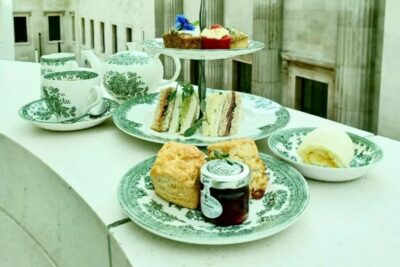
British Museum Archaeology Course and Guided Tour
Read our review →
British Museum Highlights Guided Small Group Tour
Read our review →
British Museum Guided Tour with Priority Entrance
Read our review →Browse the lists this tour appears in